A gravel calculator turns the size of your area and the depth you want into an order: cubic yards, US tons, tonnes or bags, with compaction and waste already added. A two-car driveway, 36 by 18 ft and 4 in deep once packed, needs 11 cubic yards, or 15.40 tons, of general gravel. Enter your own size in the form and the order updates as you type.
Table of Contents
How to use the gravel calculator
Work down the form from top to bottom. There is no submit button.
- Pick US or metric. You can still type any box in its own unit, and every result shows both systems.
- Describe the area. Use a rectangle, a circle, a triangle or a known area, and add up to 10 of them. A shed pad and the path to it are two areas, and so are a drive and its flares at the street. Measure a circle straight across, edge to edge, because the form asks for the diameter.
- Take out a pipe if there is one. Enter the pipe's outside size and the tool removes its volume from the stone, so a French drain trench filled around its pipe is not over-ordered. A trench with a pipe takes one layer.
- Add the layers. Each of up to 3 layers gets its own stone and depth, such as a crushed base under a decorative top.
- Say what the depth means. "Finished, after compacting" is the default, and it is right for any drive, pad or base you will pack down. Choose "loose, as spread" only for stone you will rake out and leave. Pea gravel and river rock skip this choice.
- Type depth in inches, cm or mm, not feet. 4 in is 4, not 0.33. The form warns you if a depth looks like feet.
- Leave the 10% waste on unless you are pricing an exact volume.
- Choose your bag. The common sizes are listed, and a custom bag takes cubic feet, liters, pounds or kilograms.
The results give the volume to order, its weight and the bag count. They also show how deep to spread the loose stone, so you can check the depth with a tape before you compact it.
Gravel depth by project
Most bases under a patio, shed or slab finish at 4 in, and a driveway needs at least 3 in of top stone over its base. Type the finished depth for your job from the table, and open the project's page for its layers, stone and soil checks.
| Project | Finished gravel depth | Metric |
|---|---|---|
| Driveway | 3 in of top stone or more, over a packed base | 76 mm or more |
| Patio paver base | 4 in of crushed stone with fines | 100 mm |
| Shed pad | 4 in of crushed stone | 100 mm |
| Concrete slab base | 4 in | 102 mm |
| French drain | at least 2 in under the pipe, 6 in over it | 51 mm under, 152 mm over |
| Garden bed | 2 to 3 in | 50 to 75 mm |
| Play area, falls up to 5 ft | 12 in of pea gravel put in, 9 in after it settles | 305 mm, 229 mm |
| Pea gravel path | 1.5 in of pea gravel over 4 in of base | 40 mm over 100 mm |
How much gravel do I need, step by step
The calculator finds the finished volume, adds the extra for compaction, adds 10% for waste, then turns the total into weight. Each step below works by hand.

- Finished volume: length (ft) x width (ft) x depth (in) / 12 gives cubic feet. Divide by 27 for cubic yards, because a cubic yard is a 3 ft cube. In metric, length (m) x width (m) x depth (mm) / 1,000 gives cubic meters.
- Loose volume: multiply by the stone's factor from the defaults table further down. Crushed stone with fines takes x1.25, because a rolled yard holds more stone than a loose one.
- Order volume: multiply by 1.10. WSDOT's construction manual raises stockpiled stone quantities by a tenth to cover waste.
- Weight: multiply the order volume by the stone's loose weight per cubic yard or cubic meter.
The table works the two-car drive in both systems. For a gravel driveway, the calculator needs one rectangle and one layer of general gravel.
| Step | 36 x 18 ft drive, 4 in finished | 11 x 5.5 m drive, 100 mm finished |
|---|---|---|
| Area | 648 sq ft | 60.50 m2 |
| Finished volume | 216 cu ft = 8.00 cu yd | 6.05 m3 |
| Loose volume, x1.25 | 10.00 cu yd, spread 5 in deep | 7.56 m3, spread 125 mm deep |
| Order, x1.10 | 11.00 cu yd (297 cu ft) | 8.32 m3 |
| Weight at 1.40 tons per cu yd or 1.66 t/m3 | 15.40 tons (30,800 lb) | 13.81 t |
| Bags | 594 of 0.5 cu ft | 553 of 25 kg |
Left loose and never compacted, general gravel skips the x1.25 step. The drive then needs 8.80 cu yd, or 12.32 tons, which suits only a surface you rake out and leave.
Five inches of loose stone is more than a plate compactor packs in one pass, so the calculator flags the layer. It goes down in one lift under a roller, or in two plate lifts if the stone all passes 1 in.
Circles, triangles and flared ends
Split any odd outline into rectangles, circles and triangles, then add the pieces.
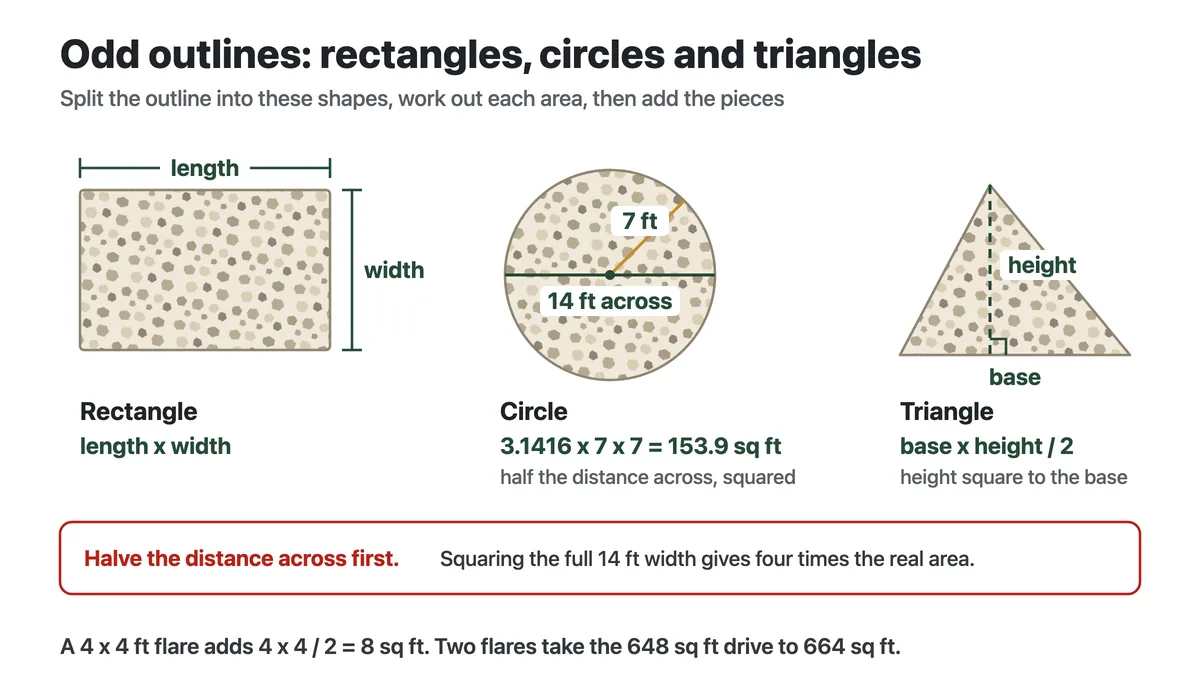
- Circle: 3.1416 x half the diameter x half the diameter. Halve the distance across first. Squaring the full width gives four times the real area.
- Triangle: base x height / 2, with the height measured square to the base.
A round pea gravel seating area 14 ft across covers 3.1416 x 7 x 7 = 153.9 sq ft. At 3 in deep that is 1.43 cu yd. Pea gravel is not compacted, so it gets no factor, and with 10% you order 1.57 cu yd, about 2.04 tons or 85 bags of 0.5 cu ft.
Most drives also widen where they meet the street. Add two 4 x 4 ft triangular flares to the 36 x 18 ft drive and each adds 4 x 4 / 2 = 8 sq ft. The total is 664 sq ft, and the order rises to 11.27 cu yd, or 15.78 tons. An L-shaped patio base works the same way, as two rectangles added together.
Gravel for common project sizes
A 10 x 10 ft area at 4 in finished takes 1.70 cu yd, or 2.38 tons, of general gravel. Each size in the table opens the calculator filled in, with general gravel at 4 in finished and the extra for packing down and spillage added.
| Size | Sq ft | Cu yd to order | US tons | m3 to order | Tonnes | 0.5 cu ft bags |
|---|---|---|---|---|---|---|
| 10 x 10 ft | 100 | 1.70 | 2.38 | 1.30 | 2.16 | 92 |
| 12 x 12 ft | 144 | 2.44 | 3.42 | 1.87 | 3.10 | 132 |
| 20 x 10 ft | 200 | 3.40 | 4.75 | 2.60 | 4.31 | 184 |
| Two-car drive, 36 x 18 ft | 648 | 11.00 | 15.40 | 8.41 | 13.97 | 594 |
Pick another stone once the form opens and the tons change with it. In crusher run, the same two-car drive weighs 15.73 tons.
How many tons of gravel do I need
Tons are the cubic yards you order times the stone's loose weight per cubic yard. For general gravel the calculator assumes 1.40 tons per cubic yard (1,660 kg/m3), so the drive's 11.00 cu yd comes to 15.40 tons.
Ask whether your supplier sells by the cubic yard, the US ton or the tonne, then read that line of the result: the drive's 15.40 tons reads as 13.97 t.
The calculator takes gravel weight per yard loose and dry, the way suppliers load it. The volume step has already added the extra for compaction, so a packed weight would count it twice.
What the calculator assumes for each stone
The stone you pick changes both the volume and the weight, so choose the one on your quote. Each stone carries a loose weight and a compaction factor. The weights come from state DOT and lab figures where they exist. Pea gravel, river rock and decomposed granite have none, so their weights are estimates, and the result says so. The UK sub-base row borrows the figure for a similar US crushed base.

The last two columns run the drive's 648 sq ft at 4 in finished, with 10% waste, through each default.
| Stone | Tons per cu yd | kg per m3 | Factor | Spread loose to | 648 sq ft at 4 in |
|---|---|---|---|---|---|
| General gravel | 1.40 | 1,660 | x1.25 | 5 in | 11.00 cu yd, 15.40 tons |
| Crusher run | 1.43 | 1,690 | x1.25 | 5 in | 11.00 cu yd, 15.73 tons |
| #57 stone | 1.30 | 1,540 | x1.14 | 4.56 in | 10.03 cu yd, 13.04 tons |
| Stone dust, screenings | 1.20 | 1,420 | x1.25 | 5 in | 11.00 cu yd, 13.20 tons |
| Ballast, large clean stone | 1.55 | 1,840 | x1.25 | 5 in | 11.00 cu yd, 17.05 tons |
| Pea gravel or river rock, estimate | 1.30 | 1,540 | none | 4 in | 8.80 cu yd, 11.44 tons |
| Decomposed granite, estimate | 1.25 | 1,480 | x1.25 | 5 in | 11.00 cu yd, 13.75 tons |
| MOT Type 1 (UK) | 1.48 | 1,750 | x1.25 | 5 in | 11.00 cu yd, 16.28 tons |
Ballast and stone dust need the same 11 yards, yet one load is nearly 4 tons heavier. If your yard sells stone by a number such as #67 or a size such as 20 mm, pick the row it belongs to. Clean stone goes with #57, and stone with fines goes with crusher run. These are planning figures. If your quarry quotes its own weight per yard, multiply your order volume by that figure instead.
How many bags of gravel do I need
Divide the order by the bag, then round up. A bag sold by volume is simple: a 0.5 cu ft bag always holds the same amount, 54 to the cubic yard. A bag sold by weight holds more or less stone depending on how heavy the stone is. The weight-bag counts below use the general gravel default.

| Bag | Per cu yd | Per US ton | Per m3 | 36 x 18 ft drive |
|---|---|---|---|---|
| 0.5 cu ft (14 L) | 54 | 39 | 71 | 594 |
| 50 lb | 56 | 40 | 74 | 616 |
| 20 kg | 64 | 46 | 83 | 699 |
| 25 kg | 51 | 37 | 67 | 559 |
| 850 kg bulk bag | 1.5 | 1.1 | 2.0 | 17 |
Count from the order volume, never the finished one. Using the drive's 8.00 finished yards gives 432 small bags instead of 594. Weight bags also shift with the stone: the drive takes 616 bags of 50 lb in general gravel, but 630 in heavier crusher run.
QUIKRETE's data sheet sells All-Purpose Gravel by the 50 lb bag and prints no volume, so count it by weight. The 20 kg, 25 kg and 850 kg sizes are common nominal sizes, so read your label and enter its figure if it differs. A few bulk bags are sold by the area they cover instead of a weight. Count those by area, using the area each bag and bulk bag covers, and do not turn that area into kilograms.
FAQ
How many bags of gravel fill a yard?
A cubic yard fills 54 bags of 0.5 cu ft, because a yard is 27 cu ft. Weight bags vary with the stone: at the general gravel default, a yard takes 56 bags of 50 lb or 51 of 25 kg.
How much gravel for 10 square meters?
At 100 mm finished, 10 m2 of general gravel needs 1.38 m3, or 2.28 t (2.52 US tons), with compaction and 10% waste included. Pea gravel or river rock left loose at 50 mm needs only 0.55 m3, about 0.85 t.
How much extra gravel should I order?
For crushed stone you will pack down, the calculator orders 1.375 times the finished volume: x1.25 for compaction, then 10% for waste. That is how the drive's 8.00 finished yards become 11.00 yards to order. Clean #57 takes x1.14 instead, and stone you rake out and leave gets only the 10%.
How much river rock do I need?
Choose the pea gravel or river rock row, an estimate of 1.30 tons per cubic yard with no compaction step. Grit and pea gravel usually sit 2 to 3 in deep in garden beds and borders, while 2 in river rock needs about 4 in. Enter that depth and keep the 10% waste on.
Conclusion
Read the order line in the unit your supplier sells by, and if the quarry quotes its own weight per yard, multiply the order volume by that figure instead. Spread the loose depth the result shows, and check it with a tape before you compact. If your quote names a stone the form does not list, the main types of gravel show whether it is crushed with fines, clean or rounded.