How Much Does a Ton of Gravel Cover
How much does a ton of gravel cover? About 116 sq ft at 2 in deep and 77 sq ft at 3 in, for loose general gravel at the usual planning weight of 1.40 tons per cubic yard. A tonne covers about 12 m2 at 50 mm. Heavier stone, a deeper layer or a rolled base all shrink that area, and the per-ton charts show by how much.
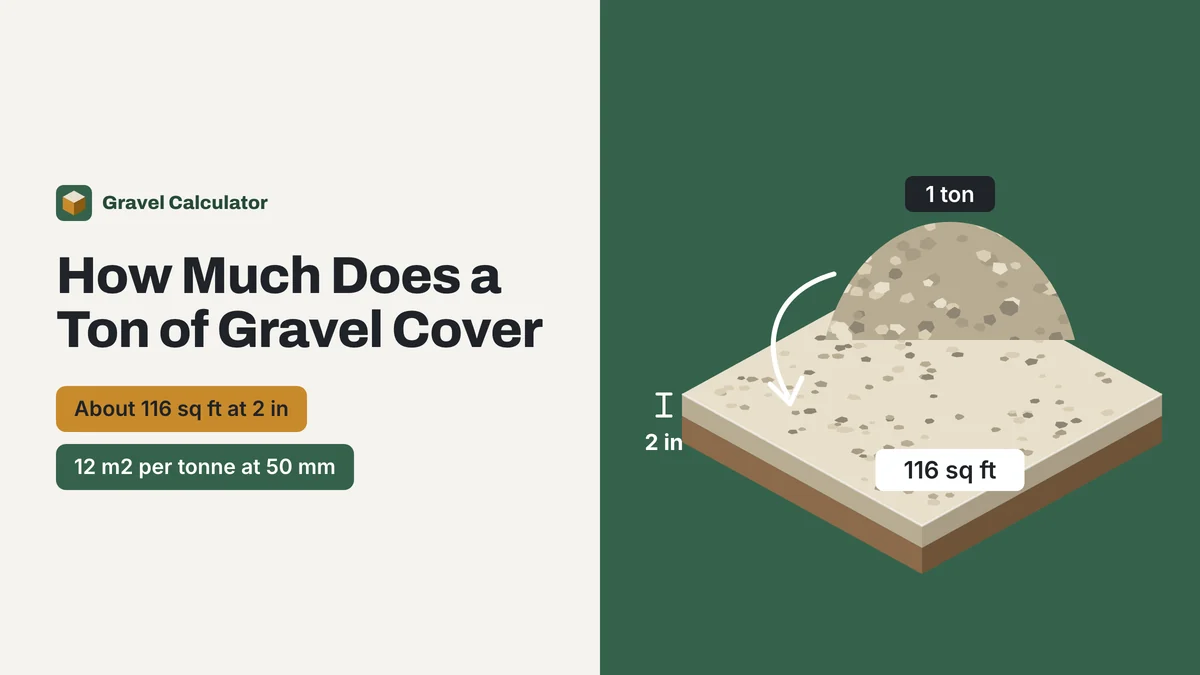
Table of Contents
Square feet per ton of gravel by depth
For general gravel, divide 231 by your depth in inches. The answer is the square feet one ton covers when spread loose, so 2 in gives 116 sq ft and 4 in gives 58 sq ft.
The 231 comes from the stone's weight. At 1.40 tons per cubic yard, one ton fills 19.3 cu ft, and 19.3 cu ft spread 1 in thick covers 231 sq ft. FEMA works from the same figure, a standard 104 lb per cu ft for uncompacted gravel. DOT loose weights for crushed gravel and base run 1.35 to 1.48 tons per cubic yard. The weight of a yard of gravel shifts with the type, so each stone gets its own divisor. The gravel calculator runs this division for your own length, width and depth.
Gravel coverage chart per US ton
Every row is square feet per US ton of loose stone on firm ground; heavier stone covers less.
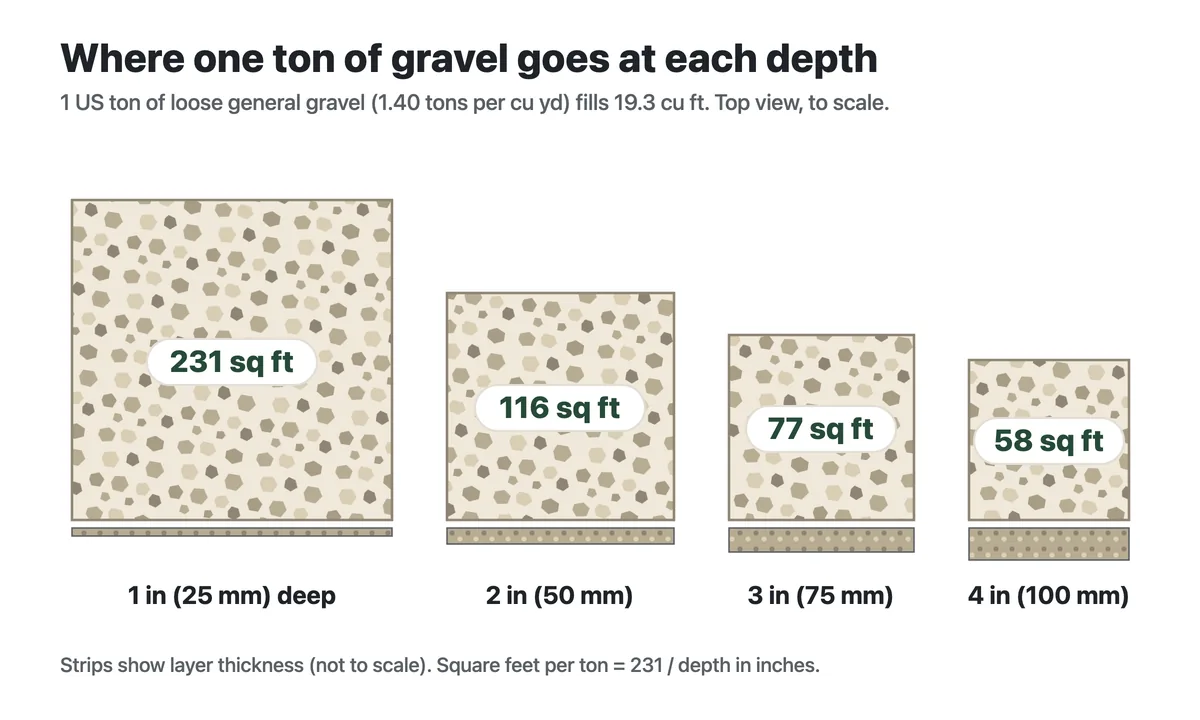
| Stone (loose tons per cu yd) | Sq ft per ton, 1 in deep | Sq ft, 2 in | Sq ft, 3 in | Sq ft, 4 in | Sq ft, 6 in |
|---|---|---|---|---|---|
| General gravel (1.40) | 231 | 116 | 77 | 58 | 39 |
| Crusher run (1.43) | 227 | 114 | 76 | 57 | 38 |
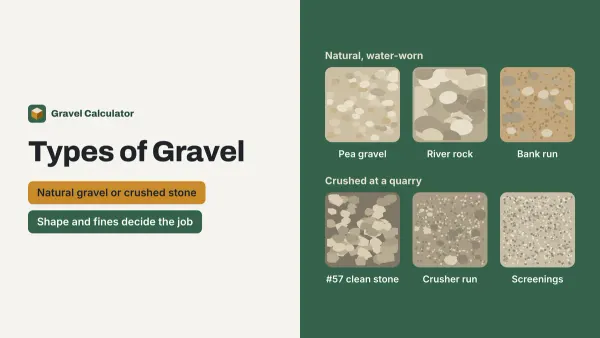
| #57 stone, pea gravel, river rock (1.30) | 249 | 125 | 83 | 62 | 42 |
| Decomposed granite (1.25) | 259 | 130 | 86 | 65 | 43 |
The general gravel row rests on the FEMA figure and the DOT loose range. The crusher run row uses WSDOT's truck weight, and the #57 stone row uses Caltrans and FHWA lab figures. The pea gravel, river rock and decomposed granite rows are estimates, based on clean stone and screenings of similar size.
Gravel coverage per m2 for each tonne
A tonne is 1,000 kg and a US ton is 907 kg, so a tonne of the same stone covers 10.2% more ground. This chart gives square metres per loose tonne.
| Stone | m2 per tonne, 25 mm | m2, 50 mm | m2, 75 mm | m2, 100 mm |
|---|---|---|---|---|
| General gravel | 24.1 | 12.0 | 8.0 | 6.0 |
| Crusher run | 23.7 | 11.8 | 7.9 | 5.9 |
| #57, pea gravel, river rock | 26.0 | 13.0 | 8.7 | 6.5 |
| Decomposed granite | 27.0 | 13.5 | 9.0 | 6.8 |
MOT Type 1 lands close to the crusher run row. Plan 20 mm clean stone, close to US #67, with the #57 row, since the site uses one weight for all clean stone.
How much can a yard of gravel cover
One cubic yard covers 162 sq ft at 2 in, whatever the stone, because a yard measures volume, not weight. Divide 324 by the depth in inches. In metric, divide 1,000 by the depth in mm to get the square metres a cubic metre covers.

| Depth (US) | 1 cu yd covers | Depth (metric) | 1 m3 covers |
|---|---|---|---|
| 1 in | 324 sq ft | 25 mm | 40 m2 |
| 2 in | 162 sq ft | 50 mm | 20 m2 |
| 3 in | 108 sq ft | 75 mm | 13.3 m2 |
| 4 in | 81 sq ft | 100 mm | 10 m2 |
| 6 in | 54 sq ft | 150 mm | 6.7 m2 |
A yard goes further than a ton of general gravel because the yard weighs 1.40 tons. Divide 324 by a stone's tons per yard and you get its divisor for a ton, so 324 / 1.40 = 231.
How far a ton goes loose vs rolled
A load covers the chart figure times the tons on the ticket. Spread loose at 3 in, 2.5 tons of crusher run covers 76 x 2.5 = about 190 sq ft (17.6 m2). That is a strip roughly 10 ft by 19 ft.
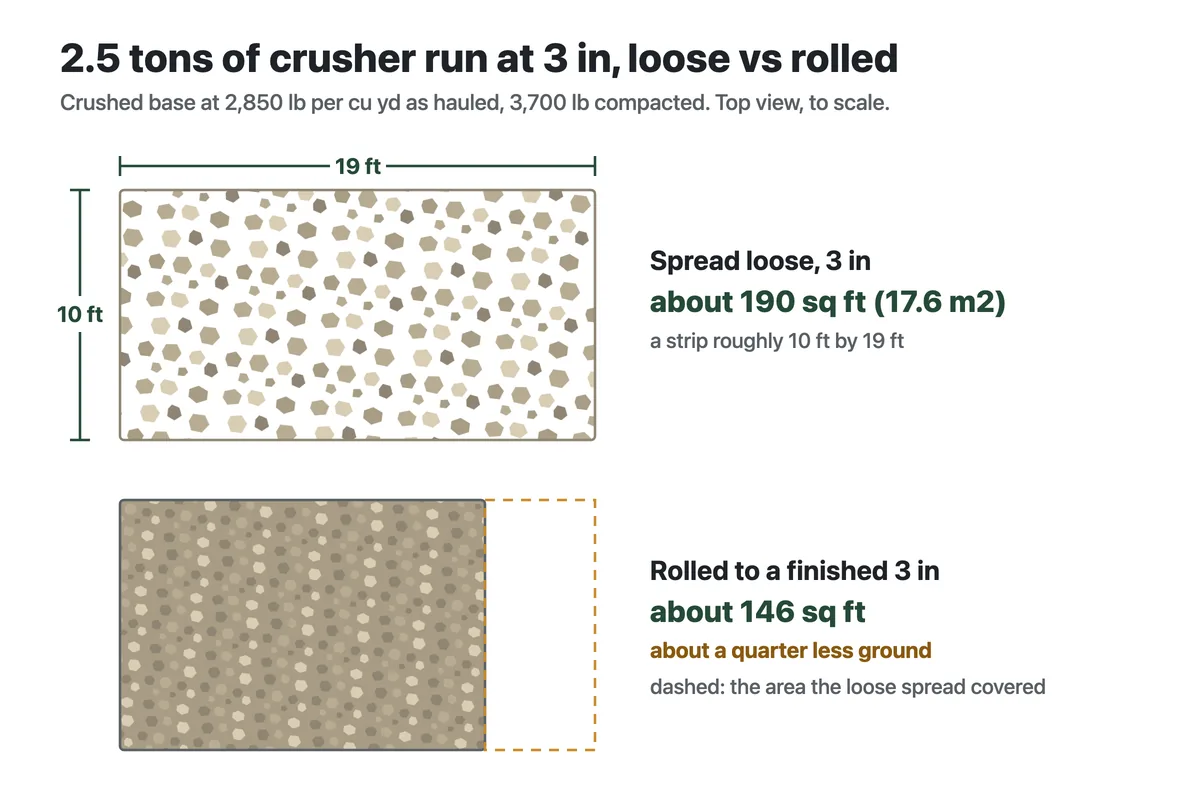
A base you roll flat covers less. WSDOT's materials table weighs crushed surfacing at 2,850 lb per cubic yard as hauled and 3,700 lb compacted on the road. At the compacted weight, one ton covers about 175 sq ft at 1 in, 88 at 2 in, 58 at 3 in and 44 at 4 in. The same 2.5 tons, rolled to a finished 3 in, covers about 146 sq ft. These rolled figures use WSDOT's weight ratio of 1.30, so they run about 3% tighter than the calculator, which plans a base at x1.25 and gives about 151 sq ft.
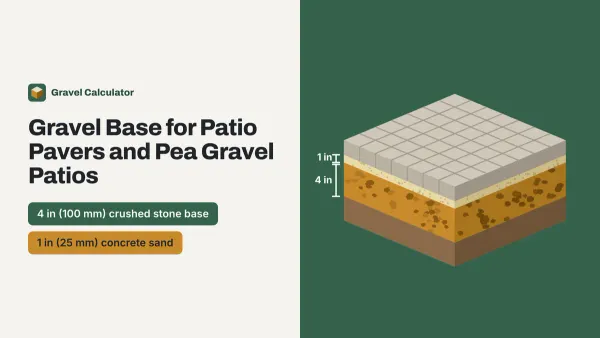
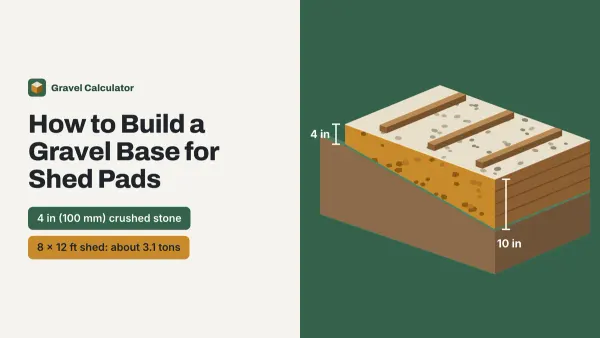
So plan crusher run or any base you will compact from those compacted figures, and spread it thicker before rolling by the amount given under how deep gravel should be. Decorative stone that is never rolled stays on the loose chart.
How much gravel per square foot
Each square foot takes 8.6 lb of general gravel per inch of depth. That is 17.3 lb at 2 in and 25.9 lb at 3 in, or 83 kg per m2 at 50 mm. Turn it around to check a quote: 2,000 lb / 17.3 lb = 116 sq ft per ton.
How much pea gravel per square foot
At about 1.30 tons per yard, pea gravel takes 16 lb per sq ft at 2 in and 24 lb at 3 in. So 100 sq ft at 2 in needs 16.7 cu ft, about 1,600 lb (730 kg). Real pea gravel can run 1.2 to 1.4 tons, which moves a ton's coverage at 2 in anywhere from 116 to 135 sq ft.
Gravel coverage per bag and bulk bag
A small 0.5 cu ft sack covers 3 sq ft at 2 in. A Heidelberg bulk pack of 20 mm stone spreads over 15 m2 at 50 mm.
The pound and kilogram rows assume general gravel at 1.40 tons per yard, so heavier stone covers a little less.
| Pack | Area in | 1 in (25 mm) | 2 in (50 mm) | 3 in (75 mm) | 4 in (100 mm) |
|---|---|---|---|---|---|
| 0.5 cu ft | sq ft | 6.0 | 3.0 | 2.0 | 1.5 |
| 50 lb | sq ft | 5.8 | 2.9 | 1.9 | 1.4 |
| 20 kg | m2 | 0.48 | 0.24 | 0.16 | 0.12 |
| Heidelberg Maxipack, 20 mm | m2 | 0.8 | 0.4 | not printed | 0.2 |
| Heidelberg bulk, 20 mm | m2 | 30 | 15 | not printed | 7 |
The two Heidelberg rows are printed on its 20 mm gravel data sheet. Its shop page is more cautious, at 3 Maxipacks per m2 for about 50 mm, so treat the sheet as a best case. Use the 50 lb row for packs that print no coverage, and the 0.5 cu ft row for decorative stone sold by volume for beds and borders.
Why some suppliers say 100 square feet
Ask three suppliers "how much does a ton of gravel cover?" and you may hear 100, 116 or 150 sq ft. Each answer hides a choice about the stone, so ask about these four things.

- Weight. The common rule of 100 sq ft per ton at 2 in assumes stone at 120 lb per cu ft, or 1.62 tons per cubic yard. That is heavier than the DOT and FEMA loose weights, so the rule gives about 14% less area than 116 sq ft.
- Depth. A ton reaches 150 sq ft only at about 1.5 in. A figure with no depth attached tells you nothing.
- Loose or rolled. A rolled base covers about a quarter less than the same tons spread loose.
- Water. WSDOT's weights are dry. With 5% water, general gravel weighs 2,940 lb per cubic yard, and a ton covers about 110 sq ft at 2 in instead of 116.
FAQ
How much will 4 tons of gravel cover?
Four tons of loose general gravel covers about 463 sq ft at 2 in, 309 sq ft at 3 in and 231 sq ft at 4 in. Crusher run covers about 2% less.
How many square yards does a ton cover?
A ton of loose general gravel covers about 12.9 sq yd at 2 in, 8.6 sq yd at 3 in and 6.4 sq yd at 4 in. Divide any square foot figure by 9 to get square yards.
How much does 3 cubic yards of gravel cover?
Three cubic yards covers 486 sq ft at 2 in, 324 sq ft at 3 in and 243 sq ft at 4 in. Those areas hold for every stone, since a yard is a volume.
Conclusion
Divide your area by the chart figure for your stone and depth, and the answer is the tons to order. Use the loose chart for stone you rake out and leave, and the rolled figures for a base you compact, which cover about a quarter less. For a drive, the stone that holds up on a driveway tells you which row of the chart to read.