How Much Does a Yard of Gravel Weigh
How much does a yard of gravel weigh? Plan on roughly 1.4 tons, or 2,800 lb (1.27 tonnes), per loose, dry cubic yard. Most stone lands between 1.2 tons for fine screenings and 1.55 tons for big ballast. Once the same stone is rolled flat, a yard packs in more rock and weighs closer to 1.85 tons. Use the loose figure for anything a truck delivers.
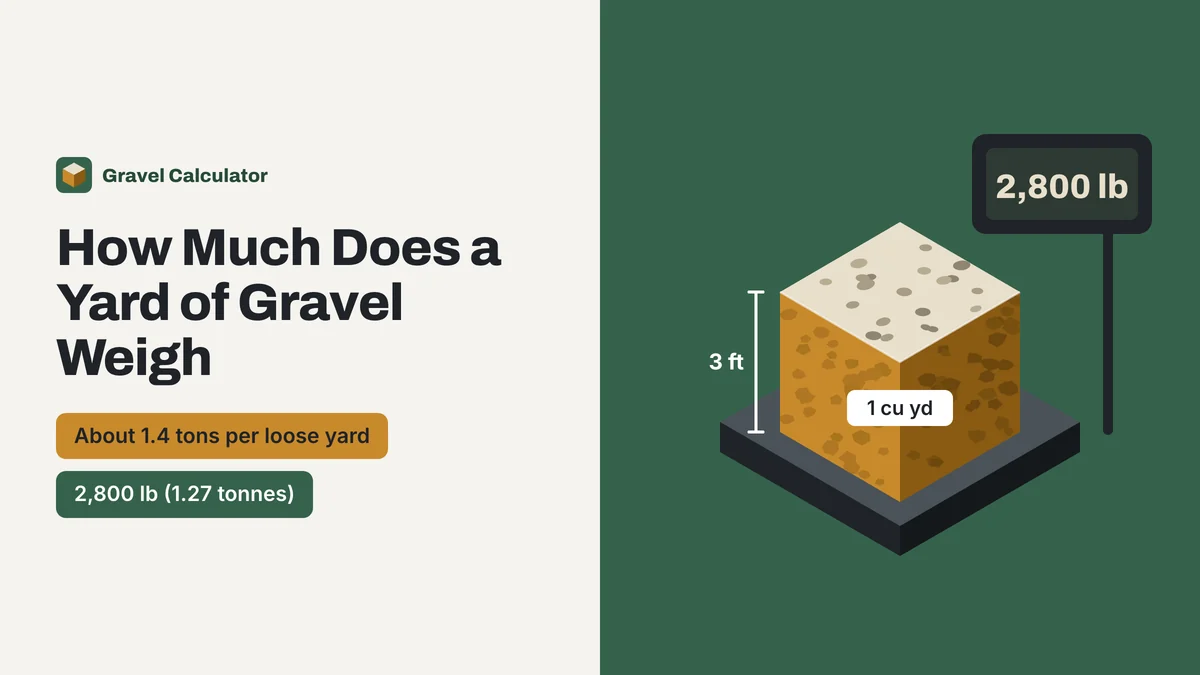
Table of Contents
Gravel weight per yard by type
Use the row for the stone you are buying, and trust the weight on your quarry's scale ticket over any table. A "yard" from a supplier always means a cubic yard: 27 cu ft of loose stone, as dumped from the truck. If you still need the yards for your area and depth, get them from the gravel calculator first.

| Stone | Pounds per yard | Tons per yard | kg per m3 |
|---|---|---|---|
| General gravel | 2,800 | 1.40 | 1,660 |
| Crusher run (DGA, ABC, road base) | 2,850 | 1.43 | 1,690 |
| #57 stone | 2,600 | 1.30 | 1,540 |
| Screenings, stone dust | 2,400 | 1.20 | 1,420 |
| Ballast | 3,100 | 1.55 | 1,840 |
| Sand, for comparison | 2,500 | 1.25 | 1,480 |
| Pea gravel, river rock | 2,600 estimate (2,400 to 2,800) | 1.30 | 1,540 |
| Decomposed granite | 2,500 (estimate) | 1.25 | 1,480 |
| MOT Type 1 sub-base (UK) | 2,950 (estimate) | 1.48 | 1,750 |
Tons here are US short tons of 2,000 lb. Crusher run is heavier than #57 because its dust fills the gaps clean stone leaves empty, the split that sorts the types of gravel.
Gravel weight per cubic foot
General gravel weighs about 104 lb per cubic foot, since a yard holds 27 of them and 2,800 divided by 27 is 103.7. The per-foot figure is handy for a wheelbarrow or a small box you can measure.
| Stone | Pounds per cubic foot |
|---|---|
| Screenings | 88.9 |
| #57 stone, pea gravel | 96.3 |
| General gravel | 103.7 |
| Crusher run | 105.6 |
| Ballast | 114.8 |
For kilograms per cubic meter, multiply pounds per cubic foot by 16.02.
How many tons of gravel in a yard
A yard of general gravel is about 1.4 tons, and a ton fills about 0.71 cubic yards. To convert, multiply the yards by the pounds per yard and divide by 2,000. To go back, multiply the tons by 2,000 and divide by the pounds per yard.

| Stone | Tons in 1 yd | Tons in 3 yd | Tons in 6 yd | Tons in 10 yd | Yards per ton |
|---|---|---|---|---|---|
| General gravel | 1.40 | 4.20 | 8.40 | 14.00 | 0.71 |
| Crusher run | 1.43 | 4.28 | 8.55 | 14.25 | 0.70 |
| #57 stone | 1.30 | 3.90 | 7.80 | 13.00 | 0.77 |
| Screenings | 1.20 | 3.60 | 7.20 | 12.00 | 0.83 |
| Ballast | 1.55 | 4.65 | 9.30 | 15.50 | 0.65 |
Take 6 yards of #57 stone. At 2,600 lb a yard that is 15,600 lb, or 7.8 tons. Estimate the same 6 yards with the general-gravel figure and you order 8.4 tons, which is 0.6 ton, or nearly half a yard, more #57 than the job needs. Working backward, 7.8 tons x 2,000 / 2,600 gives the 6 yards again.
Gravel density in kg/m3 and tonnes
In metric, loose gravel runs about 1,660 kg/m3, or 1.66 tonnes per cubic meter. DOT loose figures for crushed stone and base span 1,510 kg/m3 (Caltrans crushed limestone) to 1,750 (WSDOT base course), and rolled crushed base reaches about 2,200 kg/m3.
Before you compare quotes, check which ton is on them. NIST's unit conversion tables define all three.
| Unit | Pounds | Kilograms | Where you meet it |
|---|---|---|---|
| US short ton | 2,000 | 907 | US quarries and yards |
| Metric tonne | 2,204.6 | 1,000 | UK and other metric quotes |
| Long ton | 2,240 | 1,016 | Older British quotes |
A tonne is 10.2% heavier than a US ton. A 4.5 m3 load of general gravel weighs 4.5 x 1,660, or 7,470 kg. That is 7.47 tonnes, but 8.23 US tons on an American ticket. The same volume of UK Type 1 sub-base comes to 7.88 tonnes. Read the other way, one tonne of general gravel fills 0.60 m3.
Loose truck weight vs compacted weight
Convert any delivery with the loose figure. The compacted figure only tells you what a finished, rolled layer weighs, and it runs 25 to 30% higher for crushed base.
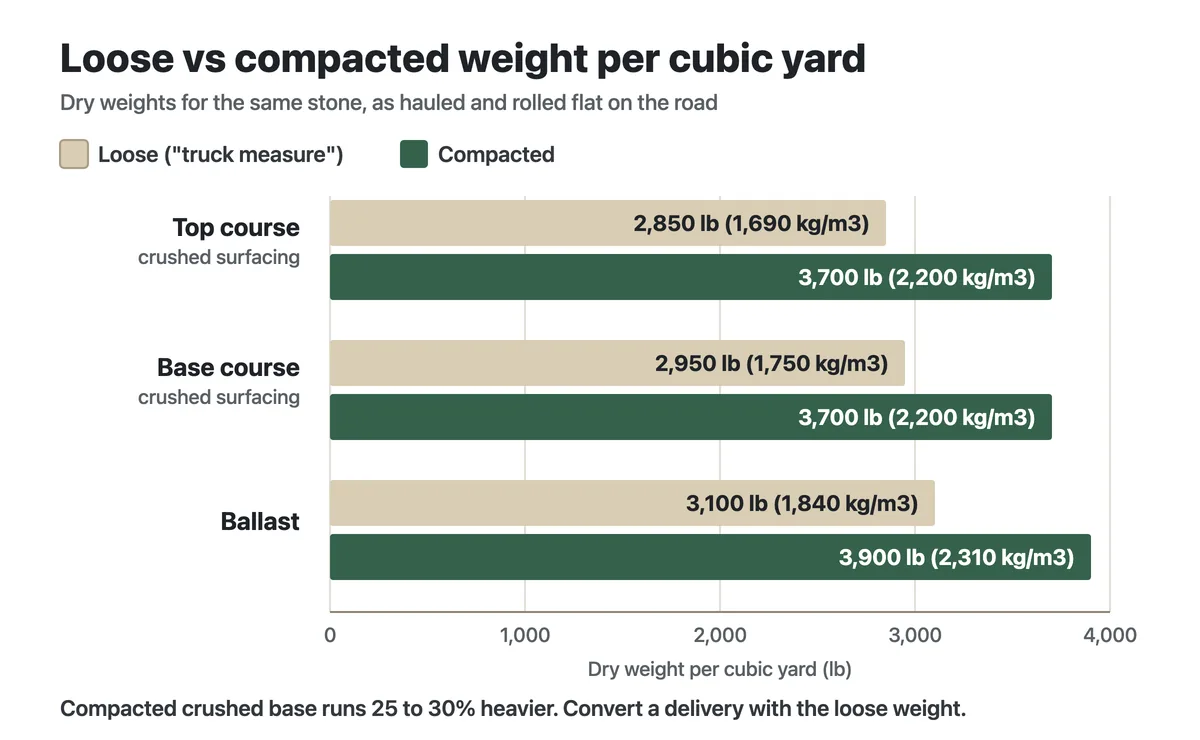
The WSDOT design manual prints both weights side by side. It calls the loose one "truck measure".
| WSDOT material | Loose lb per cu yd | Compacted lb per cu yd | Loose kg/m3 | Compacted kg/m3 |
|---|---|---|---|---|
| Top course (crushed surfacing) | 2,850 | 3,700 | 1,690 | 2,200 |
| Base course (crushed surfacing) | 2,950 | 3,700 | 1,750 | 2,200 |
| Ballast | 3,100 | 3,900 | 1,840 | 2,310 |
Mixing the two up is an expensive mistake, and it has gone to appeal. An Iowa applicant billed loose truck gravel at 1.89 tons per yard, taken from Iowa DOT's 140 lb per cu ft figure for compacted stone. FEMA's reviewers used 104 lb per cu ft, which they called the density of gravel in a freshly loaded truck. The FEMA ruling set 1.4 tons per yard for loose gravel, so the claim ran about 35% heavy.
Compacted weight is what a finished base under a crusher run pad actually weighs, about 3,700 lb per yard. The same gap is why loose stone goes down thicker than the finished gravel depth you want.
How much does a yard of gravel weigh wet
A wet yard weighs more than any table shows, and denser rock adds more again. DOT tables list dry stone of one set rock density, so ask the quarry how wet the pile is when you load. WSDOT gives a correction for each, applied in this order.
- Rock density. WSDOT's weights assume a specific gravity of 2.65. Multiply the table weight by the specific gravity on the quarry's test report, then divide by 2.65.
- Water. Multiply the result by 1 plus the free water as a decimal. Free water is the film on and between the stones, not water inside the rock.
With 5% free water, a yard of crusher run goes from 2,850 lb to 2,850 x 1.05, or 2,993 lb. You pay for 143 lb of water at the scale.
Rock type also explains why two DOTs print different weights for "crushed stone". The Caltrans maintenance manual lists loose crushed limestone at 2,550 lb per yard, crushed granite at 2,600 and crushed gravel at 2,700. WSDOT's crushed surfacing runs 2,850 to 2,950. Grading differs too, so two DOT figures for crushed stone sit up to 400 lb apart per yard.
What does a yard of gravel look like
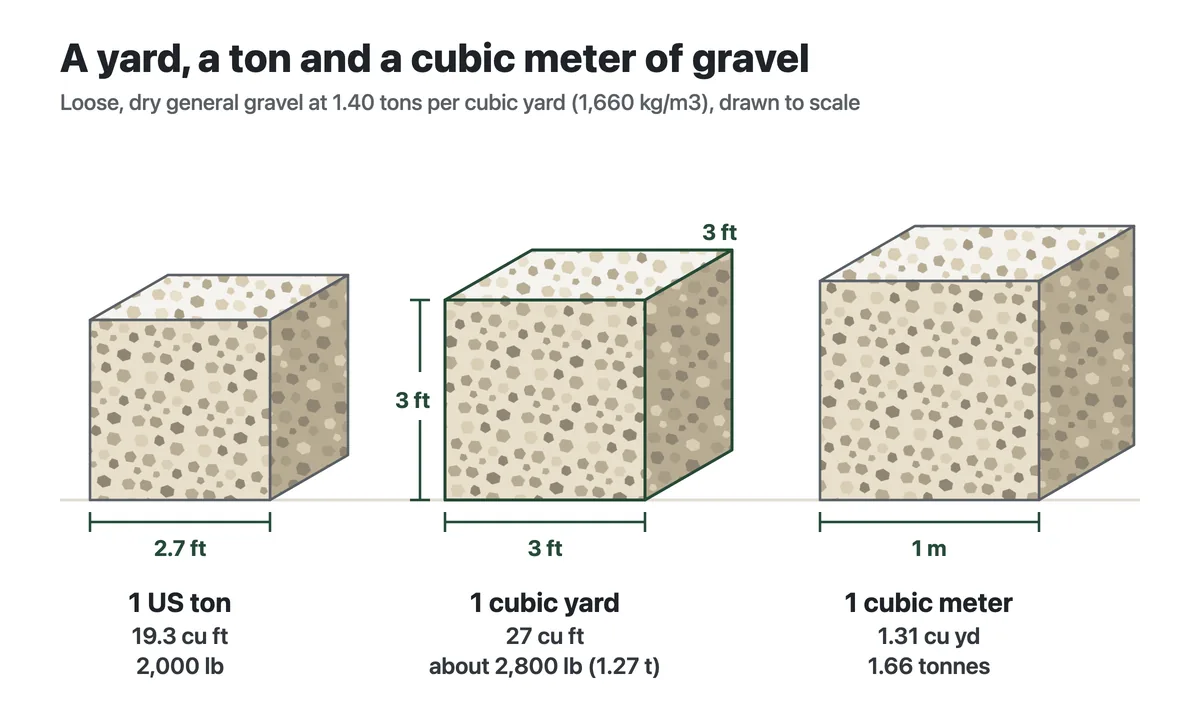
A cubic yard is a cube 3 ft long, 3 ft wide and 3 ft high. Each side is about the height of a kitchen counter. One ton of general gravel, 19.3 cu ft, would fill a cube about 2.7 ft on each side. A cubic meter is about a third bigger than a cubic yard, at 1.31 cu yd, and holds 1.66 tonnes of gravel.
Half a yard in a pickup bed
Half a yard is a 3 x 3 x 1.5 ft box of stone. The table gives its weight dry and, for crusher run, wet.
| Half-yard load | Pounds | Kilograms |
|---|---|---|
| General gravel, dry | 1,400 | 635 |
| Crusher run, dry | 1,425 | 646 |
| Crusher run, 5% free water | 1,496 | 679 |
| #57 stone, dry | 1,300 | 590 |
| Screenings, dry | 1,200 | 544 |
Check that weight against the payload on the sticker in your door jamb before the loader tips the bucket.
Weight mistakes that lead to a wrong order
The costliest weight mistake is pricing a truck load at the compacted weight, which buys about a third too many tons. Mixing up tons and tonnes, buying wet stone by the ton and using the general weight for a specific stone also turn a correct volume into the wrong ticket.
| Mistake | What goes wrong | Fix |
|---|---|---|
| Compacted weight used for a truck load | 1.85 tons per yard instead of 1.40 buys 32% too many tons | Use the loose figure for anything delivered |
| Ton and tonne mixed up | 8 tonnes is 8.82 US tons, not 8 | Ask which ton the quote is in |
| Wet stone bought by the ton | 7.8 tons of #57 at 5% free water holds 7.43 tons of stone, about 5.71 yd instead of 6 | Ask for the moisture, or round the order up |
| Square yard read as cubic yard | A square yard 4 in deep holds 3 cu ft, a ninth of a cubic yard | Add a depth, then use the coverage charts per ton and yard |
| Generic weight used for a specific stone | 6 yd of #57 ordered at the general-gravel weight buys 0.6 ton too much | Use the row for your stone |
FAQ
How much does a yard of stone dust weigh?
Screenings sold as stone dust run about 2,400 lb a yard. Fine limestone dust, the powder itself, is lighter: Caltrans lists it at 75 to 85 lb per cu ft, or about 1.0 to 1.15 tons a yard.
How much does a yard of decomposed granite weigh?
About 2,500 lb, or 1.25 tons, per loose yard. Decomposed granite is crumbly, sandy rock, so it weighs close to screenings and coarse sand rather than to crushed stone.
How much does a bag of gravel weigh?
QUIKRETE All-Purpose Gravel, a common bag, weighs 50 lb with stones up to 3/8 in. Forty of them make one US ton. For a whole bed or path, buying loose by the yard is far less lifting.
Conclusion
Before you call the supplier, multiply the loose cubic yards you are ordering by your stone's tons per yard from the weight table, never by a compacted figure. Ask whether the quote is in US tons or tonnes, and check the scale ticket against your number when the load arrives. If you have not picked the stone yet, the gravel size chart shows which number to ask for.