How to Build a Gravel Base for Shed Pads
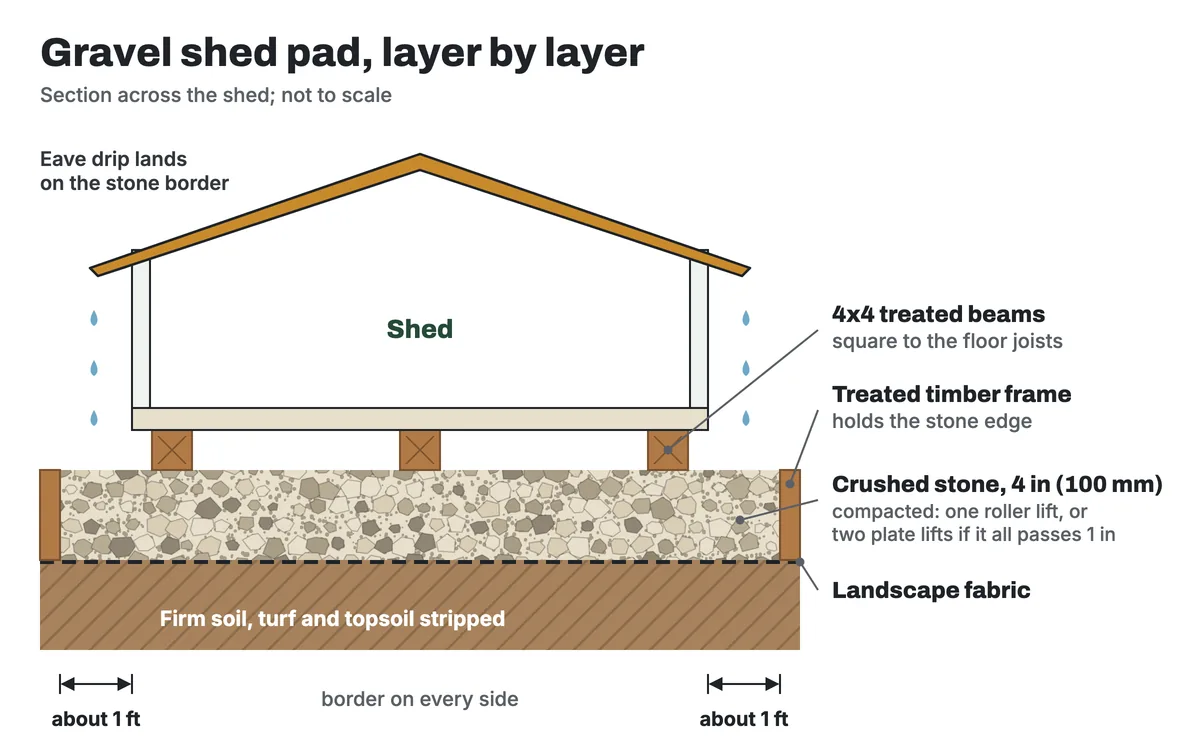
A gravel base for shed pads is 4 in (100 mm) of crushed stone, compacted over landscape fabric inside a treated timber frame, with beams or blocks on top. Make the pad about 1 ft wider than the shed on every side. For an 8 x 12 ft shed, that comes to about 3.1 tons of crusher run, laid in eight steps.
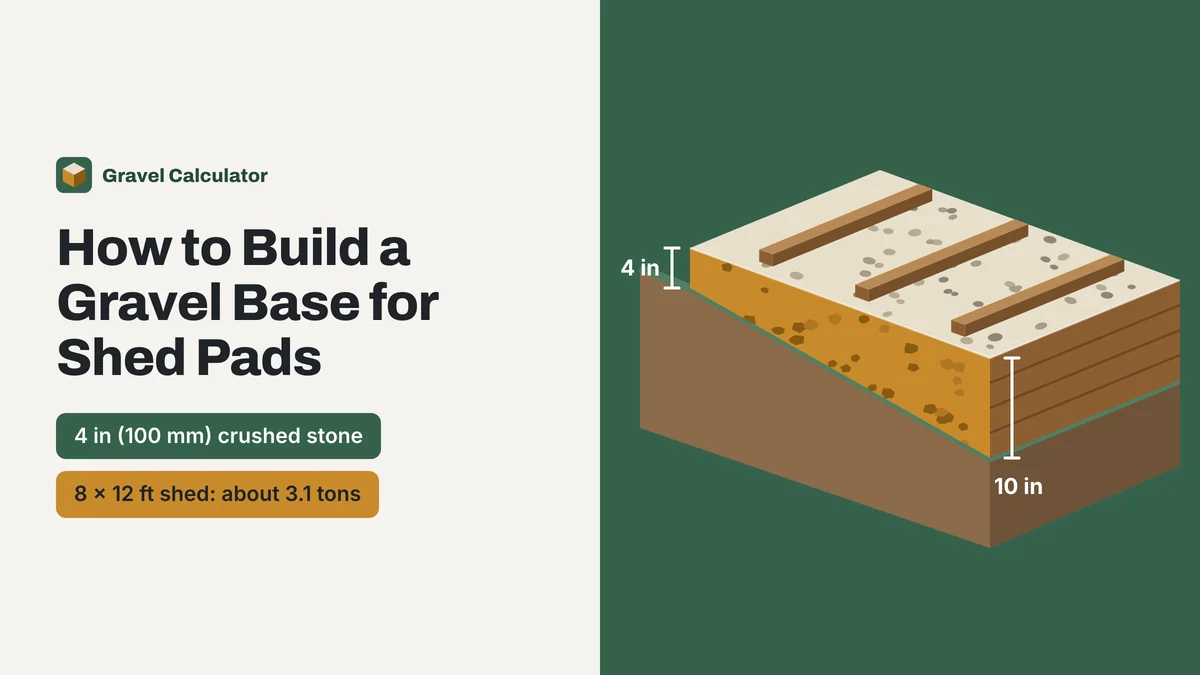
Table of Contents
Is gravel a good base for a shed
Yes. Gravel makes a good base for most backyard sheds, and Keter, which makes resin sheds, calls it a top choice for small to medium ones. Rain soaks down through the stone instead of pooling under the floor. The beams on top hold the floor clear of the ground, so air moves under it and the wood dries after a storm.
Ask the yard for crushed stone rather than rounded river gravel. Crushed pieces have sharp faces that bite into each other, and the main types of gravel split along that line between natural and crushed rock.
When concrete is better than gravel
Concrete is worth the extra work when the floor carries heavy loads, such as a ride-on mower or a bench of heavy tools. Keter notes that most backyard sheds also do well on a 4 in slab over compacted gravel, so the stone work underneath stays the same. Even then, the slab sits on a compacted gravel base under the concrete.
Size can decide it too. The IRC waives frost protection only for small accessory buildings, so a big shed may need footings set below the frost line. The table matches common shed setups to a base.
| Shed and site | Base to build | Why |
|---|---|---|
| Light-frame shed on firm or average soil | 4 in gravel pad with beams | drains, packs hard, no curing time |
| Plastic kit shed | gravel-filled grids on prepared ground | Keter still asks for ground preparation |
| Heavy loads, such as a ride-on mower | 4 in slab over compacted gravel | Keter's option for most backyard sheds |
| Light-frame shed over 600 sq ft (56 m2) | footings, as the IRC frost rule applies | outside the IRC frost exemption |
| Block or other heavy build over 400 sq ft (37 m2) | footings, as the IRC frost rule applies | outside the IRC frost exemption |
What you need
Get the stone, timber and fabric on site before the turf comes up, so the bare soil does not sit open in the rain.
The table lists what goes into the pad and the tools that build it.
| Item | Kind | What it does |
|---|---|---|
| Crushed stone | material | the pad itself, ordered by the ton for the pad size, not the shed size |
| Landscape fabric | material | keeps soil out of the stone; buy about 1 ft extra at each seam |
| Ground-contact treated timber | material | the edge frame, with stakes or long spikes to pin it |
| Treated 4x4 beams or solid patio stones | material | carry the floor clear of the stone |
| Exterior screws | material | join the frame corners |
| Tape measure, wooden stakes, mason's string | tool | mark and square the pad |
| Flat spade or rented sod cutter, rake, wheelbarrow | tool | strip the turf and move the stone |
| 4 ft level and a long, straight board | tool | check the soil, frame and stone for level |
| Plate compactor, or a hand tamper for a very small pad | tool | pack the soil and each layer of stone |
| Saw and drill driver | tool | cut and fix the frame |
A plate compactor is worth renting for any pad bigger than a garden tool shed. A hand tamper works, but it takes many more passes to pack 4 in of stone hard.
Building a gravel shed base step by step
Building a shed base with gravel takes eight steps, from string lines to beams. Each step names the slip that most often spoils it, so you can catch it before the shed goes on.

Step 1: Mark out the pad
Measure the shed, then add 1 ft on every side. An 8 x 12 ft shed gets a 10 x 14 ft pad. Drive a stake at each corner and run string between them a few inches above the ground.
Square the strings by measuring both diagonals, which match only when the corners are true. For a 10 x 14 ft pad, each diagonal comes to about 17.2 ft.
Marking the pad to the shed's own size is the usual slip here. The outer beams then sit on the thin, loose edge of the stone, and roof drip lands on the lawn. The pad runs wider than the shed, so enter the pad size, not the shed size, in the gravel calculator.
Step 2: Strip the turf and topsoil
Cut out the turf and dig off the dark topsoil inside the strings until you reach firm ground. Outdoor Living Today, a cedar shed maker, tells buyers to dig out 4 in and fill the hole with gravel or crushed rock.
Dig any soft spots deeper and refill them with crushed stone. Topping up a dip with loose soil is a common mistake, because it squeezes down once the shed sits on it. Roots and turf left under the pad rot away and leave hollows, so take them all out.
Step 3: Level and firm the ground
Rake the soil flat, then lay the straight board across it with the level on top. Check in both directions and at each corner. Run the plate over the bare soil once it is level, so the ground does not settle later under the stone.
Shape the ground just outside the strings so it falls away from the pad, about 1/8 in per foot, as Outdoor Living Today advises. A pad dug as a hollow in the lawn fills with water after every storm.
Step 4: Lay landscape fabric
Roll landscape fabric over the whole pad, out to the strings. Overlap each seam by about 1 ft so the stone cannot work into the gaps. Outdoor Living Today (cedar) and Keter (resin) both put it under the stone.
On wet silt or clay, FHWA notes that fabric stops fine soil from pumping up into the gravel. Leave it out on clay and mud slowly rises into the stone, so the pad goes soft under the beams.
Step 5: Build the edge frame
Build a frame of ground-contact treated timber around the pad, sitting on the fabric. That grade is what the IRC demands for wood that supports a house, and it is a fair bar for a shed too. Screw the corners, check the diagonals again and set the top of the frame level all round.
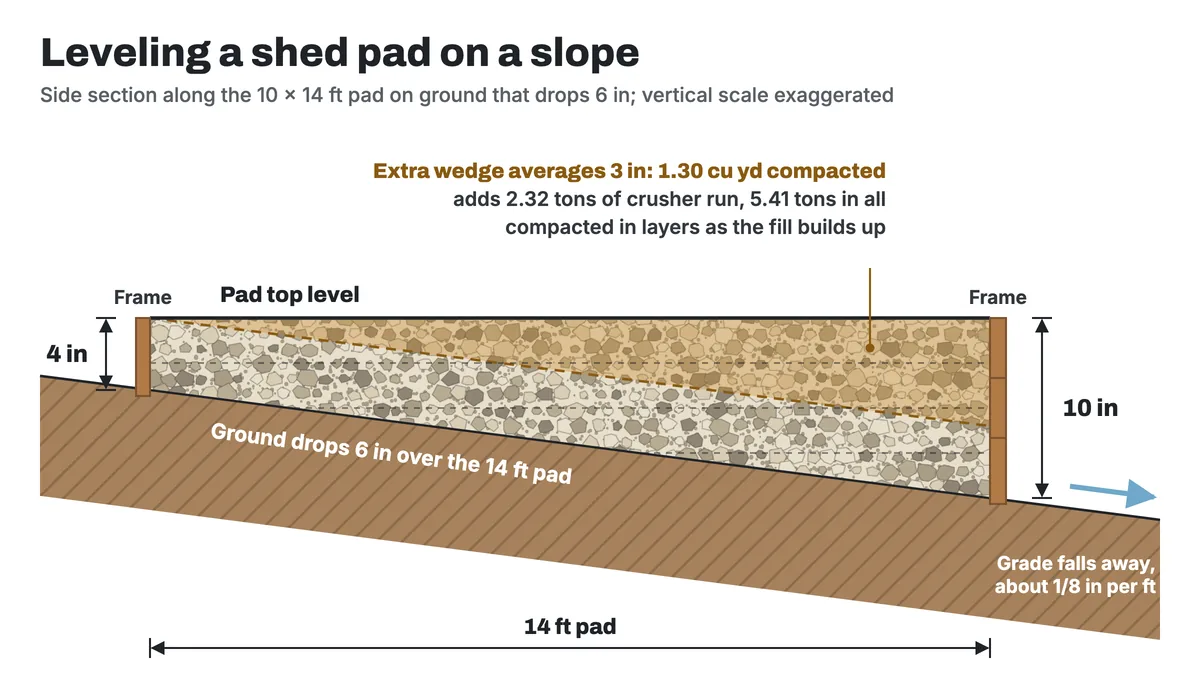
Pin each side with stakes or spikes driven on the outside. Without a frame, the stone edge spreads into the lawn and the outer beams end up on thin stone. On a slope, the low side of the frame is built up taller, with the extra fill worked out in the slope section.
Step 6: Spread the stone in layers
Tip the stone inside the frame and rake it out. A 4 in finished base of crusher run needs about 5 in of loose stone, since the plate packs it down. A heavy roller can pack those 5 in in one lift. A plate needs two layers, and that works only when every piece passes a 1 in screen.
Ask the yard for the top size of its crusher run when you order. If its biggest stone is over 1 in, use the roller, or ask for a grade that all passes 1 in. Rake the stone about 1 in above the frame top for a single rolled layer, or about 1/2 in above it for the second of two plate layers. Compacting brings either one down level with the timber.
Dumping the whole load and packing only the surface leaves loose stone at the bottom. That loose stone settles once the shed is on it, and the floor goes out of level.
Step 7: Compact the stone
Run the plate over each layer in overlapping passes, starting at the edges and working in. Lightly damp stone packs tighter than bone-dry stone, so mist it with a hose on a dry day.
Keep going until the surface no longer sinks under the plate. Then lay the board across the frame in several directions and check it with the level. Fill any low spot with stone and pack it again.
A pad that is out of level twists the shed frame, and the doors start to bind. Fixing it now takes a rake and a few passes; fixing it later means moving the shed.
Step 8: Set the beams or blocks
Lay 4x4 treated beams across the pad, square to the floor joists. Outdoor Living Today shows its buyers that layout, or patio stones under the key joist points. Bed each beam into the stone and check that they all sit level and at the same height.
Keep the shed floor off the stone itself. The beams leave an air gap that lets the floor dry, while a floor laid flat on gravel stays damp.
How deep should a gravel shed base be
Four inches of compacted stone is enough for a typical backyard shed, which matches the 4 in dig in step 2. UK maker Waltons lands in the same place, with 10 cm (3.9 in) of hardcore under its slab and concrete bases.
Frost depth does not apply to most sheds. The IRC excuses a free-standing, light-frame accessory building of 600 sq ft or less, with eaves no higher than 10 ft, from frost protection. For those sheds, the pad can sit at the surface. Some states go further: Virginia lets sheds up to 256 sq ft skip footings if, among other conditions, the supports sit level on firm soil.
The ground decides when to go deeper. Soft clay, standing water and hard freezes all call for a deeper gravel base on soft or wet ground. On bad ground, a gravel base for shed pads needs more depth, and the extra stone still goes inside the same frame.
What size gravel for a shed base
Use crusher run for most sheds. It is crushed stone mixed with its own dust, and the dust fills the gaps, so the pad packs hard under the beams. FHWA notes that fractured stone resists moving under load better than natural gravel does.

Pick clean #57 stone instead when the site stays wet. It has almost no fines, so water runs straight through. The trade-off is a top that never crusts over and stays a little loose. The table shows which stone suits which yard.
| Stone | Other names and nearest UK stone | Packs firm? | Drains? | Best use under a shed |
|---|---|---|---|---|
| Crusher run | DGA, road base, UK MOT Type 1 | yes | slowly | most sheds on firm or average soil |
| #57 stone | clean stone; UK 20 mm clean is closer to #67 | a little | fast | wet sites and low spots |
| Pea gravel | pea shingle | no | fast | not under beams or blocks |
Crusher run grades from about 1 1/2 in down to dust. #57 stone runs from about 1 in down to 3/16 in. Keep pea gravel out of the layer the shed stands on, since it gives no firm footing.
How much gravel for a shed base
Size the stone for the pad, not the shed. A border of about 1 ft on every side catches rain dripping off the eaves and leaves room for the frame. Each pad side is the shed side plus two borders.

An 8 x 12 ft shed covers 96 sq ft, but its 10 x 14 ft pad covers 140 sq ft, 46% more than the footprint.
| Shed (ft) | Pad (ft) | Pad (metric) | Crusher run | #57 stone |
|---|---|---|---|---|
| 6 x 4 | 8 x 6 | 2.44 x 1.83 m | 1.06 tons (0.96 t) | 0.88 tons (0.80 t) |
| 8 x 10 | 10 x 12 | 3.05 x 3.66 m | 2.65 tons (2.40 t) | 2.20 tons (1.99 t) |
| 8 x 12 | 10 x 14 | 3.05 x 4.27 m | 3.09 tons (2.80 t) | 2.56 tons (2.32 t) |
| 10 x 12 | 12 x 14 | 3.66 x 4.27 m | 3.71 tons (3.36 t) | 3.07 tons (2.79 t) |
| 10 x 16 | 12 x 18 | 3.66 x 5.49 m | 4.77 tons (4.32 t) | 3.95 tons (3.59 t) |
| 12 x 24 | 14 x 26 | 4.27 x 7.92 m | 8.03 tons (7.29 t) | 6.66 tons (6.04 t) |
Each pad in the table has a 1 ft border and 4 in of finished stone. The tons are what to buy: they allow for the stone the plate packs down and use each stone's weight per yard. About 10% spare brings the 8 x 12 ft shed to 3.4 tons of crusher run.
In 0.5 cu ft bags, the smallest shed takes about 37 bags of #57, while the 8 x 12 ft shed would need 107.
Gravel shed base on a slope
Keep the pad level and let the yard fall away around it. Sloped ground is no problem once the low side is built up inside a frame.
- Measure the fall. Run a level string line along the pad's long side and measure the drop at the low end.
- Cut, fill or both. Digging the high side down keeps the stone thin. Building the low side up means a taller frame and more stone.
- Frame the low side with ground-contact treated timber or blocks, level all round.
- Fill with crushed stone, never soil. Compact it in layers as you build up, the same way as the base.
- Grade around the pad so water runs off, with the same fall as in step 3.
Take the 10 x 14 ft pad on ground that drops 6 in along its 14 ft length. The stone runs from 4 in deep at the high end to 10 in at the low end. The extra wedge averages 3 in: 140 sq ft x 0.25 ft = 35 cu ft, or 1.30 cu yd compacted.
In crusher run, that wedge adds 2.32 tons, for 5.41 tons in all.
A wall that holds up the fill carries a load. Under the IRC, walls up to 4 ft skip a permit only when they support no extra load, so ask the building department before you build one under a shed. If the uphill yard sends water toward the pad, a gravel-filled drainage trench along the high side carries it around.
FAQ
Does a shed on gravel need a permit?
Usually not for a small one. Under the IRC 2021 permit exemptions, a one-story detached shed with up to 200 sq ft of floor area needs no building permit. Codes based on the IBC stop at 120 sq ft. Both measure the floor, not the pad, and the version your town adopted is the one that applies.
Can a hot tub sit on gravel?
Often, yes, if the model allows it. Hot Spring accepts pea gravel or crushed rock for spa-only installs, but its Grandee model and any deck or gazebo package need concrete. Bullfrog's advice on a gravel base for a hot tub also allows stone, with no shims and at most 1/2 in of fall over 8 ft.
Can a plastic shed sit on gravel grids?
Yes. Keter's shed foundation guide fills its base grids with gravel, but still says the ground under them needs proper preparation. Strip the turf and firm the soil as for any shed pad, then set the grids level before you fill them.
Does a greenhouse need a different gravel base?
No. Build it like a shed pad, with firm soil, fabric, 4 in of compacted crushed stone and an edge frame. If your code counts it as an accessory building, the same floor-area permit lines apply as for a shed.
Conclusion
Start with the strings and the diagonal check, because every later step builds on a square pad. On a slope, add the low side's wedge to the tons before you order, and on a site that stays wet, ask for clean #57. If the yard lists its stone by number, the gravel size chart shows what #57 means in inches.