What Is Crusher Run? Size, Specs and How It Compares to #57
Crusher run is crushed rock sold with its dust left in, graded from a top stone of about 1 to 2 in (25 to 50 mm) down to powder. Yards also call it crush and run, DGA, ABC or road base. The dust fills the gaps, so it packs into a firm base that slows water. Use it under a drive, pad or shed, not where water must drain through. The gravel calculator turns your pad size into tons.
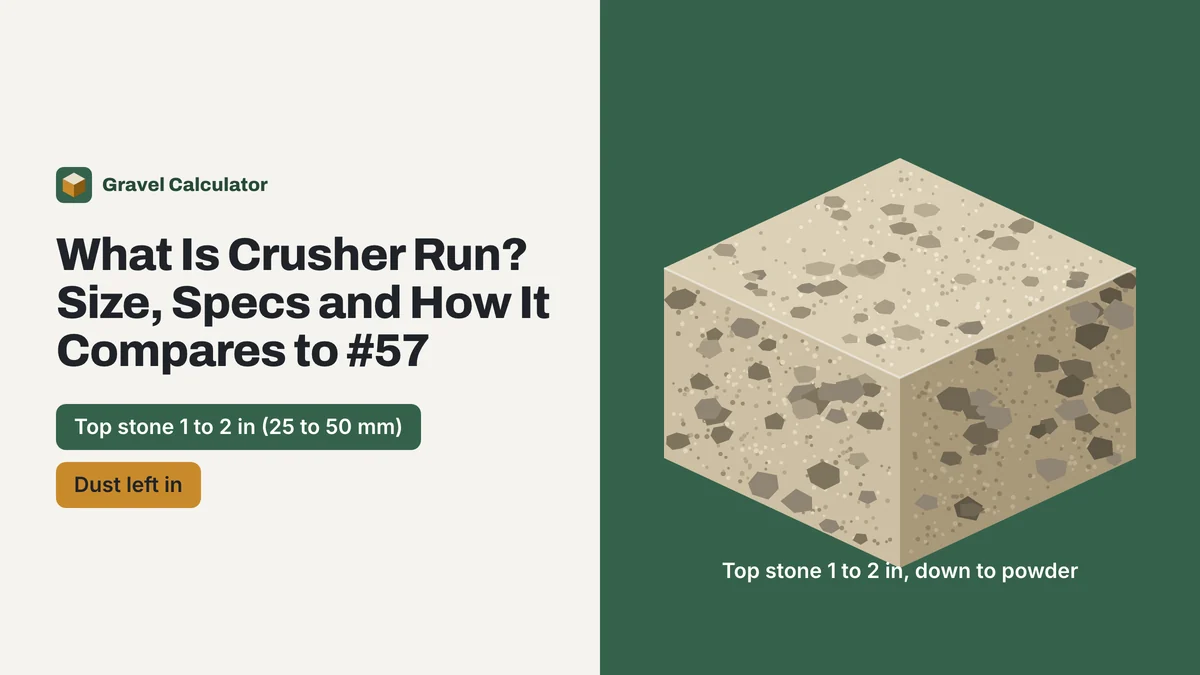
Table of Contents
What crusher run and road base gravel are
Think of crusher run as a recipe, not a single stone size: stones of every size mixed with their own grit and powder, left unwashed. Road base gravel is the same kind of mix, named for the job it does. The Virginia DOT road and bridge specifications put sizes 21A, 21B and 22 in one table of dense-graded aggregates, which is where the yard name DGA comes from.
Not every load is fully crushed, though. Virginia's Type I base must be crushed stone, crushed slag or crushed gravel, and 90% of the crushed gravel's coarse part needs at least one broken face. North Carolina's ABC may contain uncrushed gravel. Broken faces lock together under load, and natural gravel and crushed stone differ on exactly that point, so ask whether the yard's mix is all crushed.
| Name you hear | Where | Tied to a written spec? |
|---|---|---|
| crusher run, crush and run, QP, shoulder stone | US yards | no |
| DGA, sizes 21A, 21B and 22 | Virginia DOT | yes, Table II-9 |
| ABC, aggregate base course | North Carolina DOT | yes, Table 1005-1 |
Other states and quarries use their own names and numbers. Whatever the yard calls it, ask for the gradation sheet behind the name.
Crusher run gravel size and gradation
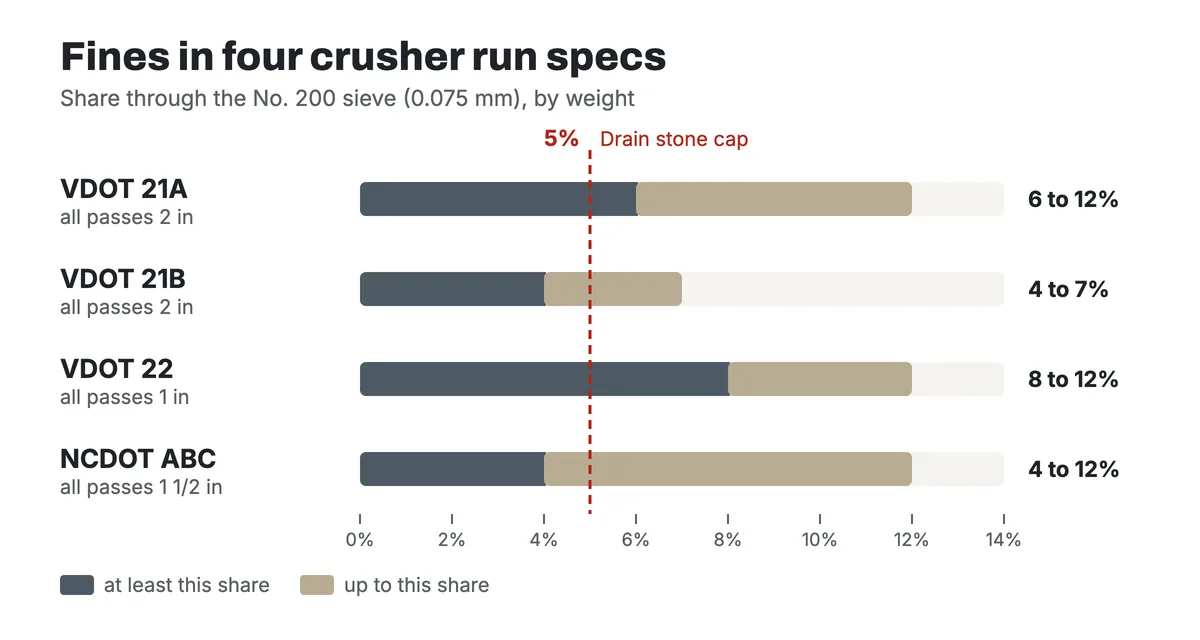
The size of crusher run gravel depends on the spec it was crushed to. US base mixes top out between 1 and 2 in, and most of the stone sits well below that. Virginia's 21A lets at most 6% stay on a 1 in sieve, and 21B at most 15%. After the top size, each number is the percent, by weight, that falls through that sieve. The No. 10 sieve is 2.00 mm, No. 40 is 0.425 mm and No. 200 is 0.075 mm.
| Spec | All passes | % through 1 in | % through 3/8 in | % through No. 10 | % through No. 40 | % through No. 200 |
|---|---|---|---|---|---|---|
| VDOT 21A | 2 in | 94 to 100 | 63 to 72 | 32 to 41 | 14 to 24 | 6 to 12 |
| VDOT 21B | 2 in | 85 to 95 | 50 to 69 | 20 to 36 | 9 to 19 | 4 to 7 |
| VDOT 22 | 1 in | 100 | 62 to 78 | 39 to 56 | 23 to 32 | 8 to 12 |
| NCDOT ABC | 1 1/2 in | 75 to 97 | no limit | 25 to 45 | 14 to 30 | 4 to 12 |
Read the last column first. Across these specs, 4 to 12% of the mix is fines, grains finer than 0.075 mm, and they bind the layer. The ABC row comes from Table 1005-1 of the NCDOT 2024 Standard Specifications. Single-size stone works the other way, banded between two sieves with almost nothing below, as the gravel size chart shows for each number.
Crusher run vs 57 stone under load and water
Pick crusher run when the layer has to carry weight and stay put. Pick #57 stone when water has to pass through it. The difference is almost entirely the dust.
| Crusher run | #57 stone | |
|---|---|---|
| Stone size | about 1 to 2 in down to dust | mostly 1 in down to 3/16 in (25 to 4.75 mm) |
| Finer than about 2 mm | 20 to 56% (No. 10 sieve) | 5% at most (No. 8 sieve, 2.36 mm) |
| Once compacted | packs into a firm layer | seats, but stays loose and never forms a crust |
| Water | slowed by the fines | passes straight through |
| NCDOT uses it for | base course, aggregate stabilization | concrete, shoulder drains, sediment control |
| Weight of a loose cu yd | 1.43 tons | 1.30 tons |
The heavier yard is the dust at work again: it fills space that sits empty in clean stone.
Where the fines help and where they hurt
Crusher run's dust helps wherever a layer must stay put under wheels or a floor. The same dust rules it out wherever water needs a path or a smooth bed must stay even.

| Job | Do the fines help? |
|---|---|
| Base under a drive, parking pad or shed | yes, they bind the base |
| Bed directly under pavers | no, they settle unevenly |
| Around a perforated pipe | no, they clog the path |
| Under an interior slab | only as a blotter, in set cases |
Pipes need clean stone, as set out for a French drain's perforated pipe. Slab bases follow their own code, covered under gravel under a concrete slab. For heavy loads or deep frost, ask your building department what base it expects.
What is crushed stone dust
Crushed stone dust is the grit left over from crushing, sold as screenings and close to size #10. None of it is bigger than 3/8 in, and at least 85% of it is under 3/16 in. Engineers class it as a sand, not a gravel. It is not the same thing as fines: fines are only the powder under 0.075 mm, while dust holds that powder plus coarser grit.
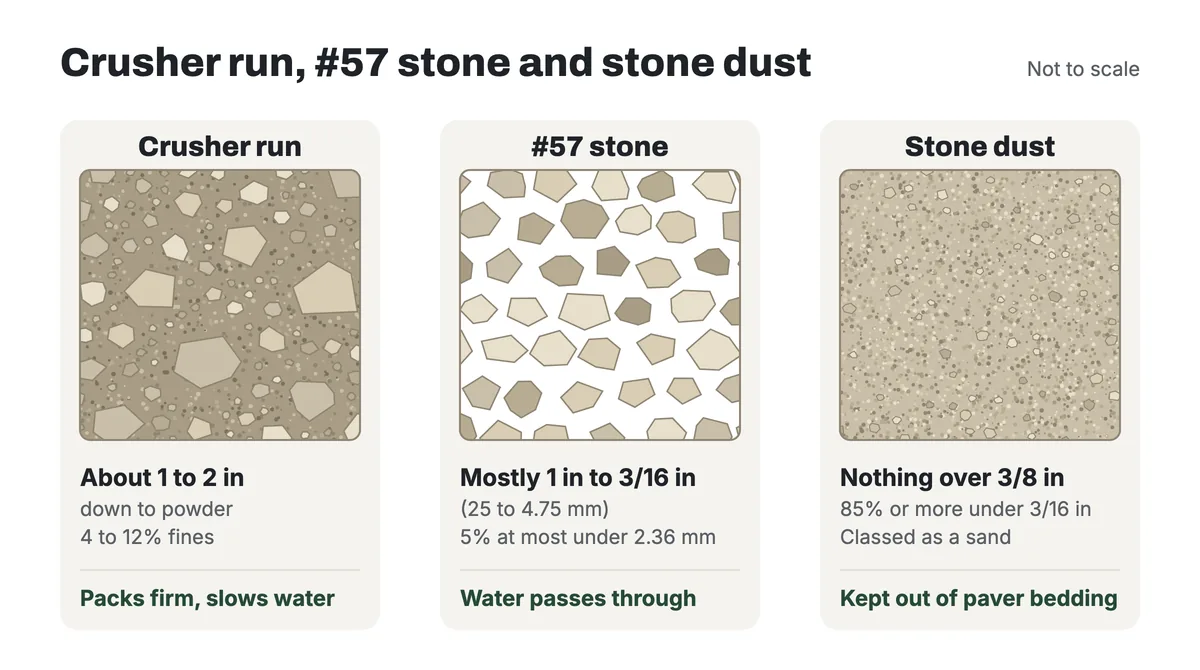
Pavers sit on a sand bedding layer over the base, not on dust.
Ordering crusher run and checking the load
A 30 x 20 ft parking pad finished 4 in thick needs about 14.6 tons (13.2 t) of crusher run, including about 10% spare. The gravel calculator works out any other size, with the extra stone that compaction squeezes out already built in.

A pad that thin goes down as one layer under a roller, or as two plate lifts if the mix all passes 1 in. Thicker bases are a different job, covered in how deep each gravel layer should be.
A ton of damp stone holds less rock
Yards sell crusher run by the ton, and part of that ton can be water. On North Carolina road contracts the base is weighed on truck scales and paid per ton, with no deduction for moisture. Virginia has its base mixed at about optimum moisture, within 2 points either way. Optimum moisture is the water content that lets stone pack to its greatest density, so a fresh load is meant to arrive damp. Keep that in mind when you check a ticket against the weight of a yard of gravel.
Your eye can reject a load, not pass it
Virginia rejects any load that is plainly contaminated or segregated, meaning the coarse and fine parts have split apart. In a split pile, the coarse patches stay loose and the fine patches rut in long wet spells, so remix it before you spread. The FHWA Gravel Roads Construction and Maintenance Guide warns that "simple visual inspection can be misleading", and only a sampled test shows the grading.
Why the fines must be rock dust, not clay
Ask for the PI on the yard's test sheet and look for 6 or less. PI, the plasticity index, is a lab score that climbs as fines behave more like clay. NCDOT wants the ABC fines at PI 4 or less, allows up to 6 only if extra lab checks pass, and rejects anything above 6. Virginia pulls Type I base off the road above PI 6. The UK highway spec goes further and wants these fines non-plastic.
The reason is water. FHWA notes that gravel bound with clay, used as a base, loses its strength once it gets wet. So never mix garden soil into a base to "help it bind".
FAQ
What is ABC aggregate?
ABC is aggregate base course, North Carolina DOT's dense base stone. Every particle passes 1 1/2 in, and 4 to 12% is fines. It may be crushed stone, crushed gravel or uncrushed gravel, and NCDOT caps its "percentage of wear" at 55%.
Does crusher run harden like concrete?
No. The mix holds no cement, and the UK highway spec files this kind of base among its unbound mixtures. It gets hard because broken faces lock when compacted and the dust packs the spaces. Water helps only while you compact it, near optimum moisture.
Is MOT Type 1 the same as crusher run?
Comparable, not the same. MOT Type 1 has its own grading and reads its 0 to 9% fines on a 0.063 mm sieve, not the US 0.075 mm one. In Britain "crusher run" is a merchant's name: the October 2025 highway spec never uses the word.
Can you spread road base on frozen ground?
No. NCDOT forbids placing base material on frozen subgrade or base. The UK spec says unbound mixtures must not be used frozen or laid on a frozen or icy surface. Wait for the thaw, then spread and compact.
Conclusion
Before you pay, ask the yard for the test sheet behind its crusher run and check that the PI reads 6 or less. When the truck tips, look for a pile split into coarse and fine patches, and remix it before you spread. A mix that passes can carry a gravel shed base or the lower layer of a driveway built from two stones.