What #57 Stone Is and How to Order It
#57 stone is clean, usually crushed and angular stone with almost no dust. At least 95% passes a 1 in screen and at most 10% is under 3/16 in. Almost all of it, 85% or more by spec, is 1 in to 3/16 in (25 to 4.75 mm). Water runs straight through, so it suits drains, permeable bases and concrete, not driveway tops.
The gravel calculator turns your measurements into tons of #57, at 1.30 tons per loose cubic yard.
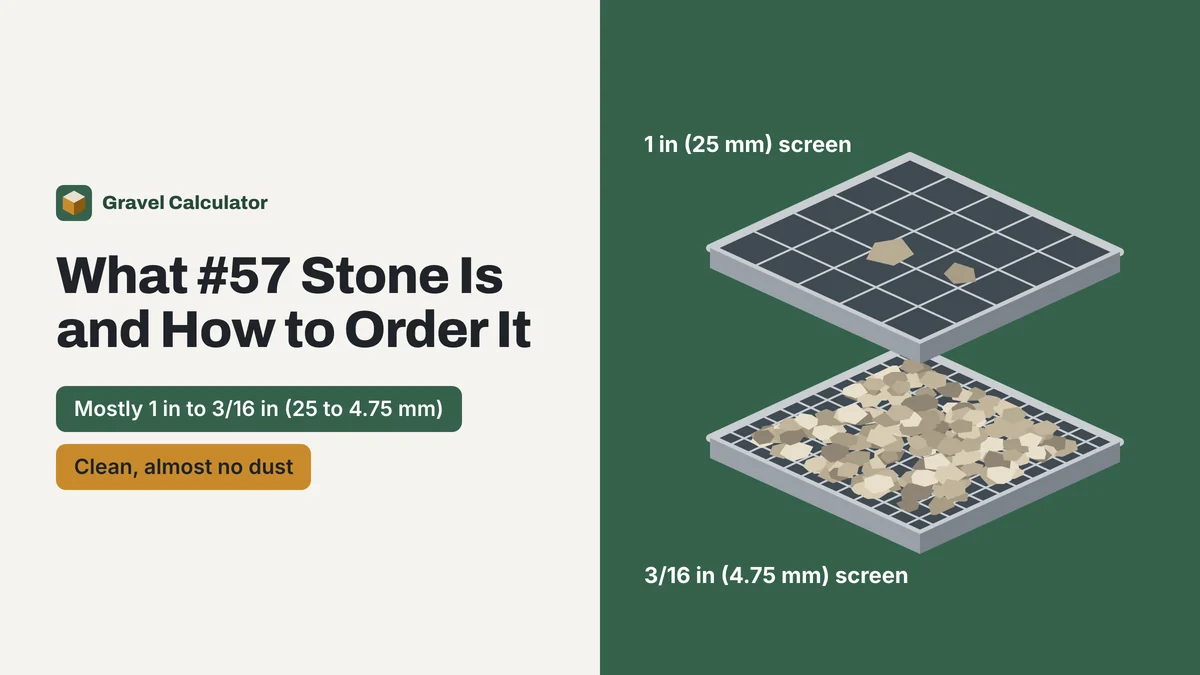
Table of Contents
#57 stone size in inches, piece by piece
Most of a #57 load falls between 1 in and 3/16 in. A few pieces may run up to 1 1/2 in (37.5 mm), but they can make up no more than 5% of the weight.
Split a load into bands and the spec allows this range:
| Piece size | Metric | Share of the load by weight |
|---|---|---|
| Over 1 in | over 25 mm | 0 to 5% |
| 1/2 to 1 in | 12.5 to 25 mm | 35 to 75% |
| 3/16 to 1/2 in | 4.75 to 12.5 mm | 15 to 60% |
| Under 3/16 in | under 4.75 mm | 0 to 10% |
| Under 3/32 in | under 2.36 mm | 0 to 5% |
The wide middle bands are why two loads of #57 can look different. One quarry may ship mostly 1 in pieces, another a mix nearer 1/2 in, and both meet the spec.
#57 stone gradation limits
The limits come from the national standard, AASHTO M 43 (ASTM D448), and the Virginia and North Carolina DOTs use the same numbers. Each cell is the share of the stone, by weight, that falls through a sieve of that size. #67 and #8 sit beside it because they are the two sizes most often swapped for #57.
| Sieve | mm | #57 | #67 | #8 |
|---|---|---|---|---|
| 1 1/2 in | 37.5 | 100% | 100% | 100% |
| 1 in | 25 | 95 to 100% | 100% | 100% |
| 3/4 in | 19 | not set | 90 to 100% | 100% |
| 1/2 in | 12.5 | 25 to 60% | not set | 100% |
| 3/8 in | 9.5 | not set | 20 to 55% | 85 to 100% |
| No. 4 | 4.75 | up to 10% | up to 10% | 10 to 30% |
| No. 8 | 2.36 | up to 5% | up to 5% | up to 10% |
| No. 16 | 1.18 | not set | not set | up to 5% |
The number itself is a blend code: #57 is sizes 5 and 7 combined, as Penn State's aggregate table puts it. It takes its top from #5, at 1 in, and its bottom from #7, at the No. 4 line. Like every AASHTO size it is open graded: porous, with large air gaps and little or no fines. Pennsylvania calls the same stone 2B.
Is 3/4 inch gravel the same as #57
No. A 3/4 in gravel size is 19 mm (3/4 x 25.4 = 19.05), and that is the sieve that defines #67, not #57. The #57 rows in the Virginia, North Carolina and FHWA tables set no limit at all on the 3/4 in sieve.
So a ticket that just says "3/4 clean" could be either size. Both drain well, but if a plan or a code names one, ask the yard for the number and check it on the gradation sheet.
"3/4 minus" is a different product again. The minus means the fines stay in, so it packs hard like crusher run and other dense base mixes instead of draining.
#8 vs #57 stone for the same job
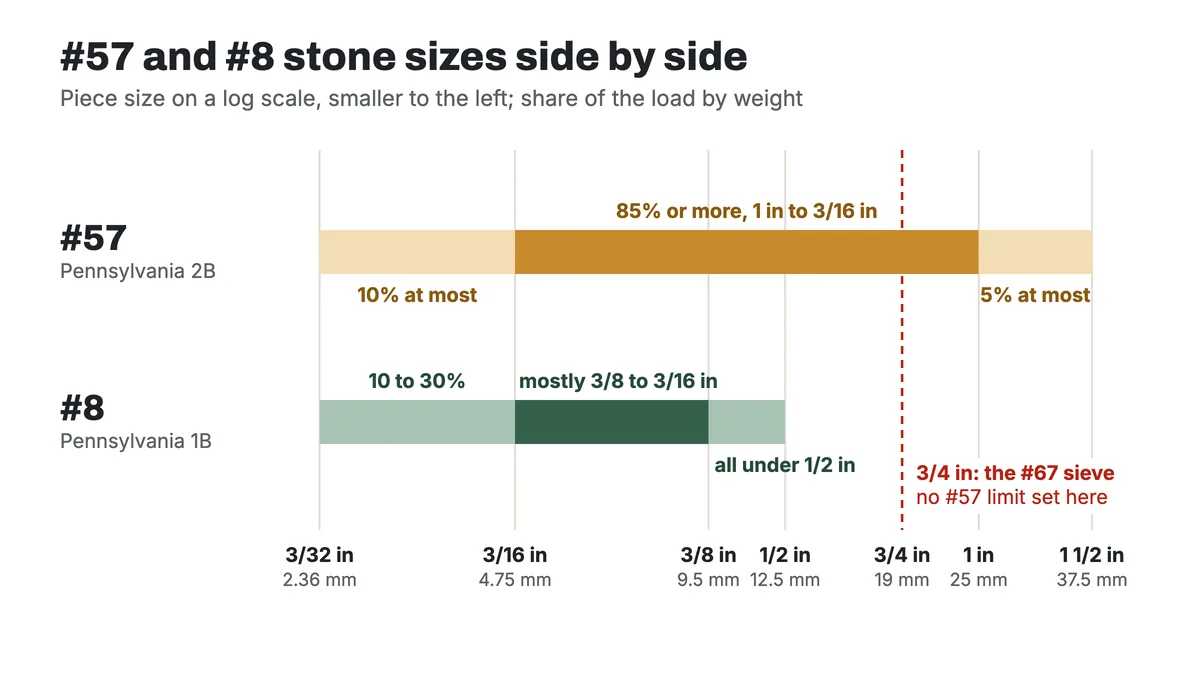
Choose #57 for a thick layer that carries water or load, and #8 where you want smaller stone in a thin layer, such as chip surfacing. #8 is the smaller stone, and all of it passes 1/2 in. It runs mostly 3/8 in down to 3/16 in, with up to a third finer, down to 3/32 in (No. 8).
| #57 | #8 | |
|---|---|---|
| Largest pieces | 1 1/2 in (37.5 mm) | 1/2 in (12.5 mm) |
| Main band | 1 in to 3/16 in (25 to 4.75 mm) | mostly 3/8 in to 3/16 in (9.5 to 4.75 mm), up to a third finer, down to 3/32 in (2.36 mm) |
| Share under 3/16 in | 10% at most | 10 to 30% |
| Pennsylvania name and listed use | 2B, buried drains | 1B, chip surfacing |
In FHWA's lab tests, the median #57 piece was about twice the size of the median #8 piece. Both are clean, open stone, so neither packs into a hard surface.
Name the size by its AASHTO number when you buy across a state line, because Indiana's No. 8 is much coarser than the national #8.
Where #57 goes and what covers it
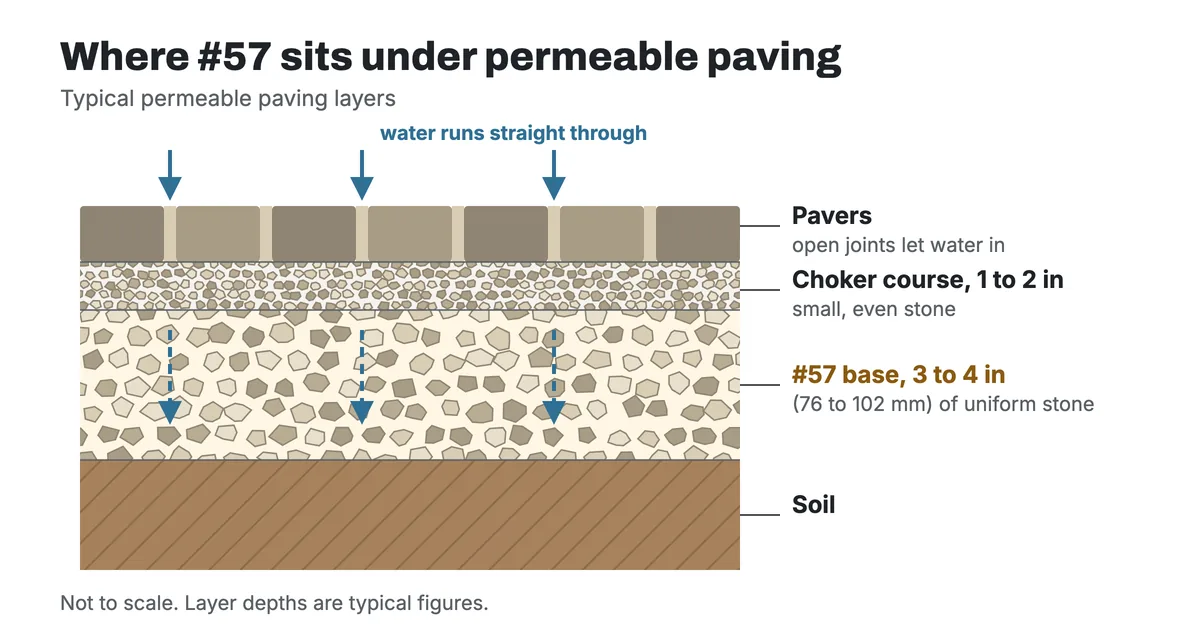
#57 earns its place as the layer water passes through, and that same openness means it needs a cap before anything fine goes on top. Its gaps swallow sand, soil and bedding grit laid straight on it.
| Job | Why #57 fits | What goes over the #57 |
|---|---|---|
| Around a perforated drain pipe | CMHA: at least 3 in (75 mm) of No. 57 or similar around a 4 in pipe, wrapped in fabric | filter fabric, then soil or base |
| Permeable paving | EPA: a base typically 3 to 4 in (76 to 102 mm) of uniform stone such as No. 57 | a 1 to 2 in choker of small, even stone, then the pavers |
| Under a concrete slab | clean, coarse stone stops ground water wicking up to the slab | a vapor sheet, then concrete |
| Concrete mix | a standard coarse-aggregate size that DOTs such as VDOT use in concrete and asphalt | nothing; the stone is inside the mix |
For a house drain, trench width and cover come from the pipe, as set out in French drain stone and trench sizes. Pavers need that choker or a bedding course first, as in the layers under a paver patio. Code rules for stone under floors are covered in gravel under a concrete slab.
#57 makes a poor top for a drive or path. With no fines to bind it, the surface never crusts and the stones keep shifting under tires, which is why a driveway top needs crushed stone with fines.
Does #57 stone compact
Yes, but only so far. A plate compactor seats the pieces against each other until they stop moving, and then the layer is done. Like all open-graded stone, it never binds into a hard, dense mat the way stone with dust does.

In an FHWA study of open-graded stone, a #57 sample weighed 95.4 lb per cubic foot poured loose and 108.7 lb vibrated. Vibration packed in 14% more stone, so this site multiplies the finished volume of #57 by 1.14 to find the loose amount to order.
FHWA's field test is simple: compact until the stone no longer moves, judged by eye. A plate packs no more than 4 in of loose stone per lift, so thicker layers go down in more than one pass, as covered in compaction and lift depths.
Ordering #57 by name and by weight
Ask for "#57" or, in Pennsylvania, "2B", and check the 1 in and No. 4 lines on the quarry's gradation sheet. Then order by weight. NCDOT's #57 provision pays for it in tons weighed on certified truck scales, so ask for the scale ticket with your load.

A 22 by 16 ft base finished 5 in deep comes to about 8.9 tons (8.0 t) of #57, spare included. The gravel calculator works out any other size, and the weight of a yard of gravel by type shows where the 1.30 tons comes from.
Watch for these names on a quote:
| Name you hear | What you get |
|---|---|
| 2B (Pennsylvania) | the same limits as #57 |
| 57M (North Carolina) | #57 with a tighter 1/2 in band, 25 to 45% passing instead of 25 to 60% |
| 57 gravel | the #57 size, but possibly rounded gravel instead of crushed rock |
| Modified, or "with fines" | a standard size with dust blended in, so it packs and drains slowly |
| 3/4 clean | either #57 or #67, so ask which |
| 20 mm clean (UK) | 20 mm is about 3/4 in, the top sieve of #67, so it compares with #67 rather than #57 |
The number sets size, not rock. VDOT lets its sizes be crushed stone, crushed slag, or crushed or uncrushed gravel, so ask what rock the yard crushes. Broken faces lock under a compactor while rounded pieces roll, which is how natural gravel and crushed stone differ.
FAQ
Is #57 or #67 stone bigger?
#57 is bigger at the top end. All #67 passes 1 in, with at least 90% under 3/4 in. #57 lets up to 5% run over 1 in, as large as 1 1/2 in. Both share the same bottom, 3/16 in.
How steep will a pile of #57 stand?
About 30 degrees. FHWA's lab sample averaged 30.2 degrees, so a dumped pile rises roughly 7 in for every 12 in it spreads sideways. Leave room around the drop spot for that slope.
Is #57 stone washed?
Not necessarily. The spec limits how much fine material may remain, not how the quarry removes it: no more than 5% may pass the No. 8 sieve (3/32 in). The #57 that FHWA tested had under 3% dust passing the No. 200 sieve. For a drain, ask for the latest gradation sheet and read the No. 8 line.
Conclusion
If a plan names #57, do not accept a quote that only says "3/4 clean" or "57 gravel" until the yard confirms the size and the rock. Plan the cap before the stone goes down, such as filter fabric over a drain or a choker course under pavers. On a shed base on a wet site, expect a top that stays a little loose, since #57 never crusts.