How Deep Should Gravel Be
How deep should gravel be? A driveway needs at least 3 in of surface stone over a packed base. A path takes about 1.5 in over 4 in of base, and a garden bed 2 in. A concrete slab sits on 4 in, and pea gravel under play equipment goes in 12 in deep. Spread crushed base about a quarter thicker than you want it to finish, because the compactor squeezes it down.
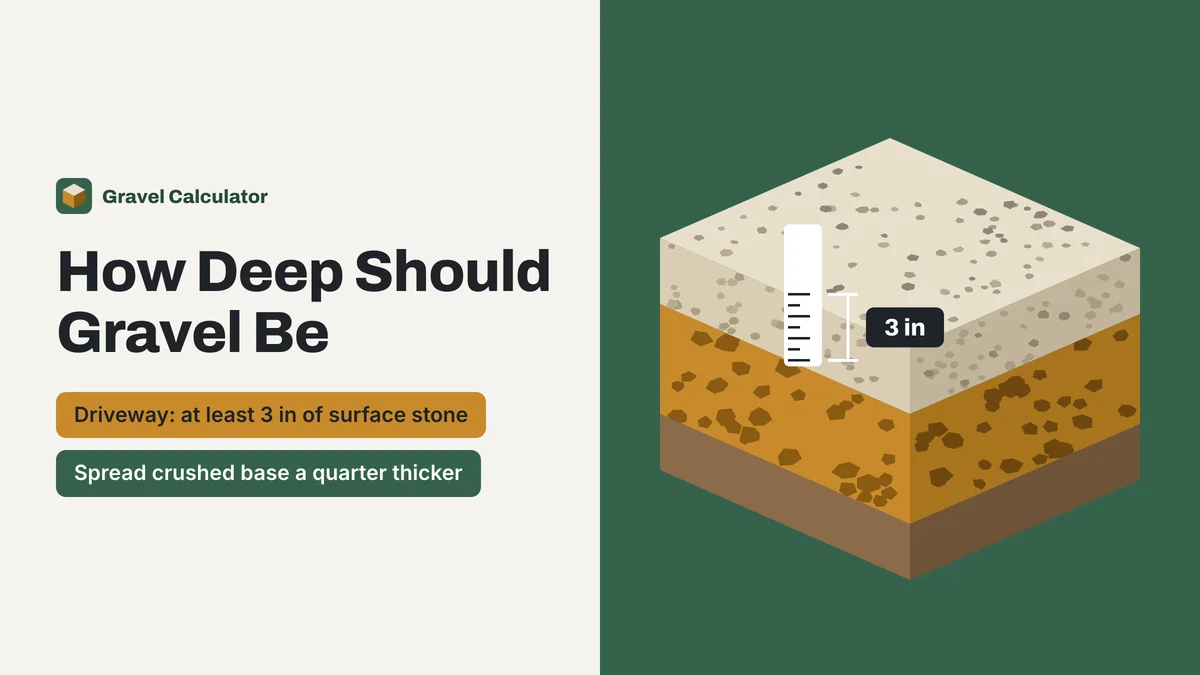
Table of Contents
How deep should gravel be for each job
Dig and build for the full build-up, not just the top layer. Surface stone only stays put when the layer under it is firm. The table splits each job into the stone you see and everything beneath it.

| Job | Top layer | Full build-up |
|---|---|---|
| Garden bed | at least 2 in (5 cm) of gravel | no base layer |
| Footpath (UK council spec) | 40 mm (1.6 in) | 140 mm (5.5 in), including 100 mm (3.9 in) of sub-base |
| Driveway (US) | at least 3 in (76 mm) | base in layers, sized to the traffic |
| Front drive (UK) | gravel or other permeable surfacing | 200 to 250 mm (7.9 to 9.8 in), including about 150 mm (5.9 in) of sub-base |
| Paver patio | pavers on no more than 1.5 in (38 mm) of sand | 4 in (102 mm) of gravel base, 5 in (127 mm) where winters are hard |
| Shed pad | the gravel is the pad | about 4 in (102 mm) of gravel or crushed rock, dug in |
| Concrete slab below grade | the slab | 4 in (102 mm) of stone passing a 2 in (51 mm) sieve |
| Foundation drain | 6 in (152 mm) over the pipe | 2 in (51 mm) under it, so 8 in of stone plus the pipe |
| Play area, falls up to 5 ft | 9 in (229 mm) of pea gravel after it settles | put in 12 in (305 mm) |
Once you know the depth, the gravel calculator turns it and your area into yards and tons. The paver industry's 4 in patio base suits well-drained soil. Iowa State's 5 in is written for cold winters, and the patio base depth for your soil and climate covers the choice.
The code rows are narrower than they look. The slab row is IRC Section R506.2, and the rules on when you can skip that base sit with gravel under a concrete slab. R405.1 is for drains along basement walls; a trench in the yard follows French drain gravel depths. The 4 in shed figure comes from maker instructions rather than a code, and shed and hot tub pad bases covers pad size and slope.
Soft ground and frost change the depth
Soft ground needs more stone, so test the soil before you settle on a number. The gov.uk check uses a 50 mm (2 in) square peg driven into the ground. If it slips past 150 mm easily, the soil may be too soft for a standard build and needs expert advice.
Frost depth varies by region, so ask your building department for the local figure before you dig footings or a slab base. For anything structural, that office has the final word on depth.
Gravel driveway layers from bottom to top
A driveway's depth is the base plus the surface, never one thick pour. Build at least two layers: a compacted base, then 3 in or more of surface stone with enough fines to bind.
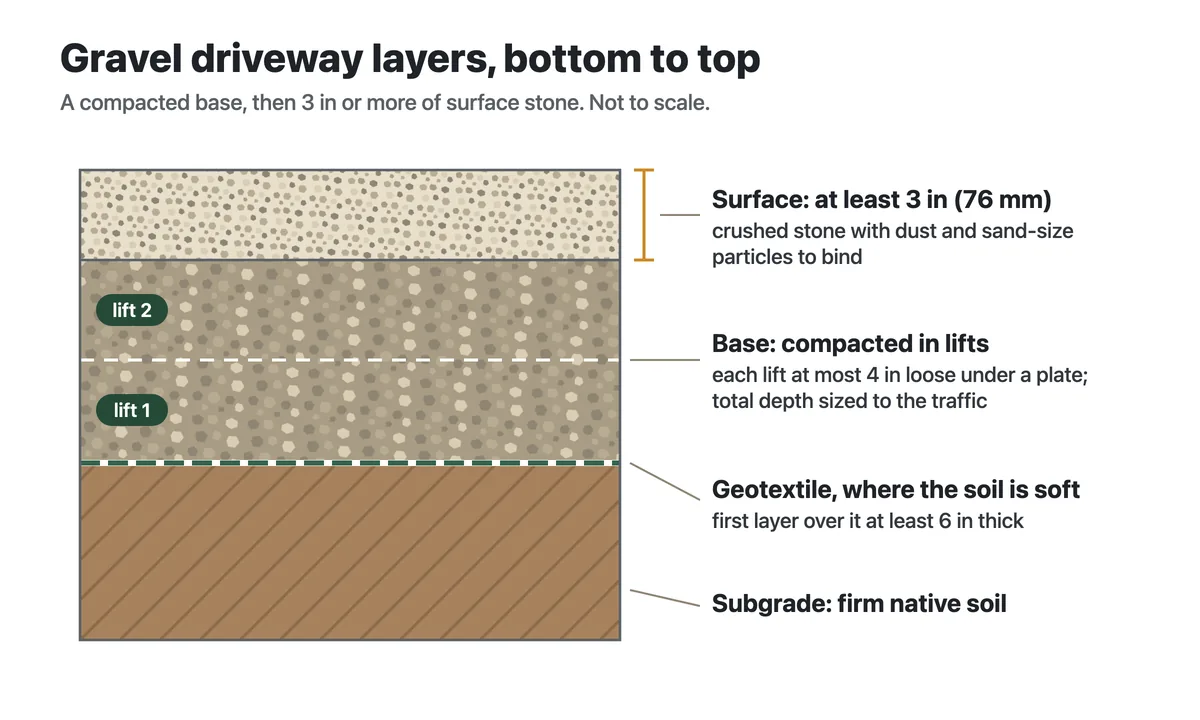
- Subgrade. Firm native soil.
- Geotextile, where the soil is soft. The first layer over it is at least 6 in thick.
- Base. Laid in lifts and compacted, each no more than 4 in loose under a plate (sizes in the lift table).
- Surface. At least 3 in of crushed stone that carries dust and sand-sized particles.
The 3 in surface figure comes from FHWA's gravel roads guide, which sets it so a grader has stone to reshape. It leaves base depth to the loads you expect, and the stone for each driveway layer changes from base to top.
What a UK front drive needs
In the UK, government advice on front gardens puts about 150 mm of packed stone over fabric, with 200 to 250 mm of build in all. That 150 mm starts out about 190 mm loose, too thick for one pass with a plate, so lay it in two layers of roughly 95 mm.
How deep should pea gravel be
Keep pea gravel thin everywhere except under play equipment. In a bed it is a light mulch. On a path or patio it is a loose top over a firm base, and under a swing or slide it becomes a deep cushion.
| Use | Pea gravel depth | What goes under it |
|---|---|---|
| Garden bed | 2 in (51 mm) | soil, or fabric if you use it |
| Path or patio | about 1.5 in (40 mm) | a packed crushed-stone base of about 4 in (100 mm) |
| Play area, falls up to 5 ft | 12 in (305 mm) put in, 9 in (229 mm) minimum | 3 to 6 in (76 to 152 mm) of drainage gravel on concrete or asphalt |
The 2 in bed figure is the RHS minimum for gravel mulch. Other rock in beds and borders is covered on gravel for garden beds. Deeper loose stone only gives your feet more to sink into. A gravel path gets most of its depth from the packed base, not the loose top.
Play areas are the one place to go deep. The CPSC Public Playground Safety Handbook rates 9 in of pea gravel for falls up to 5 ft and says never to go below 9 in. Loose fill packs down at least 25% with use, so you put in 12 in to keep 9 in. CPSC's own example uses wood chips, but the same arithmetic holds. Edge the area to hold the stone in, and mark the minimum fill level on a post so you can see when to top up.
Spread gravel thicker than the finished depth
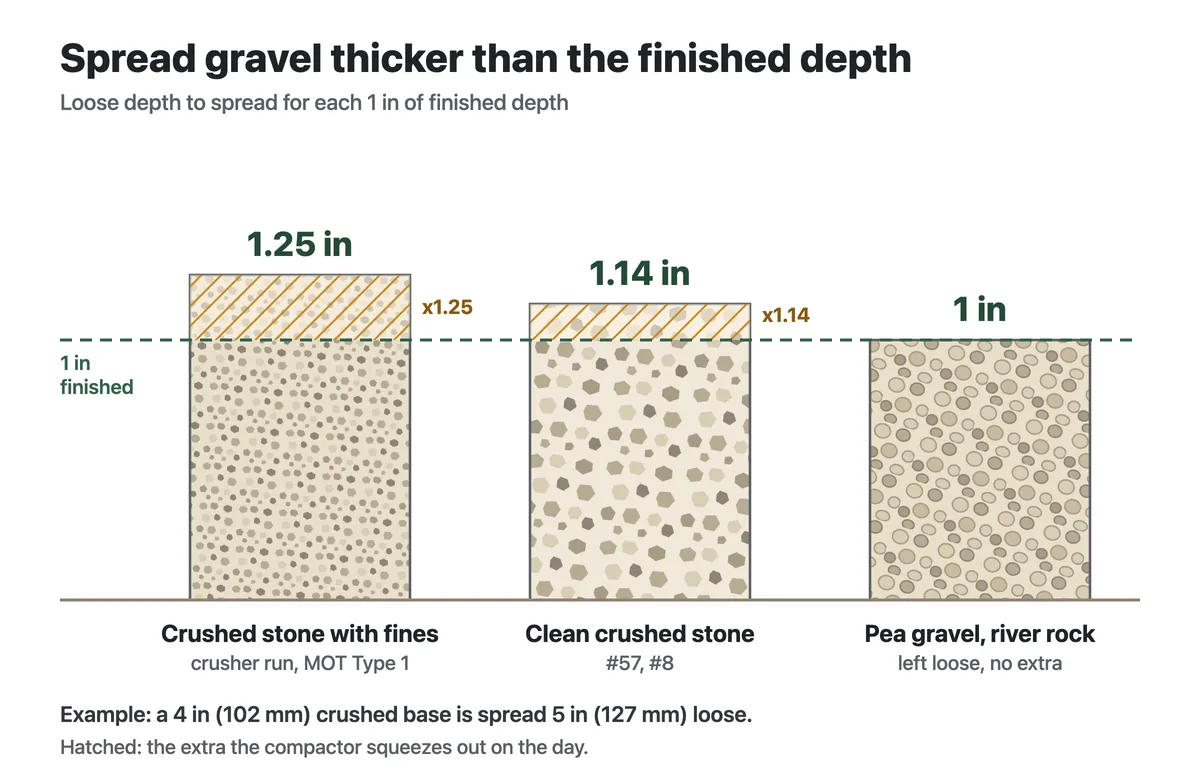
Spread crushed stone with fines a quarter thicker than you want it to end up. If you buy only the finished depth, you come up short: 4 in of loose base packs down to about 3.2 in. Clean stone shrinks less, and stone you never compact needs no extra at all.
| Stone | Loose depth per 1 in finished | Why |
|---|---|---|
| Crushed stone with fines (crusher run, MOT Type 1) | 1.25 in | loose and rolled weights sit 25 to 30% apart |
| Clean crushed stone (#57, #8) | 1.14 in | lab figure for tamped #57 |
| Pea gravel or river rock left loose | 1 in | not compacted; play areas are the exception, at 12 in put in for 9 in kept |
That extra quarter covers what the compactor squeezes out on the day. A drive keeps settling for years under rain and traffic, and FHWA puts a road's whole-life loss at 30% or more of the loose volume. Plan to top up the surface rather than piling on extra at the start.
Can crushed stone be compacted
Yes. Crushed stone with fines packs hardest: crusher run locks because its angular faces interlock and the dust fills the gaps. Clean #57 stone also compacts, but only until the pieces seat against each other, which is why it shrinks less and never sets hard. Rounded stone such as pea gravel shifts under load instead of locking.
How thick each compacted lift can be
A walk-behind plate packs at most 4 in of loose stone per lift, and a roller handles up to 8 in. Each finished lift must also be at least twice the size of the largest stone in it. A 2 in lift takes stone up to 1 in, and a 3 in lift takes stone up to 1.5 in. The gravel size chart gives the top size behind each stone number.

The table splits common base depths into lifts, using the 1.25 spread factor.
| Finished layer | Spread loose | With a plate compactor | With a roller |
|---|---|---|---|
| 4 in (102 mm) base | 5 in (127 mm) | two lifts of 2.5 in loose, each packs to 2 in | one lift |
| 5 in (127 mm) base | 6.25 in (159 mm) | two lifts of about 3.1 in loose, each packs to 2.5 in | one lift |
| 6 in (152 mm) base | 7.5 in (191 mm) | two lifts of 3.75 in loose, each packs to 3 in | one lift |
| 3 in (76 mm) surface | 3.75 in (95 mm) | one lift | one lift |
Check the top stone size before you pick a lift plan. If all the stone passes 1 in, any plate plan in the lift table works. Crusher run often runs up to 1.5 in, and then each lift has to finish at 3 in or more. So a 4 or 5 in crusher run base goes down in one lift under a roller. With 1.5 in stone, only a 6 in base splits into two plate lifts.
Depth mistakes that leave you short
Most depth problems come from the order or the compaction, not the stone.
| Mistake | What happens | Fix |
|---|---|---|
| Ordering base at its finished depth | 4 in of loose stone packs to about 3.2 in | order 1.25 times the finished depth |
| Compacting one thick layer | the bottom never packs | 4 in loose lifts with a plate, 8 in with a roller |
| Lift thinner than twice the largest stone | below the FHWA and council minimum | 1.5 in stone needs a 3 in lift |
| Pea gravel as a drive or shed base | the stone moves under load | crushed stone with fines below, pea gravel on top only |
| Play-area pea gravel at 6 in | below CPSC's 9 in minimum | put in 12 in |
| Loose stone with no edging | it drifts out and the layer thins | edge it and check depth each season |
FAQ
Does gravel depth include the base layer?
Not always, so check what a quoted figure covers. A driveway's 3 in is the surface alone. The gov.uk 200 to 250 mm for a UK drive is the full build, including about 150 mm of sub-base. Dig for the full build-up and buy each layer separately.
How often should you top up gravel?
Check depth whenever the surface looks thin, and at least once a season. Play areas need it most, because the cushion only works at full depth. Drives lose surface stone to rain and traffic for years, so adding stone now and then is normal upkeep.
Can gravel be too deep?
Yes. Loose stone spread thicker than your compactor can pack leaves a soft layer at the bottom, so stick to 4 in of loose stone per plate lift. Under a slab, the building code also caps how deep gravel fill can go unless the building department approves more.
Conclusion
Dig for the full build-up in the job table. Check the largest stone in your base before you pick a lift plan, since 1.5 in stone rules out thin plate lifts. Order every layer at its loose depth, not the finished one. To turn that depth into tons, check how far a ton of gravel goes when it is spread or rolled.