Gravel for French Drain Trenches
Gravel for French drain trenches should be clean, washed stone with no dust or sand in it, ordered by number as #57 or #67. Around a 4 in perforated pipe, #67 is the closer fit. Bed the pipe on at least 2 in of stone and cover it with 6 in more. A 75 ft trench, 12 in wide and 20 in deep, takes about 7.02 tons (6.37 t), with tamping and 10% spare included.
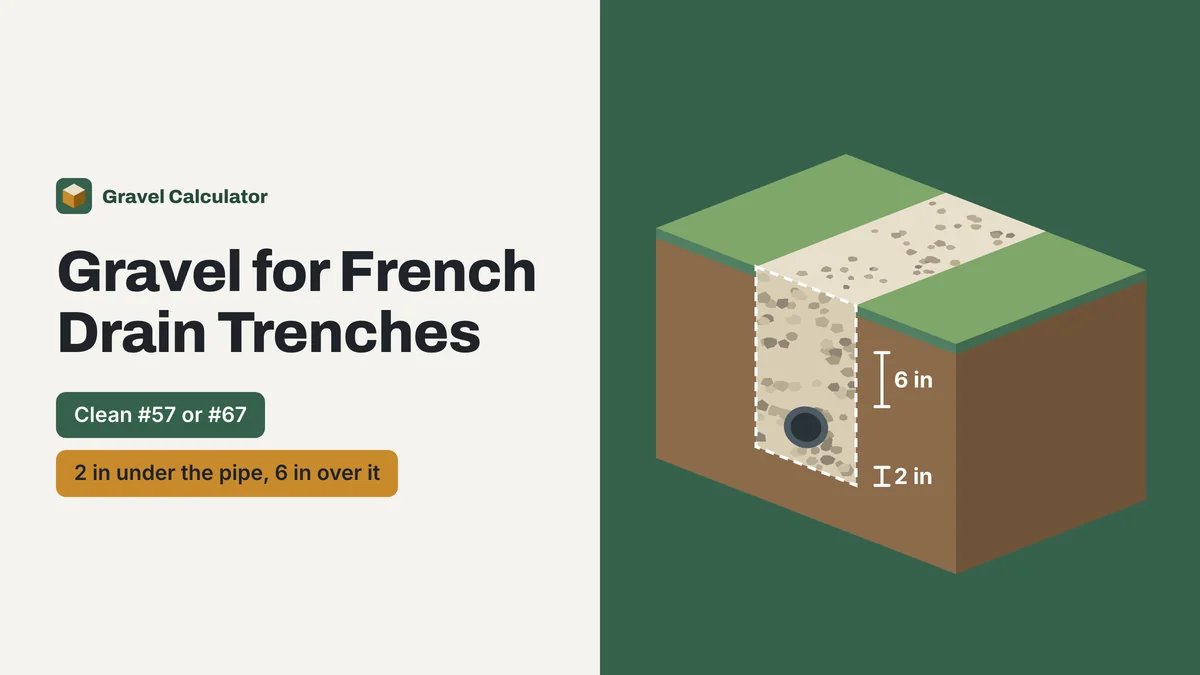
Table of Contents
What size gravel for French drain pipe
Order #67 for a 4 in pipe and #57 for a 6 in pipe or larger. Both are clean stones with almost nothing fine enough to clog the pipe, and the gravel size chart shows how those numbers map to inches. Pick by the pipe you are laying, then let the gravel calculator turn your trench into tons.
| Your pipe | Stone to order | Why it suits |
|---|---|---|
| 4 in corrugated, slotted | #67, or #57 | at least 90% of either stays on a 4.75 mm screen, wider than the 0.120 in (3.05 mm) slots |
| 4 in PVC with 1/2 in holes | #67 or #57, holes down, pipe or stone wrapped in fabric | part of any load is smaller than the holes, so the fabric does the holding |
| 6 in pipe or larger | #57 | farm drain rules allow bedding stone up to 1 1/2 in (38 mm) under pipe this size |
The building code (IRC R405.1) asks for washed gravel or crushed rock at least one sieve size larger than the pipe's openings. Indiana beds its 4 in road underdrains in stone that all passes 3/4 in. The USDA farm drain standard keeps pipe under 6 in off stones bigger than 3/4 in. Since #57 runs up to about 1 in, the smaller #67 fits both rules better on a 4 in pipe.
Clean matters more than the exact number. The farm drain standard lets no more than 5% of a drain's stone pass the No. 200 screen, which is the dust. Memphis accepts five street underdrain gradings, from #57 down to finer clean stone, and every one is crushed stone or washed gravel.
Match the stone to the pipe's holes
ADS slotted 4 in pipe has slots no wider than 0.120 in, which is finer than the 4.75 mm screen (No. 4). Read the code's "one sieve size larger" strictly, and your stone should stay on that No. 4 screen. At least 90% of #57 or #67 does.
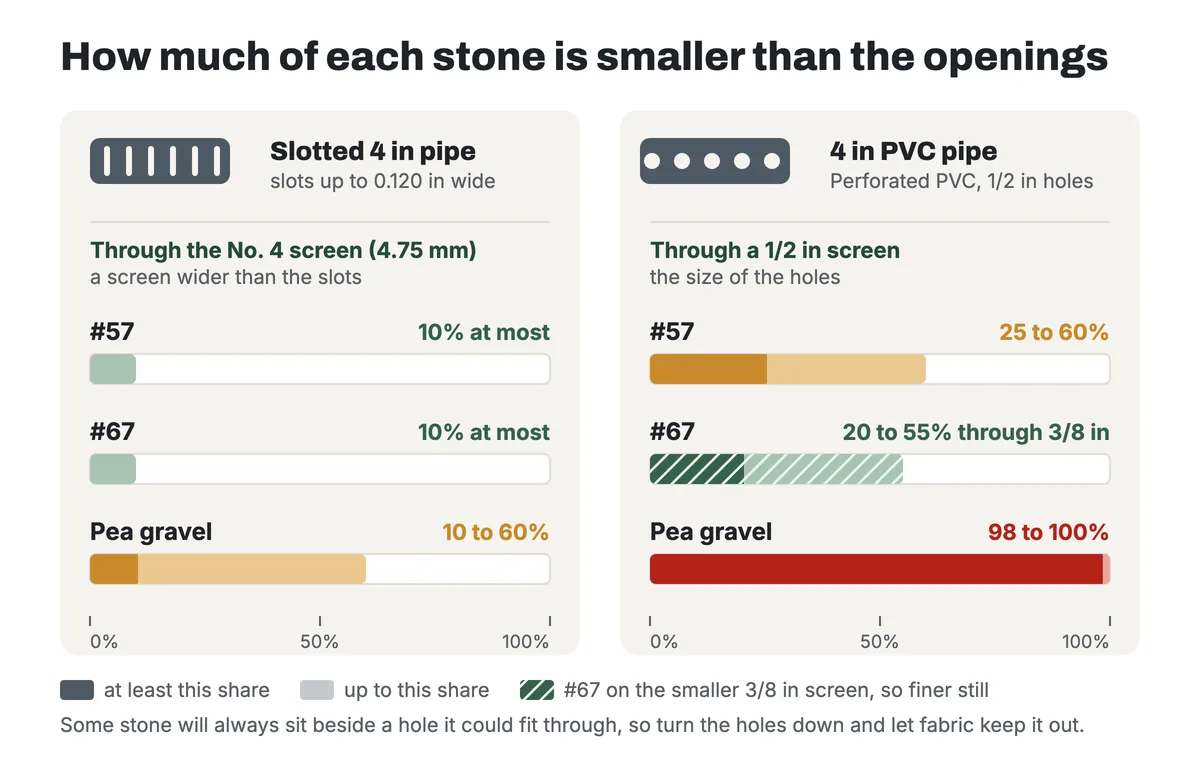
Perforated PVC is different. Charlotte Pipe's 4 in pipe made to ASTM D2729 has two rows of 1/2 in holes. Between 25 and 60% of #57 passes a 1/2 in screen, and #67 is finer still, with 20 to 55% passing 3/8 in. Some stone will always sit beside a hole it could fit through, so turn the holes down and let filter fabric keep it out.
Can you use pea gravel for French drain backfill
Yes, around slotted pipe inside a fabric sock, but not next to 1/2 in PVC holes or anywhere wheels cross. The IRC accepts washed gravel, and Indiana's pea gravel grading lets no more than 5% through the fine No. 30 screen, so it is clean enough. Its size is the catch. Between 98 and 100% of it passes 1/2 in, so it can wash straight into D2729 holes. Between 10 and 60% also passes the No. 4 screen that the strict reading of the code asks drain stone to stay on.
Pea gravel's round shape lets it roll instead of locking, so where a drain crosses a driveway, backfill with crushed driveway stone that holds firm under tires.
How to place French drain gravel around the pipe
Dig the trench 12 in wide and line it with a filter fabric suited to your soil, as set out below. Spread 2 in of stone on the floor, lay the pipe holes down, and bury it under at least 6 in more. The ADS single-wall pipe specification puts a 4 in corrugated pipe at 4.6 in across the outside. Bed, pipe and cover make a stone column 12.6 in (320 mm) tall.
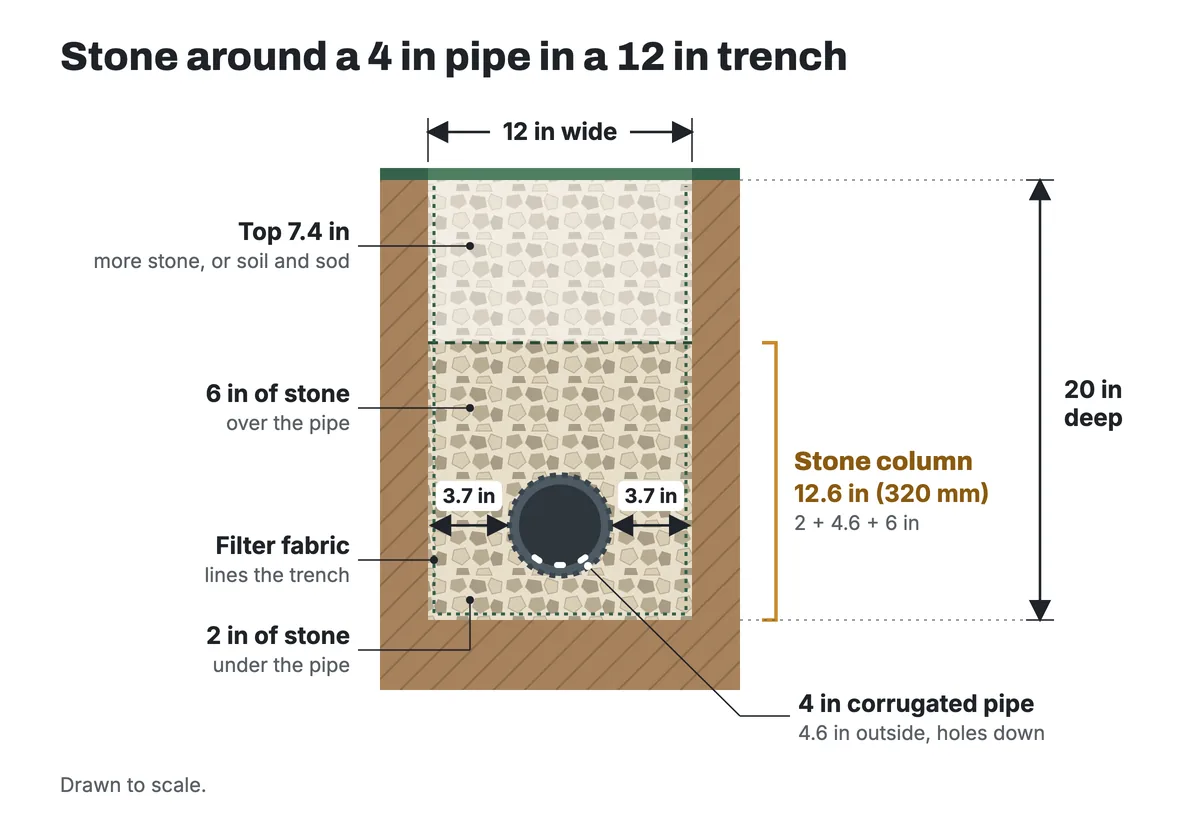
Why 12 in: around a 4.6 in pipe, that leaves 3.7 in of stone on each side, enough for both side rules below.
| Rule | Stone each side of the pipe | Narrowest trench for a 4.6 in pipe | 12 in trench |
|---|---|---|---|
| Indiana DOT 718, road underdrain | 2 in (51 mm) | 8.6 in (218 mm) | clears it |
| NRCS 606 farm drain, stone as the filter | 3 in (76 mm) | 10.6 in (269 mm) | clears it |
Memphis street underdrains default wider, 6 in a side unless the plans say otherwise, so check whether your town has a standard of its own.
Filter fabric around the stone or pipe
Use filter fabric unless the pipe maker says you do not need it. IRC R405.1 wants a filter membrane either wrapped around the perforated pipe or laid over the stone. The farm drain standard says a filter is needed in clays that break apart in water and in fine silts and sands.
In soil that is more than 40% silt, fabric can clog: Iowa's farm drain standard leaves it out there, and Vermont's asks for one that will not clog. Where two rolls meet, overlap the ends at least 1 ft with the upstream piece on top. Lap the fabric at least 10 in where it closes over the stone.
Bed, cover and close
IRC R405.1 sets the 2 in and 6 in, and road underdrain specs from Indiana to Memphis lay the pipe holes down. Memphis allows tamped layers up to 6 in, but a plate compactor firms at most 4 in of loose stone at a time. Spread it in thin layers and tamp each one. Fold the fabric shut over the top and finish with soil and sod.
How much gravel for French drain trenches
A French drain order is the trench volume minus the space the pipe takes, plus 14% for tamping and about 10% spare. A 75 ft trench, 12 x 20 in, around a 4 in corrugated pipe holds 4.31 cu yd of tamped #57, and the order is 7.02 tons. The site plans #67 at the same weight and tamping factor as #57, so the figures hold for either stone.

- Trench: 12 x 20 in is 240 sq in, or 1.667 sq ft. Times 75 ft, that is 125.0 cu ft.
- Pipe: a 4.6 in outside diameter gives 3.1416 x 2.3 x 2.3 = 16.62 sq in. Over 75 ft, the pipe fills 8.66 cu ft.
- Stone in the trench: 125.0 minus 8.66 leaves 116.34 cu ft, or 4.309 cu yd.
- Tamping: 4.309 x 1.14 = 4.912 cu yd to buy loose.
- Weight: 4.912 x 1.30 = 6.39 tons. Add 10% and order 7.02 tons.
Step 4 uses the x1.14 lab factor for tamped #57. The 1.30 is the site default for a loose yard of #57, and step 5 adds about 10% spare. This matches the gravel calculator set to this trench once you pick the 4 in corrugated pipe, on its default setting for compacted depth. In metric, the trench holds 3.29 m3 of stone once tamped.
Forget to take out the pipe and you buy 7.55 tons, 0.53 tons too many. Stop the stone at the 12.6 in IRC column, with soil in the last 7.4 in, and the order falls to 4.23 tons.
Gravel per 10 ft of trench
Each row is for 10 ft (3.05 m) of trench. Multiply by your length in feet divided by 10, then add 10%. Rows use #57 at 1.30 tons per yard, with a 4.6 in pipe taken out and 14% added for tamping.
| Trench, wide x deep | cu yd | tons | m3 | t |
|---|---|---|---|---|
| 12 x 18 in | 0.58 | 0.76 | 0.45 | 0.69 |
| 12 x 20 in | 0.65 | 0.85 | 0.50 | 0.77 |
| 12 x 24 in | 0.80 | 1.03 | 0.61 | 0.94 |
| 18 x 24 in | 1.22 | 1.58 | 0.93 | 1.44 |
| 18 x 36 in | 1.85 | 2.41 | 1.42 | 2.18 |
Gravel for drainage around a house
Gravel can only carry off water that the ground already sheds away from the walls, so fix the grade before you add any stone near the house. Under IRC 2021 Chapter 4, section R401.3, the lot must fall at least 6 in within the first 10 ft out from the foundation. That 5% fall is for the ground surface, not for a drain pipe.
Where the code calls for a foundation drain, R405.1 runs its stone at least 1 ft past the outer edge of the footing and 6 in above the footing's top. A decorative stone strip along the wall is gravel used as bed mulch, not that footing drain. If a basement wall or crawl space is already wet, have a contractor or the building department look before you dig.
French drain gravel mistakes and fixes
Most failed French drains have dusty stone around the pipe, a trench too narrow for 2 in of stone a side, or no filter in silty soil. Each row names the mistake, the rule it breaks and the fix.

| Mistake | What goes wrong | Fix |
|---|---|---|
| Crusher run or other stone with dust | VDOT's 21A grading lets 6 to 12% pass No. 200, over the 5% farm drain cap | clean #57 or #67 |
| Crushed concrete around the pipe | VDOT bars it from perforated pipe backfill and from contact with drainage fabric | natural crushed stone or washed gravel |
| A 6 in trench for a 4 in pipe | 0.7 in of stone a side, where Indiana wants 2 in | dig 12 in wide |
| No filter in silt or fine sand | the farm drain standard says these soils need a filter | wrap the pipe or line the trench |
| Rounded stone where cars cross | it shifts under wheels, and ADS wants 1 ft (0.3 m) of cover over pipe in traffic | crushed stone and 1 ft of cover |
FAQ
Can you make a French drain with only gravel?
Yes. A stone-filled trench with no pipe is an infiltration trench: water soaks into the ground instead of running to an outlet. EPA wants soil that takes in 0.5 to 3 in an hour and a trench bottom at least 4 ft above the seasonal high water table. Clogging is the most common problem it lists.
How deep should a French drain trench be?
Deep enough to reach the wet soil you want to drain, and no less than the 16 in Memphis sets for underdrains. The 12.6 in stone column around a 4 in pipe fits in a 20 in trench with room for soil and sod. Iowa's NRCS farm field drains sit far deeper, under at least 2.4 ft of cover.
What size river rock for a French drain?
Washed river gravel works if it meets a #57 or #67 grading, about 1 in down to 3/16 in. Larger landscape river rock is not a graded drain stone, so ask the yard for the number.
Is crushed stone the same as drainage rock?
"Drainage rock" is a yard's sales name, not a grade. A drain needs clean crushed stone or washed gravel with almost no fines, so ask for the size number, such as #57 or #67. Crusher run is crushed stone too, but it is sold with its dust left in, which is exactly what a drain stone must not have.
Conclusion
Dig the trench 12 in wide before you order, since a narrower cut leaves too little stone beside a 4 in pipe. Work the order from the trench volume with the pipe taken out, then add 14% for tamping and 10% spare. In silt or fine sand, buy filter fabric with the stone to wrap the pipe or line the trench. If the yard offers washed gravel in place of crushed stone, either works once it is clean, and types of gravel explains how the two differ.