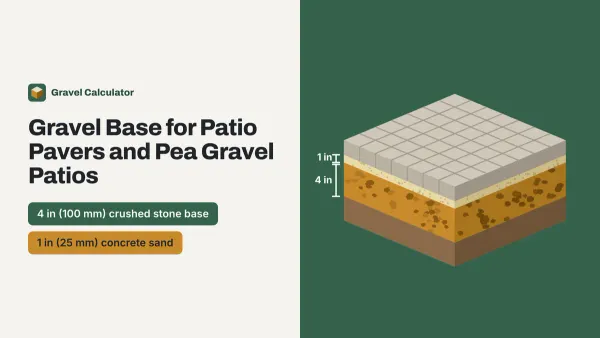
Best Gravel for Driveway Base and Surface
The best gravel for driveway use is two crushed stones, not one. Lay a dense-graded crushed base such as crusher run, then top it with at least 3 in of crushed surface gravel whose fines bind into a hard crust. Keep rounded pea gravel and clean #57 off the driving surface, since neither forms a crust. How deep each driveway layer goes depends on your soil and traffic.
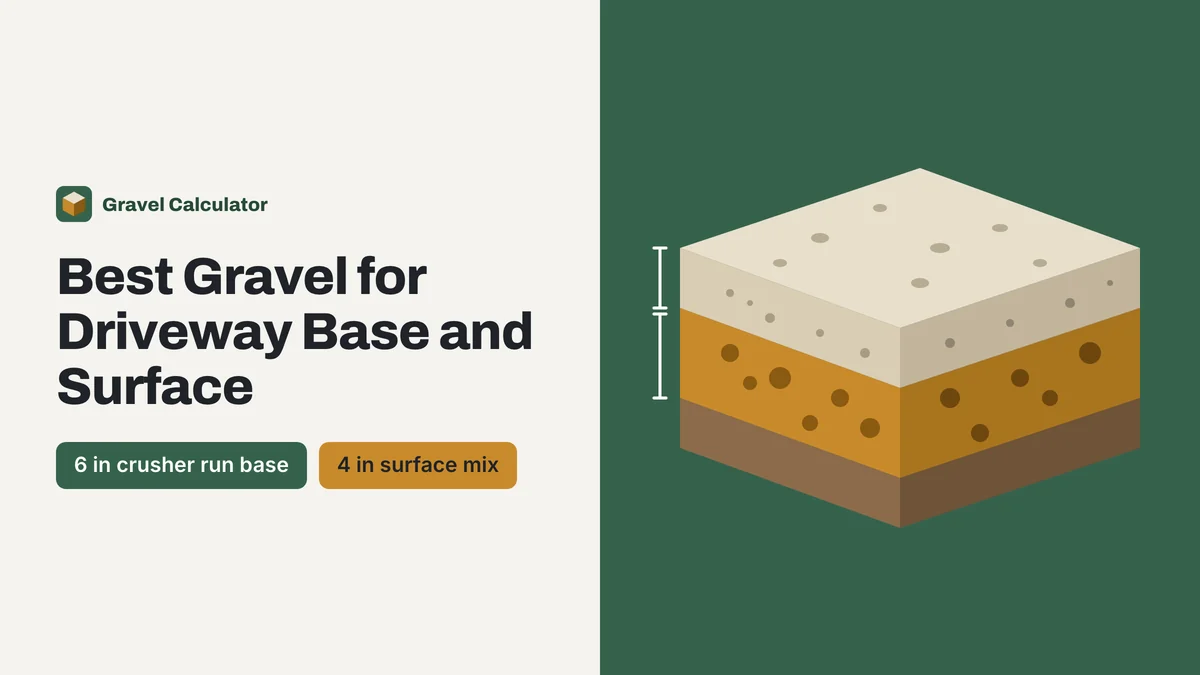
Table of Contents
- Best gravel for driveway base and top
- Types of driveway gravel compared
- What a South Dakota test road proved
- Best crushed stone for driveway tops
- Gravel size for driveway tops and bases
- Can pea gravel be used for a driveway?
- Slopes, soft soil and heavy loads
- How much crown a gravel driveway needs
- UK gravel drives and planning permission
- Ordering base and top for a 48 ft drive
- FAQ
- Conclusion
Best gravel for driveway base and top
No single gravel does both jobs well. FHWA's gravel roads guide is blunt about it: a gravel suits the base or the surface, never both.
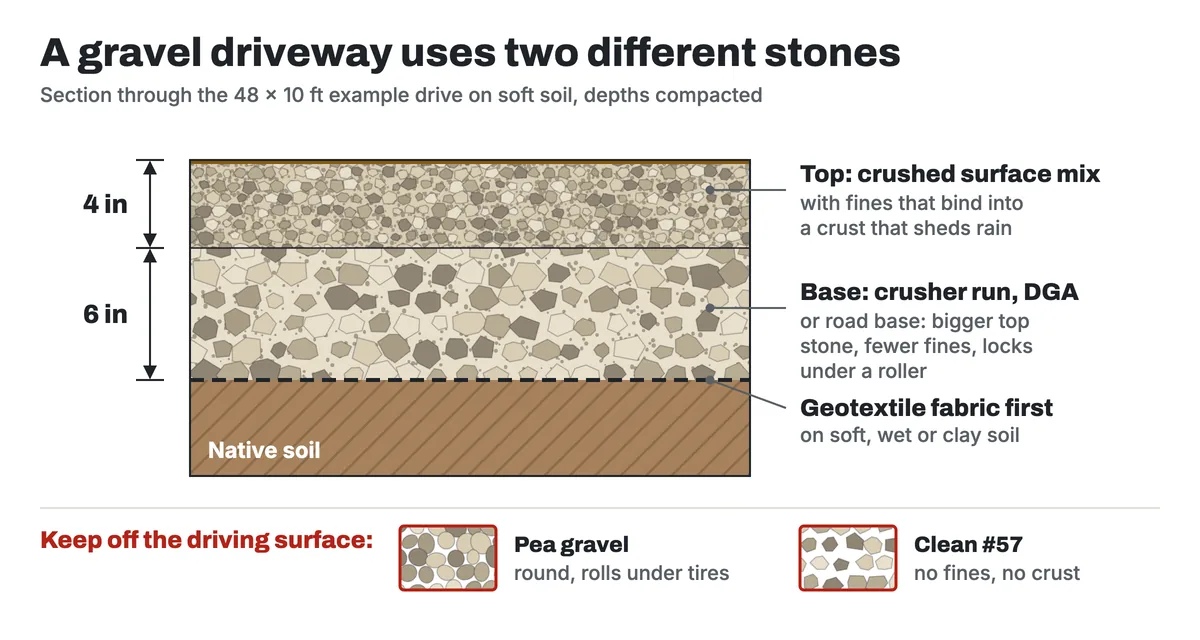
The base is dense-graded crushed stone, sold as crusher run, DGA or road base. It has a bigger top stone and fewer fines than the surface, and those fines are low-clay rock dust. South Dakota's base spec allows a plasticity index (PI, a lab measure of how clay-like the fines are) of only 0 to 6. Under a roller, the dust fills the gaps between angular stones and the layer locks.
The top needs more fines, and fines that bind. FHWA counts as fines every grain that passes a No. 200 sieve, smaller than 0.075 mm. They glue the bigger stones into a crust that sheds rain. Put base stone on top instead and FHWA expects a rough surface that is hard to blade smooth.
Clean stone has a narrower role. #57 stone drains fast but never locks, so it belongs in a permeable base that water must pass through, not under your tires.
Some contractors build three layers instead: large base stone such as #3, about 2 to 1 in, then a layer of #57, then a fines-rich top. That deeper build suits soft or wet ground and drives that carry heavy trucks, where the base has to be thicker and drain freely. On firm ground under cars, two packed layers do the job with one less delivery to spread and roll. Once the two stones are chosen, the gravel calculator turns your drive's size and layer depths into yards and tons.
Types of driveway gravel compared
Crushed stone with fines makes the best driveway top, and clean or rounded stone belongs below it or beside the drive. The table sorts the stones yards sell by the layer each one can hold.
| Gravel | What it is | Pros | Cons | Layer |
|---|---|---|---|---|
| Crusher run | angular crushed stone mixed with its own dust | packs hard and locks | a base grade left on top drives rough and is hard to blade smooth | base, or top in a surface grade |
| #57 stone | clean crushed stone, about 1 in down to 3/16 in (25 to 4.75 mm) | drains fast | no fines, so it never forms a crust | base, where water must pass through |
| #411 | crushed stone with fines; Ohio DOT's Item 411 runs from 1 1/2 in (37.5 mm) to dust, 3 to 15% fines | binds into a firm surface | Ohio's limits are wide, so ask the yard for its test sheet | top or base |
| Pea gravel | round natural stone, mostly under 3/8 in (9.5 mm) | drains, looks neat on a flat drive | rolls under tires | neither, or a thin loose top over a packed base |
| River rock | rounded stone, bigger than pea gravel | drains well | shifts under tires instead of locking | neither; edging and drainage strips |
| Decomposed granite (DG) | weathered granite that crumbles to small grains | packs firm for paths | not the crushed, fractured stone driveway specs call for | neither |
| Crushed concrete | recycled concrete, broken and graded | UK Type 1 sub-base allows it; FHWA reports acceptable results mixed with recycled asphalt | not allowed around perforated drain pipe in Virginia's spec | base |
| Limestone or limestone screenings | the most common US crushed rock, sold graded with fines or as screenings under 3/8 in | graded limestone works if it is hard enough | screenings alone have no stone near the 3/4 to 1 in top size surface specs use | graded: top or base; screenings: neither |
| Marble chips | crushed marble, a calcite or dolomite rock | decorative look | calcite rates 3 on the Mohs hardness scale against quartz at 7, so chips scratch easily | neither; borders only |
Rock type matters less than grading. For a limestone drive that sees trucks, ask for an LA abrasion result under the 45% limit in Pennsylvania's surface spec.
What a South Dakota test road proved
Binding fines are what keep surface stone in place.

A 1 mile (1.6 km) test road in eastern South Dakota compared three surface gravels under about 100 vehicles a day, 12% of them heavy trucks. A year after construction, crews weighed the loose stone left on each section.
| Surface gravel on the test mile | Loose stone after 1 year (US tons) | Metric |
|---|---|---|
| Top size controlled only, all under 1 in | 405 tons | 367 t |
| Met the state spec, with near-minimum fines | 211 tons | 191 t |
| Modified mix, maximum fines and PI 7 | 71 tons | 64 t |
The high-fines mix left less than a fifth of the loose stone of the top-size-only gravel, and about a third of the spec gravel's. Over three years of watching, it also needed up to 75% less blading and never washboarded. The top-size-only section grew so hard to maintain that it had to be regraveled.
A home drive sees far fewer trucks, but the lesson holds: pick the top mix with the most binding fines your climate allows.
Best crushed stone for driveway tops
Ask for a crushed surface mix that keeps its fines. A DOT surface gravel works, as does Pennsylvania's Driving Surface Aggregate (DSA) or a crusher run driveway top from a quarry that can show its grading. Avoid washed stone and sandy fill. FHWA notes that broken stone beds into a road surface far better than rounded stone, and that sand-rich fill gravel stays loose.
The two state specs agree on fines and disagree on clay. South Dakota's surface gravel wants a PI of 4 to 12, usually from natural clay. Pennsylvania's DSA caps PI at 4 and bans adding clay or silt soil, so its fines must come from crushed rock.
So buy the mix graded at the quarry, and ask for its test sheet. The FHWA Gravel Roads Construction and Maintenance Guide notes that many suppliers keep gradation and PI results for their stockpiles.
Gravel size for driveway tops and bases
Choose a 3/4 in top stone for the surface in a dry climate, and up to 1 in where rain is heavier. Pennsylvania's DSA allows up to 1 1/2 in. Every one of these mixes grades all the way down to dust.
Figures are the share by weight passing each sieve. The two South Dakota columns come from FHWA's Table 1; the DSA column comes from the Pennsylvania Driving Surface Aggregate spec.
| Sieve (US) | Sieve (mm) | SD surface, % passing | SD base, % passing | PA DSA surface, % passing |
|---|---|---|---|---|
| 1 1/2 in | 37.5 | 100 | ||
| 1 in | 25 | 100 | ||
| 3/4 in | 19 | 100 | 80 to 100 | 65 to 97 |
| 1/2 in | 12.5 | 68 to 91 | ||
| No. 4 | 4.75 | 50 to 78 | 46 to 70 | 30 to 65 |
| No. 8 | 2.36 | 37 to 67 | 34 to 54 | |
| No. 16 | 1.18 | 15 to 32 | ||
| No. 40 | 0.425 | 13 to 35 | 13 to 35 | |
| No. 200 (fines) | 0.075 | 4 to 15 | 3 to 12 | 11 to 15 |
| Plasticity index | 4 to 12 | 0 to 6 | 4 max |
A blank cell means that spec sets no limit at that sieve.
Check the bottom two rows on any quote. Surface mixes keep about 3 to 15% fines; clean stone keeps almost none. DSA also requires hard stone, with an LA abrasion loss under 45%. If the sieve numbers are new to you, the gravel size chart maps them to stone sizes.
Rainfall shifts the target. FHWA's sample surface spec splits at 20 in (508 mm) of rain a year:
| Rain per year | Top stone | Fines passing No. 200 | PI |
|---|---|---|---|
| Over 20 in | 1 in | 3 to 12% | 3 to 10 |
| Under 20 in | 3/4 in | 8 to 15% | 8 to 15 |
Wetter places get fewer, less clay-like fines. Drier places get more, so the crust holds without rain to wet it.
Can pea gravel be used for a driveway?
Only as a thin loose top on a flat drive, laid over a compacted crushed base. It should never be the layer that carries the car. Pea gravel is round and has almost no fines, so it rolls under tires instead of locking.
UK government guidance says loose gravel drives scatter or form waves, and do not suit steep drives or wheelchairs. A strip of block paving or asphalt across the mouth of the drive cuts the stone carried into the street. Where a drive meets a public gravel road, FHWA says to finish the entrance level with the road edge, so built-up stone does not change the road's shape.
Slopes, soft soil and heavy loads
On a slope, use the crushed surface mix with no loose stone on top. Other site problems have their own fixes.
| Situation | What to ask for |
|---|---|
| Slope steeper than 1 in 20 (5%) | crushed surface mix, no loose top |
| Soft, wet or clay soil | geotextile fabric before any stone |
| Trucks, RVs, delivery vans | hard crushed stone, fines near the top of the range |
| Wheelchair or pushchair use | a bound surface, not loose gravel |
On a 48 ft drive, 1 in 20 is a 2.4 ft rise from end to end. For hard frost, very heavy loads or water running toward the house, have a local contractor size the base. A poured drive needs a gravel base under a concrete slab.
How much crown a gravel driveway needs
Crown the surface 4 to 6%, which is 1/2 to 3/4 in of fall per foot from the center line. Pennsylvania's DSA sets that range. FHWA recommends about 4% and never more than 6%, because a steeper crown slides cars toward the edge.
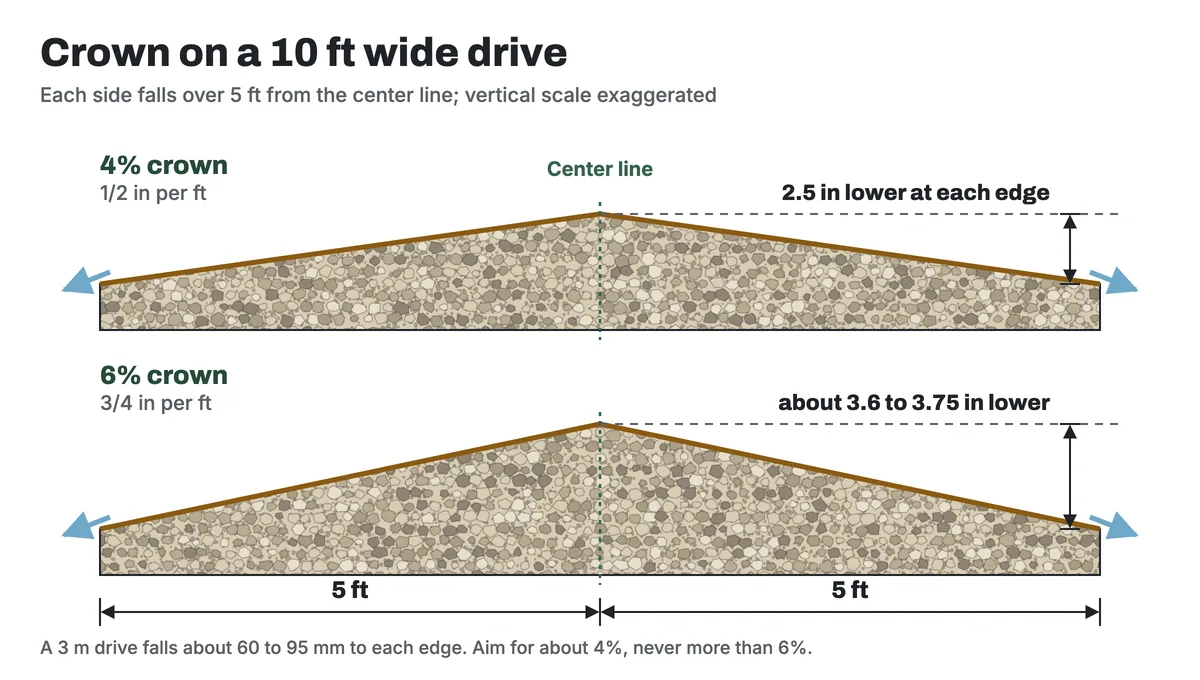
On a 10 ft wide drive crowned in the middle, each side falls over 5 ft. At 4% that is 5 x 1/2 in, or 2.5 in at each edge. At 6%, or 3/4 in per foot, it is about 3.6 to 3.75 in. A 3 m drive falls about 60 to 95 mm to each edge.
UK gravel drives and planning permission
A gravel front drive in the UK needs no planning permission at any size, so long as the stone beneath it drains as well. Lay the gravel over an open-graded sub-base such as Type 3 or 4/20, not MOT Type 1, whose sand and silt stop water passing through.
Under the UK government's front garden rules, gravel counts as a permeable surface. A hard surface needs no permission either if its rainwater runs to a lawn or border. Above 5 m2 (53.8 sq ft), a hard surface that drains nowhere permeable does need permission.
The same guidance warns that drives steeper than 1 in 20 may not suit permeable surfacing. On clay, the drive may need a drain connection or a pipe laid under the stone, much like gravel for drainage trenches.
Ordering base and top for a 48 ft drive
A two-layer drive arrives as two loads on two tickets. Take a 48 x 10 ft single-car drive on soft soil, with fabric, 6 in of compacted base and 4 in of compacted top.

| Layer | Stone | Finished | To order, with 10% waste | Weight | Metric to order, weight |
|---|---|---|---|---|---|
| Base, 6 in | crusher run or road base | 8.89 cu yd | 12.2 cu yd | 17.5 tons | 9.3 m3, 15.9 t |
| Top, 4 in | crushed surface mix with fines | 5.93 cu yd | 8.1 cu yd | 11.7 tons | 6.2 m3, 10.6 t |
| Both | 14.8 cu yd | 20.4 cu yd | 29.1 tons | 15.6 m3, 26.4 t |
The order column adds about a quarter for what the roller packs down, then the calculator's 10% waste allowance. Weights use Washington DOT's 1.43 tons per loose cubic yard for crushed surfacing, applied to both layers. Spread and roll the base before the top arrives, so the top goes onto a firm, crowned layer.
FAQ
How do I keep driveway gravel from moving?
Top the drive with crushed stone that carries binding fines, since broken stone beds in where rounded stone rolls. Keep a 4 to 6% crown so rain runs off instead of cutting ruts. Where the drive meets the street, a short paved apron holds back stone that tires would carry out.
Do I need fabric under a gravel driveway?
Yes, on soft or wet silt and clay. FHWA notes that geotextile stops those fine soils pumping up into new stone, and it wants the first layer over fabric at least 6 in thick. To test, drive a 2 in square peg: if it slides past 6 in with little effort, treat the soil as soft.
Is a gravel driveway considered impervious?
In the UK, no. Government guidance counts gravel as permeable. In the US the answer varies by place, so ask your city or county permit office how it classes a gravel drive.
Conclusion
Book the two loads as separate deliveries, so the base is spread, rolled and crowned before the surface mix is tipped on it. Measure the slope first: a drive steeper than 1 in 20 gets the crushed surface mix with no loose stone on top. If the yard's stone names do not match the ones here, types of gravel sorts crushed stone from rounded gravel so you can ask for the right one.