Gravel Under Concrete Slab Floors
Plan on 4 in (102 mm) of compacted gravel under concrete slab floors. Use #57 or #67, both clean stone, for that base. The IRC requires it when the slab sits below grade, as in a basement, unless the soil is well-drained sand or gravel. For a garage or patio slab on grade, your building department decides, and crusher run packs into a firm, flat bed there.
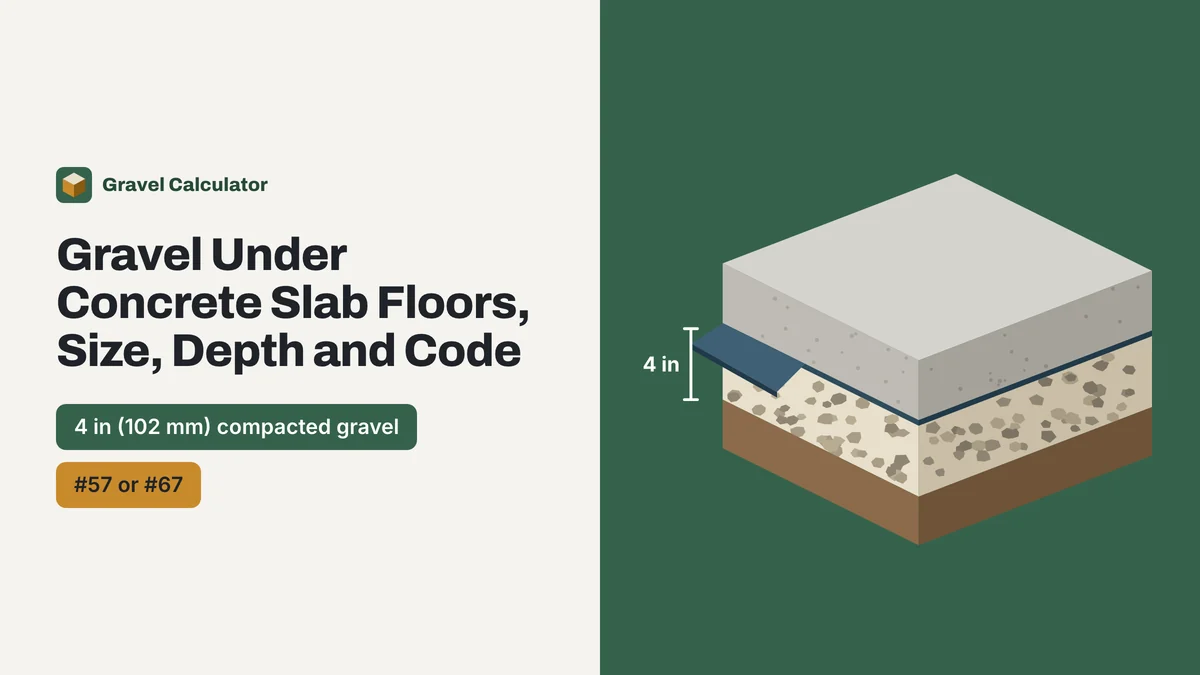
Table of Contents
Why gravel under concrete and when code requires it
Put stone under every indoor slab, even where the code is silent. NRMCA advises a vapor retarder under every interior floor slab, laid on a smooth, compacted base that gives the concrete even support. On wet ground, a coarse stone layer also stops water wicking up into the floor, and EPA uses one as the gas-permeable layer under radon-resistant slabs.

The code itself is narrower. IRC R506.2.2 makes the 4 in base mandatory only when the slab is below grade. Even then it can be skipped on Group I soils, which the IRC soil table lists as GW, GP, SW, SP, GM and SM. In plain terms, those are gravels and sands that drain well, some with a little silt. The section says nothing about an on-grade garage or patio, so the building department makes that call.
Before any stone goes in, R506.2 has you strip all vegetation, topsoil and debris inside the foundation walls. Then enter the slab's length, width and base depth in the gravel calculator for cubic yards and tons.
Gravel for an outdoor concrete pad is simpler to choose, since NRMCA says exterior slabs on grade generally need no vapor retarder. A pad with no concrete on it is a different build, covered in gravel pads for sheds and hot tubs.
How deep the fill under a slab can go
IRC R506.2.1 caps fill under a slab at 24 in (610 mm) of clean sand or gravel, or 8 in of earth, unless the building department approves more. The fill must be natural and nonorganic, must not swell when wet, and must be compacted for even support.
Some states move the limit, and Oklahoma's adoption of the 2018 IRC allows 48 in of clean sand or gravel. England's Approved Document C sets almost the same cap as the IRC, 600 mm of hardcore.
Water pressing on below-grade walls is a job for stone around a foundation drain outside the walls, not for the slab base.
What size gravel under a concrete slab meets code
For a below-grade base, order #57 or #67. Both pass the 2 in (51 mm) sieve named in R506.2.2 with room to spare, and both are clean, the code's second test.
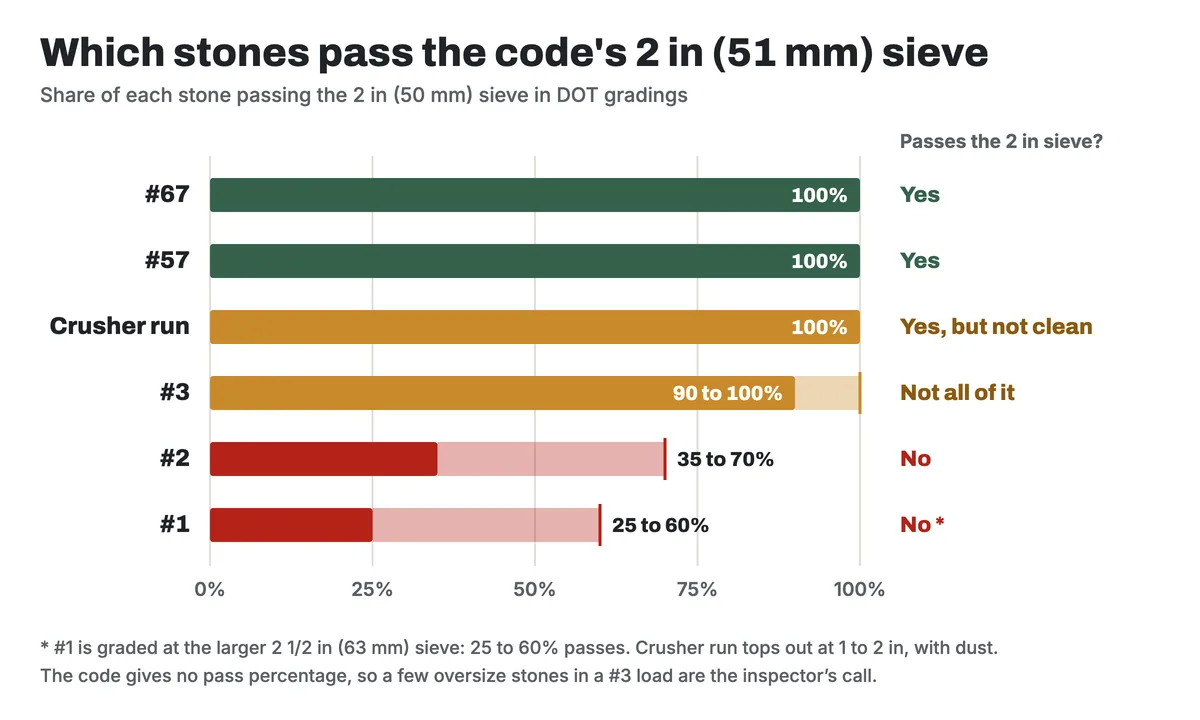
Crusher run passes the sieve too, since US gradings top out between 1 and 2 in. It is dense-graded, though, with dust and sand mixed in on purpose to make it pack. That is not clean stone, so ask the building department before you put it under a basement floor.
The table checks common size numbers against the rule. DOT gradings print the 2 in sieve as 50 mm, while the IRC says 51 mm.
| Stone | DOT grading at the top sizes | Passes the 2 in sieve? |
|---|---|---|
| #67 | 100% passes 1 in (25 mm) | yes |
| #57 | 100% passes 1 1/2 in (37.5 mm) | yes |
| Crusher run | 1 to 2 in (25 to 50 mm) down to dust | yes, but not clean |
| #3 | 90 to 100% passes 2 in (50 mm) | not all of it |
| #2 | 35 to 70% passes 2 in (50 mm) | no |
| #1 | 25 to 60% passes 2 1/2 in (63 mm) | no |
The numbers run backwards, so #1 is the coarsest stone and #67 among the finer ones. The code gives no pass percentage, so a load of #3 with a few oversize stones is the inspector's call.
Which stone for each layer under a slab
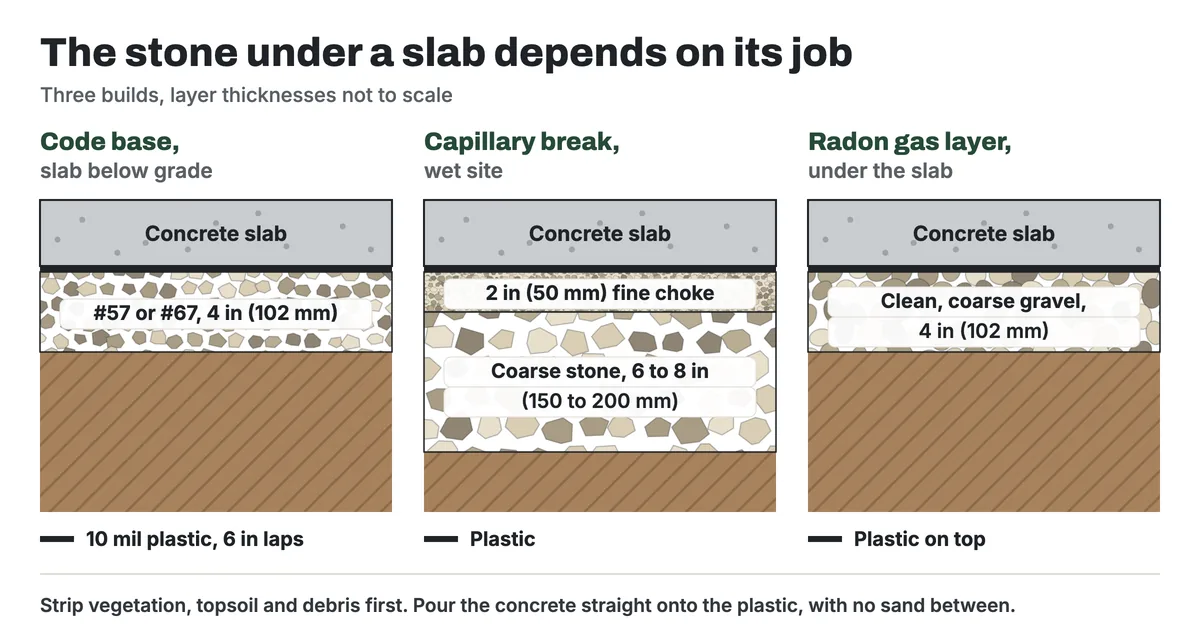
Each layer under a slab has one job, and the job picks the stone. Crushed stone with fines, the dust and sand-size grains that fill the gaps, makes a firm or blotting bed. Clean, coarse stone with no fines makes a layer that breaks rising moisture or lets radon move.
| Layer job | Stone to ask for | Thickness |
|---|---|---|
| Code base, slab below grade | clean sand, gravel or crushed stone passing 2 in (51 mm) | 4 in (102 mm) |
| Bed under a vapor retarder | clean, fine-graded, preferably crushed; no concrete sand | smooth, compacted top |
| Blotter under a bare interior floor | crusher run, 1 1/2 in (37.5 mm) to dust | 4 in (100 mm) or more |
| Capillary break, wet site | coarse gravel or crushed stone, then a fine choke | 6 to 8 in (150 to 200 mm) plus 2 in (50 mm) |
| Radon gas layer | clean, coarse gravel, no size named | 4 in (102 mm) |
A blotter is a layer of crusher run that the concrete sits on directly, with no plastic between. NRMCA allows it only under an interior floor with no moisture-sensitive covering, in a humidity-controlled space. The stone must be dry before the pour, and the roof should ideally be on. Where the same stone carries a retarder instead, NRMCA suggests topping it with fine-graded material so the slab slides less as it shrinks.
On a wet site, lay 6 to 8 in of coarse stone such as clean #57. Building Science Corporation rates crushed stone or coarse gravel as an effective capillary break under basement slabs. Vapor still passes through it, so the plastic goes on top, over a 2 in choke of fine compactable fill that keeps the stone from damaging the sheet.
EPA's radon layer is 4 in of clean, coarse gravel with plastic on top. EPA names no size, and #57 is simply one stone that fits that description.
How much gravel goes under a concrete slab
An 18 x 22 ft garage on grade takes about 9.6 tons of crusher run for a 4 in base. The same floor takes about 8 tons of clean #57 as a 4 in base, and about 12 tons as a 6 in capillary break.

Each row starts from the 4.89 cu yd that a 4 in layer fills over 396 sq ft. It then adds the calculator's compaction allowance and its 10% waste allowance, and converts at each stone's weight per yard.
| Job on an 18 x 22 ft floor | Stone and finished depth | Order | US tons | Tonnes |
|---|---|---|---|---|
| Garage or shop slab on grade | crusher run, 4 in | 6.72 cu yd | 9.61 | 8.72 |
| Basement base or radon layer | clean #57, 4 in | 6.13 cu yd | 7.97 | 7.23 |
| Capillary break on a wet site | clean #57, 6 in | 9.20 cu yd | 11.95 | 10.85 |
Either clean-stone row also needs the 2 in choke if plastic goes on top. Over this floor that is 2.44 cu yd once compacted, so ask the yard for that much of its fine compactable fill. In metric, a 5.5 x 6.7 m garage at 100 mm takes 5.07 m3 of crusher run, about 8.56 tonnes.
Lay the 4 in base, about 5 in of loose crusher run, in one roller lift. Two plate lifts work only if the stone all passes 1 in, as the lift depths for each base show.
Base stone for common slab sizes
Each row is a 4 in compacted base with the same allowances as the garage.
| Slab | Compacted base | Crusher run, tons | Crusher run, tonnes | #57, tons | #57, tonnes |
|---|---|---|---|---|---|
| 10 x 10 ft pad | 1.23 cu yd | 2.43 | 2.20 | 2.01 | 1.83 |
| 24 x 24 ft two-car garage | 7.11 cu yd | 13.98 | 12.68 | 11.59 | 10.52 |
| 30 x 40 ft shop | 14.81 cu yd | 29.13 | 26.43 | 24.15 | 21.91 |
10 mil or 6 mil plastic over the gravel
Use 10 mil plastic. It meets the 2021 IRC text and NRMCA's advice, and it more than covers a county still on the 2018 code, which asked for 6 mil polyethylene.
The 2021 IRC, as adopted in Virginia and South Carolina, calls for a vapor retarder of at least 10 mil (0.25 mm). It must meet ASTM E1745 Class A, sit between the slab and the base, and have joints lapped at least 6 in. NRMCA's vapor retarder guidance also recommends 10 mils on a smooth, compacted base, with seams taped and sealed at pipes and edges.
Pour the concrete straight onto the plastic. ACI 302 wants it that way under any floor that will get a moisture-sensitive covering. Building Science Corporation goes further and says never to leave sand between the sheet and the slab. Skip flood curing as well, since ACI warns the water can collect in the base.
Does a garage slab need a vapor barrier
Usually not. The 2018 IRC and Virginia's 2021 text exempt garages, carports, unheated accessory buildings and unheated storage rooms under 70 sq ft. Walks and patios unlikely to be enclosed and heated are exempt too. South Carolina drops "Garages" from that list, so a garage slab there gets the plastic. If you may heat the garage one day, lay the plastic now, because it cannot go in after the pour.
Before the pour
- Check whether the slab sits below grade, and which IRC edition your county adopted.
- Strip vegetation, topsoil and debris, then lay the stone the layer's job calls for, usually 4 in compacted.
- Add a 2 in choke if the plastic goes over clean, coarse stone.
- Lay 10 mil plastic with 6 in laps and taped seams.
- Pour the concrete straight onto the plastic, with no sand between.
FAQ
Can sand replace gravel under concrete slab floors?
For the code base, yes, since R506.2.2 accepts clean graded sand. NRMCA rules out concrete sand because it shifts too easily, but accepts at least 3 in of crushed stone sand as a blotter under bare floors. The sand bed under a paver patio is a different layer with a different job.
Does pea gravel work as a slab base?
No. Pea gravel is round, so it shifts under load instead of giving the slab firm, even support. Use crushed stone: clean #57 for a base below grade, or crusher run under a garage on grade.
Can recycled concrete go under a slab?
Only with sign-off. The IRC treats crushed or recycled concrete as non-natural fill. It needs a registered design professional's certification and the building department's approval before it goes under a slab as fill or base.
What stone goes under a footing?
For a poured footing, the IRC asks for no stone, since R403.1 sets footings on undisturbed natural soil or engineered fill. Follow your plans if they show stone, since the plans then set its size and depth.
Conclusion
When the plastic goes over clean #57 or #67, add the 2 in choke of fine compactable fill to the order, so the stone cannot damage the sheet. On a wet site, size that clean layer at 6 to 8 in rather than 4 in. Ask for the stone by name, since crusher run keeps its dust and is not clean stone, and types of gravel explains the difference.