Gravel Size Chart From #1 to #10 in Inches and mm
Gravel sizes run from #1, the biggest at about 3 1/2 to 1 1/2 in (90 to 37.5 mm), down to #10 screenings, mostly grit under 3/16 in. On a gravel size chart, a lower number means bigger stone, and a two-digit number such as #67 spans two single sizes. Each number is a band, not one stone: #8 is mostly 3/8 in down to 3/16 in, with up to a third finer, down to 3/32 in.
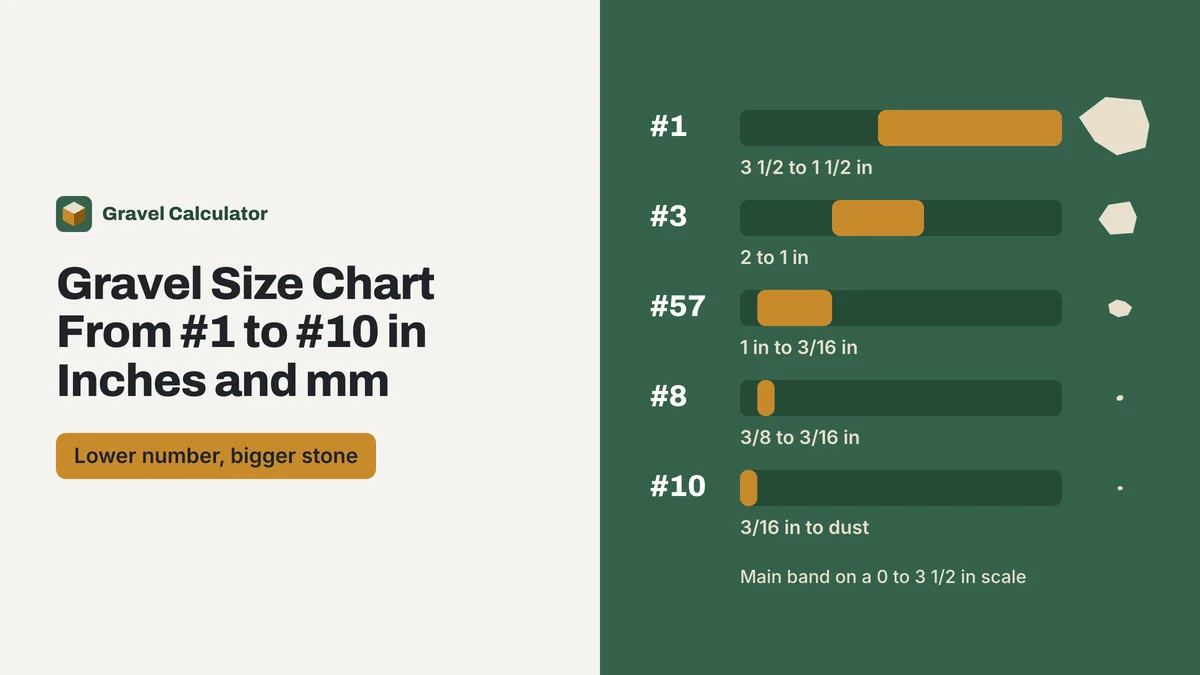
Table of Contents
Gravel size chart by number, #1 to #10
Gravel sizes by number come from one national standard, AASHTO M 43 (ASTM D448), which state highway departments reprint. The band is where most of the load sits. The top sieve is the screen every piece fits through. Once you have picked a size, the gravel calculator turns length, width and depth into cubic yards and tons.
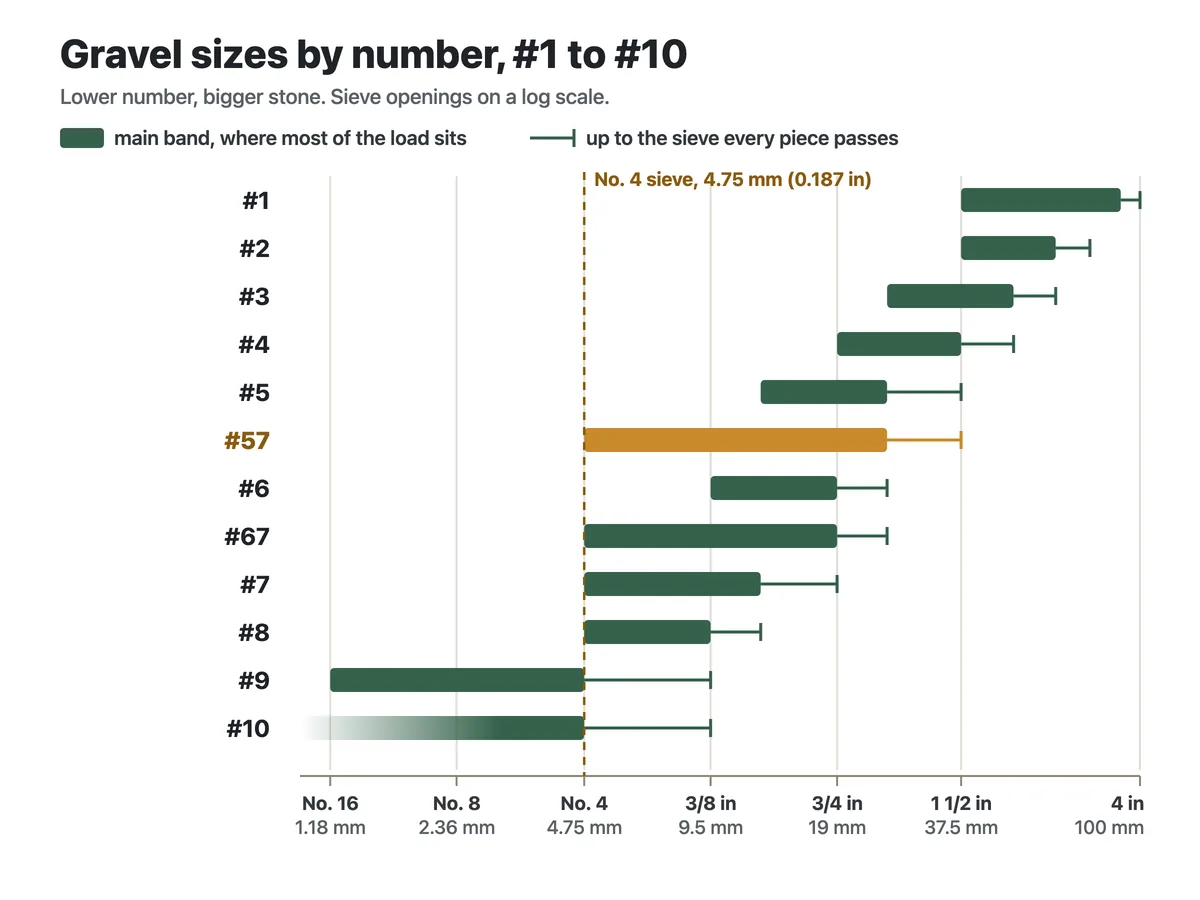
The first table holds the sizes you will meet on home jobs, with where each one turns up.
| Size | Every piece passes | Main band, in | Main band, mm | Where you meet it |
|---|---|---|---|---|
| #1 | 4 in / 100 mm | 3 1/2 down to 1 1/2 in | 90 down to 37.5 mm | ballast |
| #3 | 2 1/2 in / 63 mm | 2 down to 1 in | 50 down to 25 mm | erosion-control gravel mulch |
| #57 | 1 1/2 in / 37.5 mm | 1 in down to 3/16 in | 25 down to 4.75 mm | buried drains, slab base |
| #67 | 1 in / 25 mm | 3/4 in down to 3/16 in | 19 down to 4.75 mm | underdrains, slab base |
| #7 | 3/4 in / 19 mm | 1/2 in down to 3/16 in | 12.5 down to 4.75 mm | underdrains |
| #78 | 3/4 in / 19 mm | 1/2 in down to 3/32 in | 12.5 down to 2.36 mm | underdrains |
| #8 | 1/2 in / 12.5 mm | 3/8 in down to 3/16 in, up to a third finer | 9.5 down to 4.75 mm, up to a third finer | chip surfacing, underdrains; a band close to pea gravel |
| #9 | 3/8 in / 9.5 mm | 3/16 in down to 3/64 in | 4.75 down to 1.18 mm | sand-size grit |
| #10 | 3/8 in / 9.5 mm | 3/16 in down to dust | 4.75 mm down to dust | screenings, similar to stone dust |
The rest are crushed stone sizes that Virginia's road specs call for in concrete, asphalt, surface treatments and drainage. Few home projects call for them by name, but they fill the gaps in the numbering.
| Size | Every piece passes | Main band, in | Main band, mm |
|---|---|---|---|
| #2 | 3 in / 76 mm | 2 1/2 down to 1 1/2 in | 63 down to 37.5 mm |
| #357 | 2 1/2 in / 63 mm | 2 in down to 3/16 in | 50 down to 4.75 mm |
| #4 | 2 in / 50 mm | 1 1/2 down to 3/4 in | 37.5 down to 19 mm |
| #5 | 1 1/2 in / 37.5 mm | 1 down to 1/2 in | 25 down to 12.5 mm |
| #56 | 1 1/2 in / 37.5 mm | 1 down to 3/8 in | 25 down to 9.5 mm |
| #6 | 1 in / 25 mm | 3/4 down to 3/8 in | 19 down to 9.5 mm |
| #68 | 1 in / 25 mm | 3/4 in down to 3/32 in | 19 down to 2.36 mm |
| #89 | 1/2 in / 12.5 mm | 3/8 in down to 3/64 in | 9.5 down to 1.18 mm |
The bands follow Virginia's size table, with #4, #6 and #89 filled in from North Carolina and FHWA.
A size number tells you nothing about the rock. Limestone, granite and gravel all come in the same numbers, so a #8 can be crushed limestone or rounded river stone. Shape and dust content are covered under the main types of gravel.
Size numbers are not sieve numbers
A #4 stone is about 1 1/2 to 3/4 in. The No. 4 sieve is a screen with 4.75 mm openings, a little over 3/16 in. Specs write both as "No. 4", which is why some charts wrongly describe #4 stone as tiny grit. The same trap applies to #8 stone and the No. 8 sieve.

| Sieve | Opening in mm | Opening in inches |
|---|---|---|
| No. 4 | 4.75 mm | 0.187 in, about 3/16 |
| No. 8 | 2.36 mm | 0.093 in, about 3/32 |
| No. 16 | 1.18 mm | 0.046 in, about 3/64 |
Inch sieves carry rounded metric labels. A straight conversion of 1 1/2 in gives 38.1 mm, yet the matching sieve is labelled 37.5 mm. Likewise, 3/8 in works out to 9.525 mm against a 9.5 mm label.
How to read a gravel gradation chart
Ask the yard for the gradation sheet, then check two lines: the sieve that nearly all of it passes, and the sieve where only a small share gets through. Those two lines give you the real size of the load.
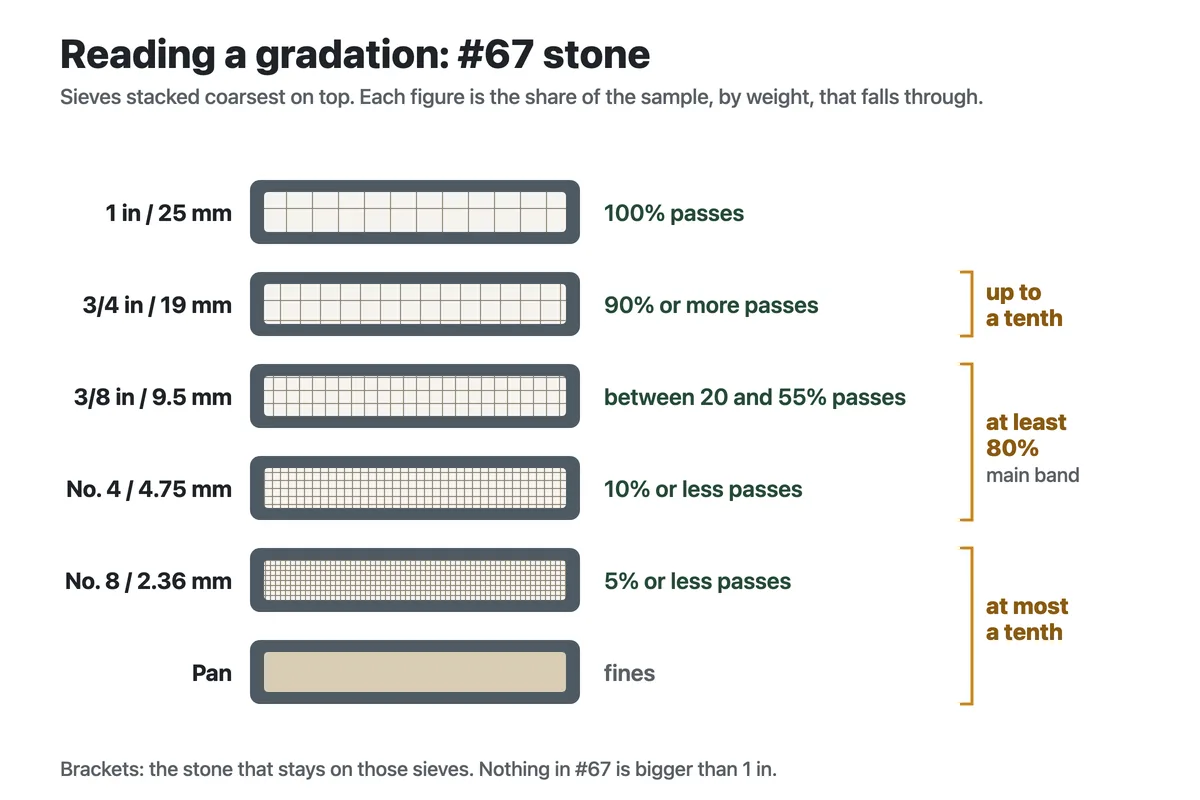
A lab gets those figures by shaking a sample through a stack of square-hole screens and weighing what falls through each one. That share of the weight is called percent passing. The table puts #67 between the two single sizes it spans.
| Sieve | #6 | #67 | #7 |
|---|---|---|---|
| 1 in / 25 mm | 100% | 100% | not set |
| 3/4 in / 19 mm | 90% or more | 90% or more | 100% |
| 1/2 in / 12.5 mm | between 20 and 55% | not set | 90% or more |
| 3/8 in / 9.5 mm | 15% or less | between 20 and 55% | between 40 and 70% |
| No. 4 / 4.75 mm | 5% or less | 10% or less | 15% or less |
| No. 8 / 2.36 mm | not set | 5% or less | 5% or less |
Read the #67 column from the top. Nothing is bigger than 1 in. Up to a tenth of the load may sit between 1 in and the 19 mm screen. At the bottom, no more than a tenth may be finer than the No. 4 sieve. Take both tenths away and at least 80% of the stone lies inside the main band.
Now look across. The top of #67 matches #6, and the bottom matches #7. Every two-digit number works this way: #78 runs from the top of #7 to the bottom of #8, and #357 stretches from #3 all the way to #7. So #6, #7 and #67 are three different products, and the yard should load the number on your plan.
State numbers that break the pattern
State highway departments keep their own numbering, and the same name can mean a very different stone. Indiana's No. 8 is the clearest case.
| Sieve | AASHTO #8 passing | Indiana No. 8 passing |
|---|---|---|
| 1 in / 25 mm | not set | 100% |
| 3/4 in / 19 mm | not set | between 75 and 95% |
| 1/2 in / 12.5 mm | 100% | between 40 and 70% |
| 3/8 in / 9.5 mm | 85% or more | between 20 and 50% |
| No. 4 / 4.75 mm | between 10 and 30% | 15% or less |
Indiana's version lets up to a quarter of the load be bigger than 3/4 in, while every piece of AASHTO #8 passes 1/2 in. The INDOT 2024 specifications switch to the national limits only when a contract names an AASHTO size. Indiana's other numbers carry limits of their own too, so check its table before you assume an AASHTO match.
Pennsylvania has a similar trap. Its "#4" is ballast sitting on the AASHTO #1 row, about 4 in down to 3/4 in. Ask for #4 there and you could get stone roughly twice the size you expected. Across a state line, say "AASHTO #8" or "AASHTO #4", or ask for the quarry's gradation sheet. Names like Virginia's 21A are not size numbers at all but base blends that keep their dust, the family covered under crusher run and similar mixes.
UK gravel sizes and metric grades
In the UK, merchants sell gravel in millimetre grades, and a grade is read as a lower and an upper sieve. Aggregate Industries, for one, grades gravel to 20 mm and 40 mm. The table matches each common grade to the nearest US band.

| Metric grade | In inches | Nearest US size |
|---|---|---|
| 10 mm | 0.39 in | 3/8 in, the #8 band |
| 20 mm | 0.79 in | 3/4 in, the #67 band |
| 40 mm | 1.57 in | 1 1/2 in, the #4 band |
| Type 1, 0/31.5 mm | dust to 1.24 in | crusher run |
These pairs are close, not equal: a 10 mm stone is about half a millimetre bigger than 3/8 in. Whether a yard's "3/4 clean" is really #57 stone comes down to which sieve the 3/4 in refers to.
How to read 10/20 and 0/31.5 labels
UK labels read d/D, where d is the lower sieve and D the upper sieve, both in mm. A bag marked 10/20 holds stone graded between the 10 mm and 20 mm sieves. Sub-base mixes always start at 0, because they keep their dust, so 0/31.5 runs from fine dust up to the 31.5 mm sieve.
MOT Type 1, Type 1F and Type 3 sizes
The UK Specification for Highway Works, CC 201 sets three sub-base gradings. Type 1 is the everyday grade, and the other two have narrower jobs.
| Mix | Designation, mm | Designation, in | Fines finer than 0.063 mm | Use |
|---|---|---|---|---|
| Type 1 | 0/31.5 mm | dust to 1.24 in | 9% or less | general sub-base |
| Type 1F | 0/20 mm | dust to 0.79 in | 12% or less | narrow widening under 1 m / 3.3 ft |
| Type 3 | 0/40 mm | dust to 1.57 in | 5% or less | open graded, lets water through |
Every piece of Type 1 passes a 63 mm sieve, and every piece of Type 3 passes 80 mm.
Some merchants, Aggregate Industries among them, describe Type 1 as 40 mm down to dust. That is trade wording, not the spec. CC 201 needs only 75 to 99% of Type 1 to pass 31.5 mm, so up to a quarter of the load can be bigger. That makes it roughly the old 37.5 mm-down grade. For a patio sub-base, order Type 1 by its 0/31.5 designation.
When stone counts as gravel
Where gravel starts depends on who is measuring. Geologists call any grain from 2 to 64 mm gravel. On the Wentworth scale, 16 to 32 mm is coarse gravel, so a 1 in piece of #57 counts as coarse gravel to a geologist.
US engineers draw the line at the No. 4 sieve under the Unified Soil Classification System. If most of the coarse part passes it, the material is sand. That is why FHWA classes #9 and #10 as poorly graded sands and the larger sizes it tested as gravels. In the UK, Heidelberg Materials draws a similar line, calling aggregate coarse above 4 mm.
FAQ
What size is #1 crushed stone?
Size #1 crushed stone is about 3 1/2 to 1 1/2 in (90 to 37.5 mm). Every piece passes a 4 in screen, and no more than 5% of the load is smaller than 3/4 in. It is the largest of the standard numbers.
What size is 3/8 inch gravel in mm?
Exactly 9.525 mm, which specs print as 9.5 mm. In a size chart, 3/8 in is the top of the #8 band, where 85 to 100% of the stone passes. UK 10 mm gravel is the nearest metric grade.
How many gravel size numbers are there?
AASHTO M 43 defines 19 size numbers. The main size chart on this page shows the 17 that appear in the Virginia, North Carolina and FHWA tables. States add their own on top, so the number on a quarry ticket may not be an AASHTO size at all.
Conclusion
Ask the yard for stone by its AASHTO size number. If the ticket shows a state number such as Pennsylvania's #4 or a UK grade such as 10/20, match its gradation sheet to the chart before you pay. Once the number is settled, the next choice is how deep to lay that gravel.