Gravel Base for Patio Pavers and Pea Gravel Patios
A gravel base for patio pavers is 4 in (100 mm) of crushed stone with fines, compacted hard and topped by 1 in (25 mm) of loose concrete sand. The Concrete Masonry & Hardscapes Association (CMHA, formerly ICPI) and the Brick Industry Association (BIA) both use those two numbers. Ask the yard for crusher run, also sold as road base or DGA, or MOT Type 1 in the UK. The gravel calculator turns your patio size into tons.
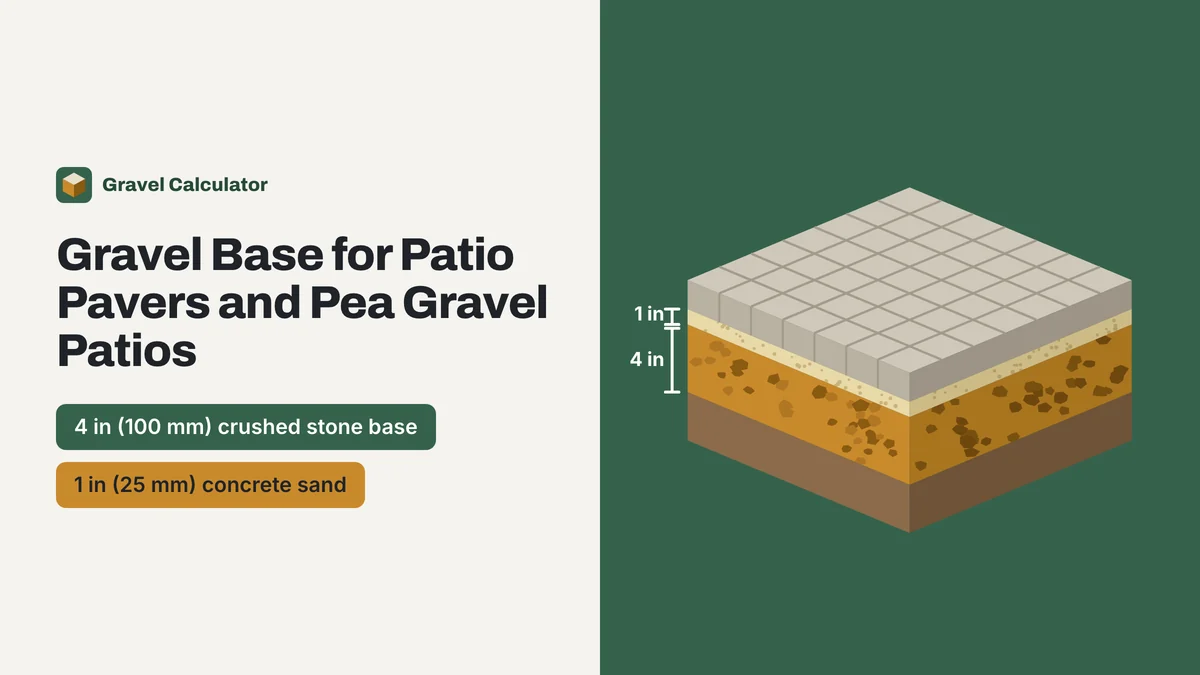
Table of Contents
What type of gravel for paver base
Buy dense-graded crushed stone: sharp, angular pieces from about 3/4 in down to dust. The dust is the point. CMHA's Tech Note PAV-TEC-017 says a base with 5 to 12% fines, the share that passes a No. 200 sieve, keeps the bedding sand from sinking into it.

If the yard asks for a spec, CMHA accepts the aggregate base your city or state uses under asphalt roads, or stone that meets ASTM D2940.
| Stone | As the patio base? | Why |
|---|---|---|
| Crusher run (dense-graded base) | Yes, first choice | packs flat and hard; its fines hold the sand up |
| MOT Type 1 (UK) | Yes | the standard UK sub-base, graded 0/31.5 mm and sold as "40 mm down" |
| Recycled crushed concrete | Yes, for foot traffic | CMHA allows up to 100% in a patio base, with more risk of white efflorescence on the pavers |
| Clean #57 stone | Only with a choke course | no fines, so the sand drops into the gaps |
| Pea gravel or river rock | No | round stone keeps shifting under load (FHWA) |
Clean #57 stone has almost no fines, with at most 5% passing a No. 8 sieve, so its gaps stay open and sand laid straight on it trickles away. CMHA's fix is a choke course: fine stone spread over the surface and compacted into it.
What size crushed stone for pavers
Ask for a top size of about 3/4 in (19 mm), graded down to fine dust. BIA describes patio base stone that way, and Iowa State Extension's paver guide also uses gravel 3/4 in and smaller. Yards in some areas sell by number or by millimeter instead, and the gravel size chart matches the two.
Gravel depth for patio bases by soil and climate
Lay at least 4 in of compacted base on soil that drains well, and plan on 5 in where winters are hard. CMHA sets the 4 in minimum for patios and walks. Iowa State Extension uses 5 in for Iowa winters, with the sand capped at 1.5 in. Pouring concrete instead? A slab has its own base rules, covered in gravel under a concrete slab.
| Patio site | Compacted base | Bedding sand |
|---|---|---|
| Well-drained soil | at least 4 in (100 mm) | 1 in (25 mm) |
| Cold winters | 5 in (127 mm) | at most 1.5 in (38 mm) |
| Clay, wet soil or hard freeze-thaw | thicker than 4 in (100 mm), over geotextile | 1 in (25 mm) |
Both trade groups say to go thicker on weak, wet or freezing ground without naming a number, so Iowa's 5 in is a reasonable starting point there. CMHA adds geotextile fabric over clay, moist silt and soil that stays wet for part of the year, with at least 12 in of overlap downhill.
Work in layers, keeping the stone slightly damp, because a plate compactor packs at most 4 in of loose stone at a time. A 4 in finished base starts about 5 in loose and needs two plate lifts of stone that all passes 1 in, or one lift under a roller. Never work on frozen ground: CMHA rules out base stone on frozen soil, frozen base stone, and sand or pavers on a frozen base.
Pavers that will carry a car need a deeper base, at least 6 in by CMHA and 8 in by BIA, and driveway gravel covers that build. Next to a house foundation or on ground that heaves badly, have a local contractor set the depth.
Gravel base for patio pavers, layer by layer
Dig 7 3/8 in (187 mm) below the finished patio height: 4 in of base, 1 in of sand and a 2 3/8 in paver. The base carries the weight. The sand only sets each paver at height, and joint sand locks the pavers together.
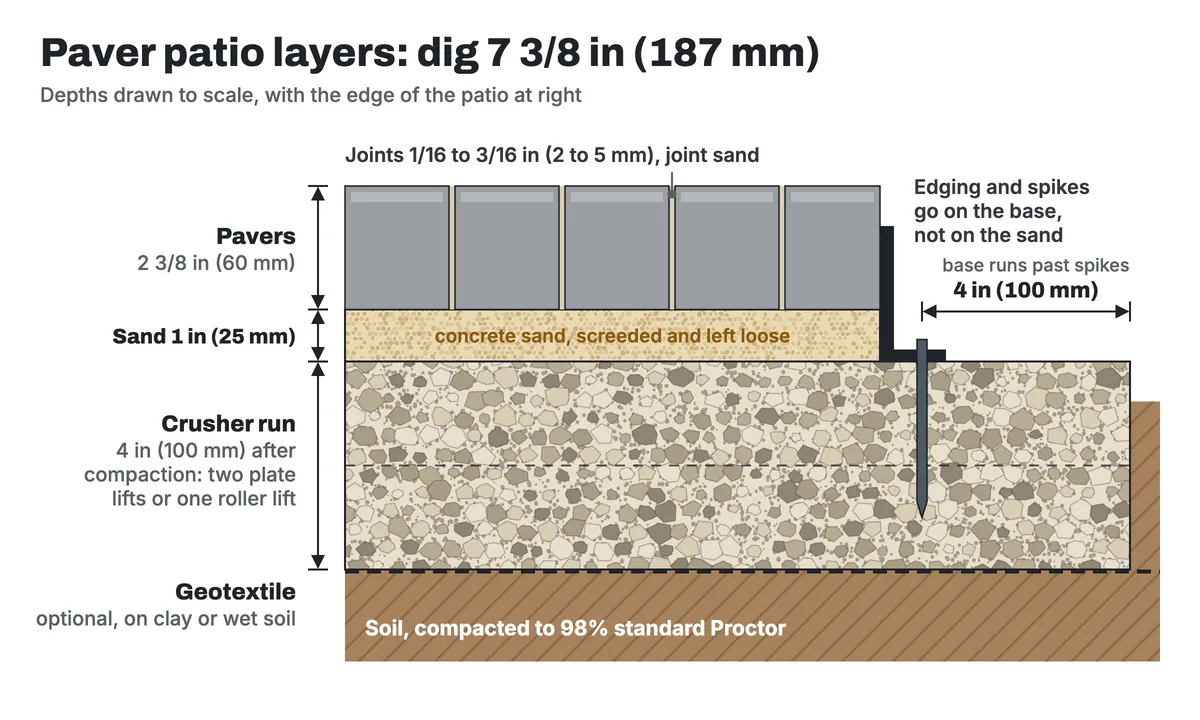
| Layer, bottom up | Thickness | What goes in |
|---|---|---|
| Subgrade | none added | native soil, compacted to 98% standard Proctor |
| Geotextile | optional | fabric, for clay, wet or freeze-thaw soil |
| Base | 4 in (100 mm) after compaction | crusher run |
| Bedding sand | 1 in (25 mm), screeded, left loose | concrete sand, ASTM C33 |
| Pavers | 2 3/8 in (60 mm) | concrete pavers |
| Joints | 1/16 to 3/16 in (2 to 5 mm) wide | joint sand, swept in |
Set the edging on the finished base before any sand goes down, with at least 1 in of its face touching the pavers. CMHA's guide spec keeps the edging spikes at least one base thickness in from the edge of the base. On a 4 in base, the stone runs 4 in past the spikes on every side, which is why the order below covers more ground than the pavers do.
Give the surface a fall of at least 1.5%, the minimum in CMHA Tech Note PAV-TEC-002. Across a 12 ft patio that is a 2.16 in drop, sloped away from the house. Water that still pools at the low edge can be led off by a gravel French drain.
Paver base vs paver sand
Paver base is the compacted crushed stone that carries the load. Paver sand is the 1 in bed the pavers sit in. For the bed, buy concrete sand: CMHA asks for sand that meets ASTM C33 (CSA A23.1 in Canada), and yards sell that grading as concrete sand.
Keep mason sand, limestone screenings and stone dust out of the bed. CMHA says screenings and dust compact unevenly and stop water draining sideways through the sand. The Iowa State Extension paver guide adds that they break down over time. Mason sand does belong in one place: CMHA allows it in the joints.
Get the base flat before the sand goes on. CMHA's tolerance is plus or minus 3/8 in over 10 ft under a straightedge. Filling dips with extra sand is the classic error, Iowa State says, and a bed thicker than 1.5 in ends in a washboard surface. Screed the sand, leave it loose, and let the plate compactor settle the pavers into it.
UK block paving is built a little differently. Bedford Borough Council's paving spec compacts a 30 mm laying course of 0/4 mm sand, where the US method screeds 1 in and leaves it loose.
Where pea gravel fits in a patio
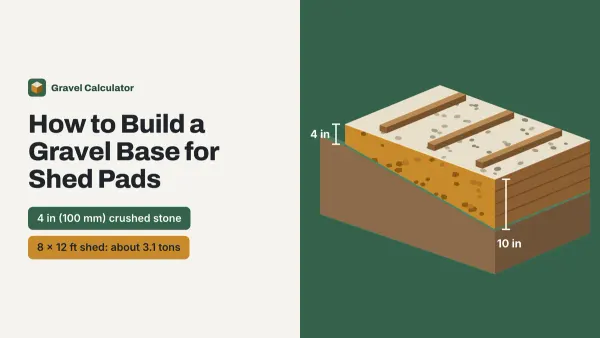
Pea gravel never goes under pavers, but it makes a good loose surface on top of a crushed-stone base. That second build is what most people mean by a pea gravel patio. Round pea gravel never packs to the 98% density CMHA wants under pavers, so it fails as a base.
For a loose patio, lay the same compacted crushed-stone base, then add about 40 mm (1.6 in) of pea gravel on top. That matches the build Hertfordshire County Council uses for public footpaths: a 40 mm surface layer over a 100 mm sub-base. Paths, play areas and other loose surfaces are covered in how deep gravel should be.
Pea gravel does not pack down, so order its finished depth plus about 10% spare, with no extra for compaction. For a firmer surface under chairs, decomposed granite is one of the common types of gravel worth a look.
Gravel and sand for a 14 × 12 patio
A 14 × 12 ft paver patio on a 4 in base takes about 4.5 tons of crusher run, waste included, plus half a cubic yard of concrete sand. Two details make a patio order different from a plain gravel area.
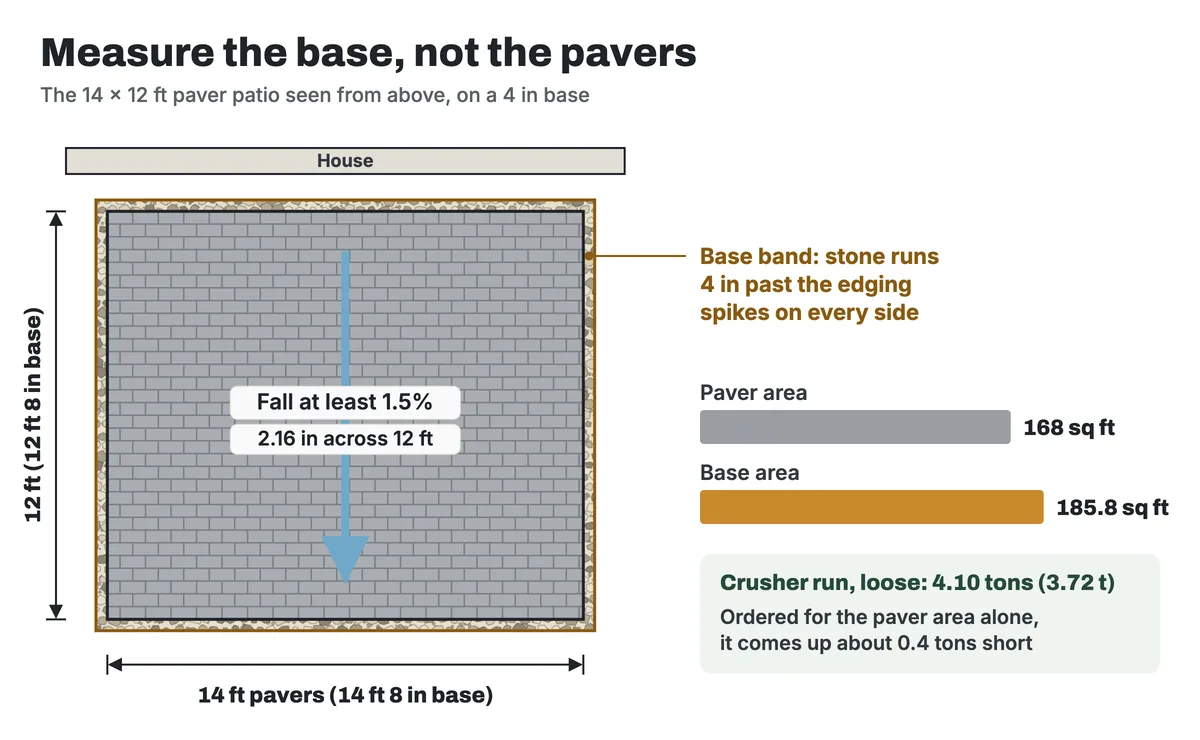

First, measure the base, not the pavers. With the stone running 4 in past the edging on each side, the base is 14 ft 8 in by 12 ft 8 in. The base covers 185.8 sq ft against 168 sq ft of pavers, so an order sized to the pavers alone comes up about 0.4 tons short.
Second, the sand covers only the pavers and is never compacted: 0.52 cu yd at 1 in, or 28 half-cubic-foot bags (31 with waste).
| Order line | 14 × 12 ft, 4 in base | Metric |
|---|---|---|
| Crusher run, loose | 2.87 cu yd, 4.10 tons | 2.19 m3, 3.72 tonnes |
| Crusher run with 10% waste | 3.15 cu yd, 4.51 tons | 2.41 m3, 4.09 tonnes |
| Concrete sand, 1 in bed | 0.52 cu yd | 0.40 m3 |
| Concrete sand with 10% waste | 0.57 cu yd | 0.44 m3 |
Laid 4 in thick, that base holds 2.29 cu yd once compacted. Loose stone loses about a fifth of its volume under the plate, so you order 1.25 times that. Washington State DOT's crushed surfacing figures put crusher run at about 1.43 tons per loose cu yd, and the weight per yard of each gravel covers other stones.
In metric, a 4.2 × 3.6 m patio on a 100 mm base needs 3.53 tonnes of loose crusher run, or 3.89 tonnes with waste.
BIA's patio guide prints a factor of .01235 cu yd per sq ft for a 4 in base. The number is simply 4 ÷ 12 ÷ 27, the finished volume, so multiply it by the same 1.25 before you order loose stone.
Base stone by patio size
The table gives tons of crusher run to order for common patio sizes, with about 10% spare. Each base runs its own thickness past the edging, and the metric rows use the rounder 100 mm and 125 mm.
| Patio | 4 in (100 mm) base | 5 in (125 mm) base |
|---|---|---|
| 10 × 10 ft | 2.76 tons (2.51 tonnes) | 3.56 tons (3.23 tonnes) |
| 12 × 12 ft | 3.89 tons (3.53 tonnes) | 5.00 tons (4.53 tonnes) |
| 16 × 12 ft | 5.12 tons (4.65 tonnes) | 6.56 tons (5.95 tonnes) |
| 20 × 15 ft | 7.86 tons (7.13 tonnes) | 10.01 tons (9.08 tonnes) |
| 3 × 3 m | 2.38 tonnes (2.62 tons) | 3.07 tonnes (3.38 tons) |
| 3.6 × 4.8 m | 4.42 tonnes (4.87 tons) | 5.65 tonnes (6.23 tons) |
FAQ
Do you need gravel under pavers?
Yes, if you want them to stay flat. CMHA sets at least 4 in of compacted base under a patio on well-drained soil and says bedding sand must never make up for a weak or uneven base.
Can you put gravel between pavers?
Not in standard paver joints. CMHA spaces concrete pavers 1/16 to 3/16 in apart, too tight for gravel, and fills the gaps with joint sand. Iowa State says that sand working into the joints is what lets the pavers interlock and share the load.
How much sand do I need under pavers?
At the usual 1 in depth, allow 1 cu ft of concrete sand for every 12 sq ft of pavers. In metric, 1 m3 covers 40 m2 at 25 mm. Add 10% for waste, and work it from the paver area, not the wider base.
Conclusion
Choose 4 in of base on well-drained soil or 5 in where winters are hard, and size the crusher run to run that thickness past the edging. If the yard sells the base stone under another name, the crusher run page lists them.