Types of Gravel
The types of gravel sold for home projects fall into two families. Natural gravel is rock that water and ice have already broken and rounded: pea gravel, river rock and bank run. Crushed stone is quarry rock broken by machine: clean stone such as #57, crusher run, screenings and recycled concrete. For most jobs the name matters less than two things: the shape of the stones, and whether the load carries fines.
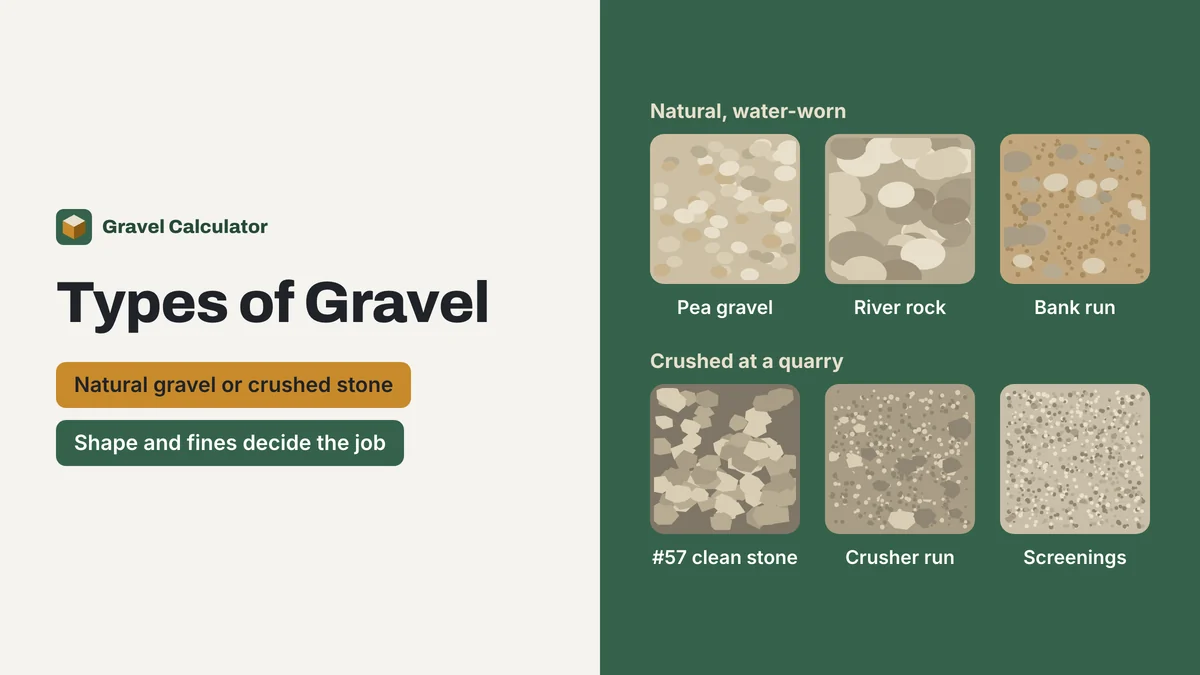
Table of Contents
Common types of gravel compared
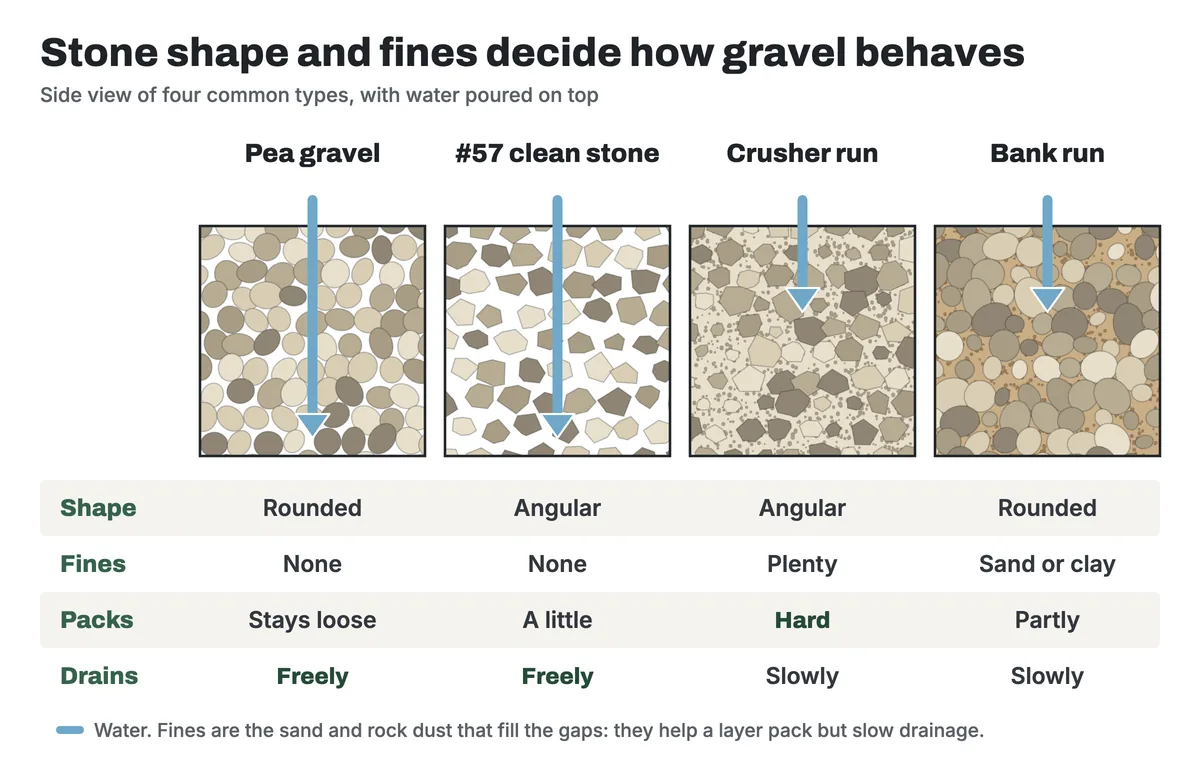
Ask for angular stone with fines when the layer has to carry weight, and clean stone when water has to pass through it. Angular faces lock together under a compactor, while rounded stones roll past each other. Fines are the sand and rock dust that fill the gaps, so a load with fines packs harder but drains more slowly.
| Type | Origin | Shape | Fines | Packs or drains | Good for |
|---|---|---|---|---|---|
| Pea gravel | natural | small, rounded | none | drains freely, stays loose | edged paths, beds |
| River rock | natural | larger, rounded | none | drains freely, stays loose | beds and borders |
| Bank run (river run) | natural | rounded, mixed sizes | sand or clay | packs partly, drains slowly | fill |
| Crushed gravel | natural, then crushed | broken faces | often | packs well | road and drive layers |
| Clean stone, such as #57 | quarried and crushed | angular, one size band | none | drains freely, packs only a little | drainage, open base, concrete |
| Crusher run | quarried and crushed | angular, every size down to dust | plenty | packs hard, drains slowly | base under drives, pavers and pads |
| Screenings (stone dust) | quarried and crushed | fine chips and dust | mostly fines | packs hard, drains slowly | fine grit; engineers class it as sand |
| Decomposed granite (DG) | weathered granite | coarse grains | yes | packs firm | paths, including accessible ones |
| Lava rock (scoria, volcanic cinder) | volcanic | rough, full of gas holes | none | drains freely | decorative beds |
| Riprap | quarried blocks | large, angular | none | heavy enough to stay put | banks and shorelines |
| Recycled crushed concrete | recycled | angular | usually | packs well | base layers |
Round stones have nothing to hold them in place, so pea gravel belongs in edged beds and paths, not under car tires. The pea gravel guide shows where it works and where it fails.
#57 is a clean stone: angular, but washed free of fines, so water runs straight through. VDOT lists open-graded stone like it for drainage, and the #57 stone page gives its full grading.
Which type of gravel for which job
Load-bearing jobs take crusher run or another graded crushed base, drains take clean stone, and beds and paths can take rounded or decorative stone held in by an edge. Once you have picked a type, the gravel calculator turns your area and depth into an order.

| Job | Type to ask for | Why | Full answer |
|---|---|---|---|
| Driveway | crusher run base, then a crushed surface gravel with binding fines | the base locks under a roller; the top's fines bind into a crust | choosing driveway stone |
| Patio or paver base | graded crushed base | packs hard and flat | patio base layers |
| Shed or hot tub pad | graded crushed base or clean stone | firm and level, or free draining | shed pad gravel |
| Under a concrete slab | clean stone below grade; crusher run only on grade, if the building department allows | even support under the slab | base under a concrete slab |
| French drain | clean stone such as #57 | no fines to clog the gaps | French drain stone |
| Garden beds, borders, paths | pea gravel, river rock, DG | rounded or decorative; DG packs firm for paths | garden gravel and landscape rock |
| Riverbank or shoreline | riprap | heavy blocks resist scour (washing away) | a local engineer or contractor |
What is gravel made of
Gravel is made of loose fragments of many kinds of rock, not one rock type, and its most common mineral is quartz. In the US, most commercial gravel is dug from glacial deposits, river channels and river flood plains. There, ice and moving water have already broken the rock and worn it smooth.
Size is what separates gravel from sand. Geologists start gravel at 2 mm (0.08 in), and the ISO 14688 soil standard tops it out at 63 mm, about 2 1/2 in.
Very little of it ends up in gardens. USGS counted 42% of 2025 US construction sand and gravel as concrete aggregate, 20% as road base and coverings, 12% as fill and 9% for asphalt. The last 17% covers smaller uses, among them drainage stone, riprap, landscaping and pea gravel.
Is crushed stone the same as gravel
No. In the US trade, gravel means natural stone shaped by water, and crushed stone means rock broken by machine at a quarry. USGS reports the two as separate commodities. Crushed stone is "the other major construction aggregate," in the words of its 2026 sand and gravel summary.
The words blur because crushed stone so often stands in for natural gravel, most of all in the densely populated Eastern US, USGS notes. A load sold simply as "gravel" could therefore be either. Crushed stone is also the bigger business: about 1.5 billion tonnes in 2025, against 870 million tonnes of construction sand and gravel, or roughly 1.7 to 1.
What is crushed gravel
Crushed gravel sits between the two families. It is natural gravel run through a crusher, so most pieces pick up broken faces. Caltrans lists it as its own material, separate from crushed limestone and crushed granite. The broken faces help it bind better than the river stone it started as, which is why it turns up in road and drive layers.
Types of crushed stone by rock and grading
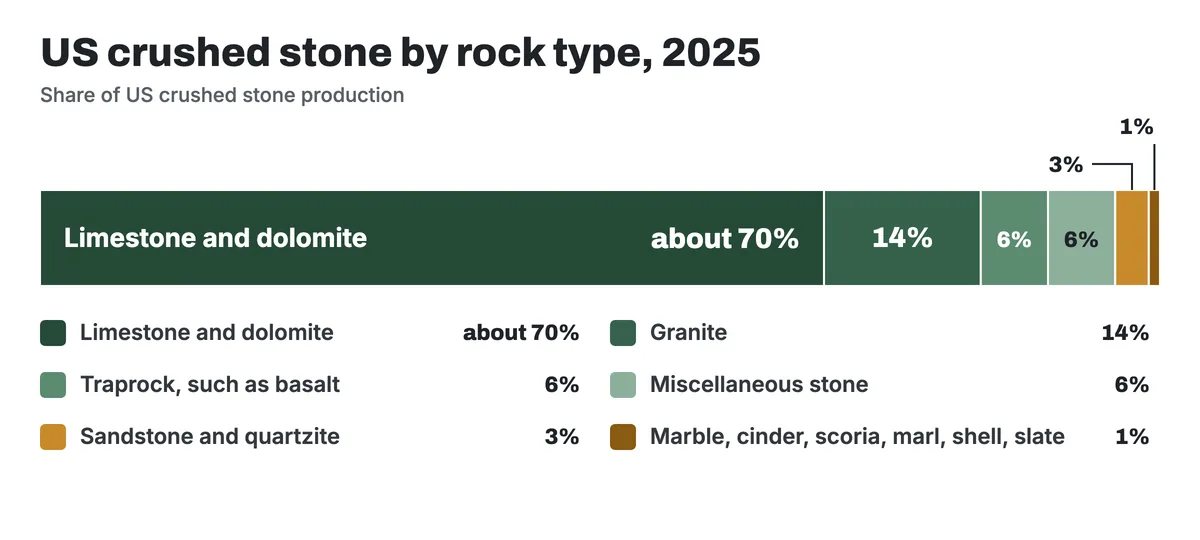
Most crushed stone in the US is limestone or dolomite, and granite is a distant second. The shares below come from the USGS crushed stone summary for 2025 production.
| Rock type | Share of US crushed stone, 2025 |
|---|---|
| Limestone and dolomite | about 70% |
| Granite | 14% |
| Traprock (dark volcanic rock such as basalt) | 6% |
| Miscellaneous stone | 6% |
| Sandstone and quartzite | 3% |
| Marble, volcanic cinder and scoria, marl, shell, slate | 1% |
About 72% of that stone went into construction aggregate, mostly for building and repairing roads.
Clean stone, graded stone and screenings
The same quarry rock is sold in three gradings. Clean stone is one size band with the fines washed or screened out; the trade calls it clean rock. Graded stone keeps every size from the largest piece down to dust, so it packs into a hard layer. Its usual name is crusher run, and it is also sold as DGA (dense grade aggregate), QP (quarry process) or shoulder stone. Screenings are the fine leftovers of crushing, sold as stone dust. Paver guidance keeps them out of the bed under pavers, which takes concrete sand instead.
When a plan calls for a "crushed stone base," it usually means the graded kind. The crusher run and road base page covers it in depth.
Recycled crushed concrete
Recycled crushed concrete is old concrete broken and screened into base stone, and it packs well. It is still a niche product: USGS called the recycled share of US aggregate "very small" in 2025. Britain's highway spec, MCHW CC 201, accepts it in Type 1 sub-base but caps wood, plastic and metal at 1% of the mix. Look a load over for rebar and wire before it goes under your drive.
Gravel types in the UK, Australia and Canada
Only a few foreign names are the same product as a US type: pea shingle is pea gravel, and rock armour is riprap. The rest do a similar job under their own local specs, so order by what the stone does, not by the name alone.
| Local name | Where you hear it | Closest US type | Same stone or similar job |
|---|---|---|---|
| Pea shingle | UK | pea gravel | same stone |
| Shingle | UK | river rock | similar: rounded and water-worn, often larger |
| Rock armour | UK | riprap | same |
| MOT Type 1 sub-base | UK | crusher run | similar job, own grading spec |
| Type 3 open-graded sub-base | UK | clean crushed stone | similar job, own grading spec |
| Blue metal | Australia | crushed traprock | similar: names the rock, basalt, not a size |
| Granular A | Canada | crusher run | similar: the grade with the least sand |
| DGA, QP, shoulder stone | US | crusher run | same |
| Clean rock | US | clean stone | same |
Shingle on its own means smooth, rounded, water-worn stone. Geologists put beach shingle at about 20 to 200 mm, or roughly 3/4 to 8 in, so most of it is far coarser than pea gravel.
Both British sub-base names are spec gradings, not loose trade words, and the UK section of the gravel size chart gives their sieve limits. Some US stone sites use "Type 1" for clean crushed stone, the opposite of the British meaning, so ask "with fines or clean?" whenever a seller quotes a type number.
What to ask the stone yard
A few questions head off most wrong loads. Ask whether the stone is natural or crushed: rounded stone suits looks and drainage, and angular stone suits anything that must hold firm. Ask whether it comes with fines or clean, because fines pack hard and clean stone drains. If color or hardness matters, ask which rock the quarry crushes, since limestone, granite and traprock differ. Ask for the largest stone in inches, because size numbers are not the same at every yard.

FAQ
Is gravel permeable?
Yes. Water can pass through natural gravel at more than 1 cm per second, which works out to about 118 ft an hour. Fines slow it down, which is why drainage jobs call for clean stone.
What is bank run gravel?
Bank run, also called river run, is natural gravel dug with its sand or clay still mixed in. It comes unwashed and in mixed sizes. The sand fills the gaps, which helps it pack but slows drainage, so keep it out of drainage jobs.
Is gravel an aggregate?
Yes. Aggregate is the trade word for the sand, gravel and crushed stone that go into concrete, asphalt and road base. USGS reports natural sand and gravel and crushed stone as the two main kinds, and counts recycled concrete and asphalt as a small third source.
Conclusion
Tell the yard the job when you call, because a drive base, a drain and a bed each take a different family of stone. Before you accept a type number or a local name, ask "with fines or clean?" and how big the largest stone is. With the type chosen, the weight of a yard of gravel tells you how many tons that volume comes to.