What Is Pea Gravel
Pea gravel is small, rounded natural gravel about the size of garden peas, sold in Britain as pea shingle. Almost none of it is bigger than 1/2 in (12.5 mm), and most passes 3/8 in (9.5 mm). The smooth, nearly dust-free stones roll instead of locking. That makes it a good loose layer for paths, play areas and bed tops, and a poor one where weight rests or water runs.
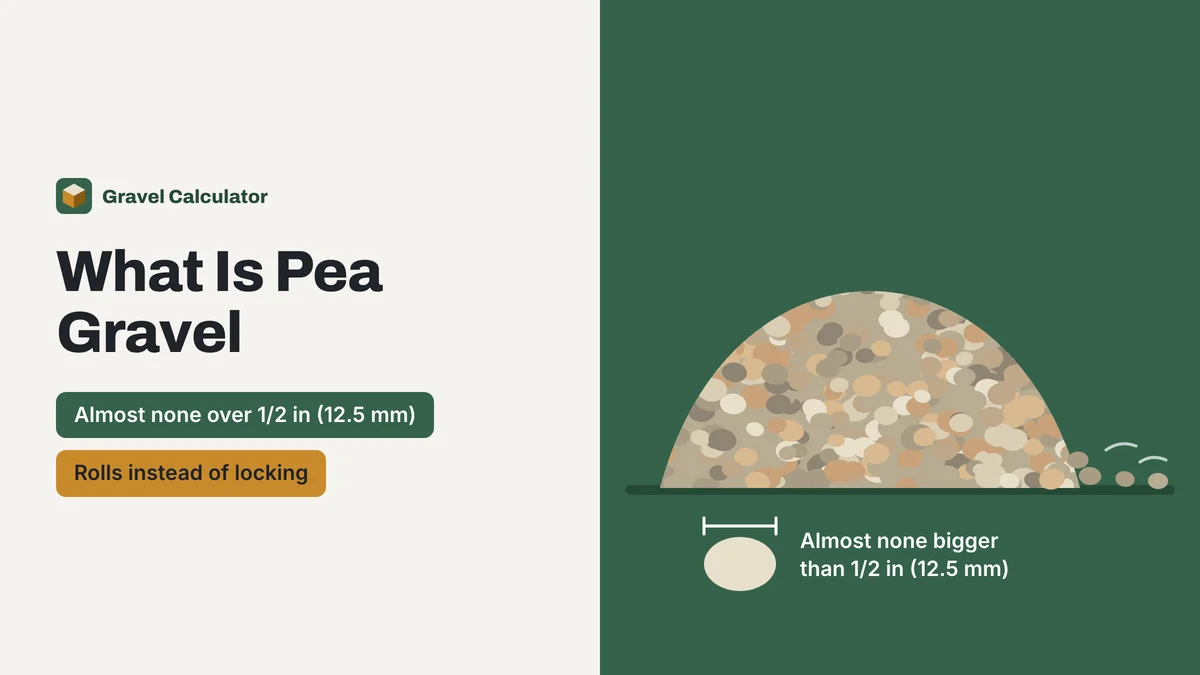
Table of Contents
What is pea gravel
Pea gravel is natural gravel that water has already worn round, sold in a narrow band of small sizes. Rock fragments lose their corners fast once a river carries them, so the stones arrive smooth, with no broken faces to grip each other.
It is a size and shape, not a rock type. Whatever rock the local deposit holds ends up in the pile. Quartz is the most common mineral in gravel, because it is hard, resists chemical attack and has no planes along which it splits easily.
The color comes from that same mix, so it changes from one pit to the next. One yard's load may run pale and another's dark, and the product name tells you nothing about which. Two reasons make the color worth checking before you buy. A pale stone stays cooler on a sunny path, as the heat section below explains. A sample also shows you the real mix, which is easier than sending back a full load.
What size is pea gravel
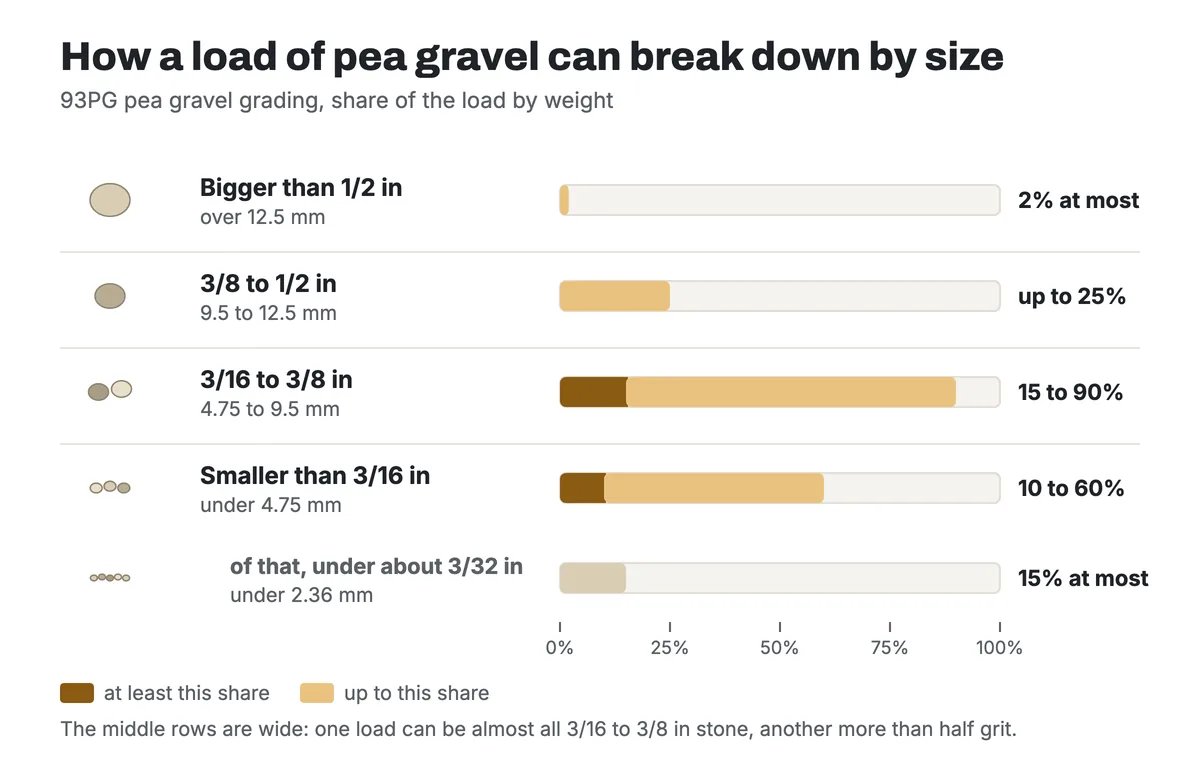
Expect stone from 1/2 in down to grit, with the share between 3/16 and 3/8 in varying a lot from one yard to the next. Indiana DOT's 93PG is one of the few public specs that names pea gravel at all. The table shows how a load that meets it breaks down by weight.
| Part of the stone | Share of the load by weight | Same sizes in metric |
|---|---|---|
| Bigger than 1/2 in | 2% at most | over 12.5 mm |
| Between 3/8 and 1/2 in | up to 25% | 9.5 to 12.5 mm |
| Between 3/16 and 3/8 in | 15 to 90% | 4.75 to 9.5 mm |
| Smaller than 3/16 in | 10 to 60% | under 4.75 mm |
| Of that, smaller than about 3/32 in | 15% at most | under 2.36 mm |
Look at how wide the middle rows are. One yard's load can be almost all 3/16 to 3/8 in stone, while another's is more than half grit under 3/16 in, and both meet the spec. If the feel of the surface matters, ask the yard for its gradation sheet or look at the pile before you buy.
The INDOT 2024 Standard Specifications, section 904.03(e), also require the stone to be generally uncrushed, with no more than 20% crushed pieces. Outside Indiana, the closest standard size is AASHTO #8. That band is comparable, but it caps the grit under 3/16 in at 30%, half of what 93PG allows. A size number is not a rock type, so #8 can also be crushed stone. The gravel size chart shows #8 next to its neighbors.
What is pea gravel used for
Pea gravel is good for loose layers that drain: paths, play areas, bed tops and backfill around a wrapped drain pipe. For a path or play area, choose the depth first. Under swings and slides, CPSC ties it to the fall height, and those numbers live with the other play area and path depths. With a depth chosen, the gravel calculator turns your area into cubic yards and tons. The common jobs sort out like this.

| Job | Good fit? | Why |
|---|---|---|
| Garden path, loose top layer | yes | drains fast and stays loose; CPSC says it resists compacting |
| Public playground surfacing | yes, deep enough | CPSC lists it as appropriate, but not for toddler play areas |
| Bed and border mulch | yes | outlasts organic mulch but feeds the soil nothing |
| Backfill around slotted pipe in a fabric wrap | yes | clean and free-draining |
| Base under pavers, a shed or a slab | no | round stone shifts under load |
| The layer a car drives on | no | broken stone holds its place far better |
| Wheelchair route | no | not firm and stable unless treated |
| Slope or swale that carries runoff | no | runoff under half an inch deep can move it |
Around a drain pipe, the stone suits a fabric-wrapped slotted pipe but not one with large drilled holes, which the French drain gravel guide explains.
Pea gravel pros and cons
The strengths and the faults come from the same thing: round, clean stone that never packs.
| Pros | Cons |
|---|---|
| Drains fast, because it is open stone with almost no fines | Shifts under feet, wheels and pavers, since it never locks |
| Stays loose, which CPSC wants under play equipment | Runoff under half an inch deep on a 5% slope can start it moving |
| Helps rain soak in during short, heavy storms | Needs a solid edge to stay where you spread it |
| Lasts longer than bark or wood chips as a bed cover | Adds no nutrients to the soil |
| A gravel-covered bed stays cooler on top than paving or wood chips | Sends more heat down into the soil, and rock in summer sun gets very hot |
| As a bed mulch, small rock keeps soil moister than big rock | Fails as a wheelchair route unless treated and maintained |
Three of those faults decide most jobs: the stone moves under a load, washes off a slope and heats the soil beside plants. After the comparison with crushed stone, one section explains each of them.
Pea gravel vs crushed stone
Choose crushed stone wherever a layer has to stay put, and pea gravel where loose stone is the point. The difference is shape, and the table follows it from the pile to the job.
| Pea gravel | Crushed stone | |
|---|---|---|
| Shape | round and smooth, worn by water | angular, with broken faces |
| Once tamped or rolled | still shifts and moves | faces interlock and resist movement |
| As the top of a drive | rolls under tires | broken pieces embed into the surface |
| Under pavers, a shed or a slab | creeps out from under the load | the usual base, compacted in lifts |
| Typical job | paths, play areas, bed tops | bases, drive layers, drain trenches |
Crushed stone comes in more than one grade. #57 stone has no dust and lets water through, yet its broken faces hold better than round pebbles. Crusher run with its binding dust packs hard instead. The wider split between natural gravel and quarry stone is laid out in the guide to types of gravel.
Why pea gravel rolls instead of locking
Three things keep pea gravel loose: round stones, almost no fines and sizes that sit close together. Tamping changes none of them.

- The stones are round. Water wore them smooth, and 93PG allows no more than 20% crushed pieces. FHWA's guide to gravel roads notes that rounded stone tends to shift and move under load, while fractured stone resists movement.
- There is almost no fine material. The spec lets at most 5% through a fine No. 30 screen, so there is little sand or dust to fill the gaps. FHWA notes that gravel this low in fines will not form a crust.
- The sizes are close together. At least 60% of the stone sits between about 3/32 and 3/8 in, so few small ones wedge between the large ones. Penn State describes open-graded stone like this, low in fines, as porous: it drains well but does not compact into a dense mass.
CPSC's playground handbook sums up the result in one line: it resists compacting. That is exactly what you want under a swing set and what you never want under a load. This is why a paver patio sits on compacted crushed stone with fines, the usual gravel base for patio pavers, and a drive needs angular stone that locks under tires.
Will pea gravel wash away
Yes where water runs across it, and no where rain simply soaks in. CSU Extension notes that this small stone helps water soak into the soil in short, intense storms, while larger rocks increase runoff. The losses happen where runoff gathers: below a downspout, along a driveway edge and on any slope.
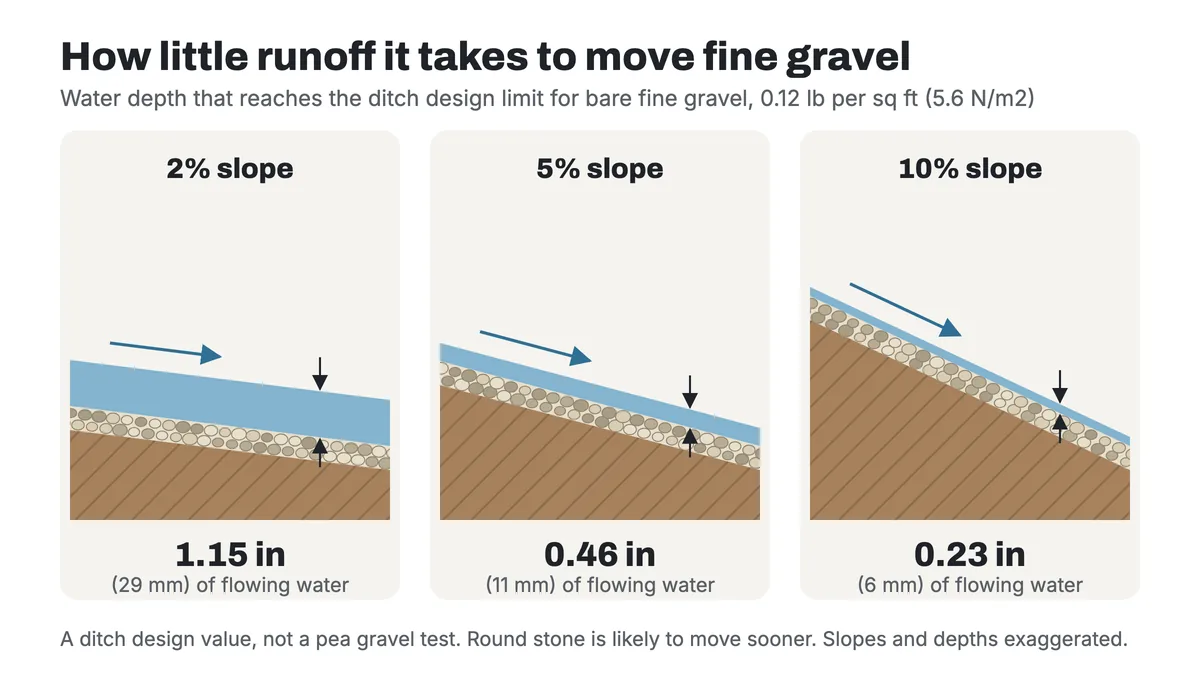
Small round stone takes less moving water to shift than most people expect. FHWA's ditch manual, HEC-15, rates bare fine gravel to stand a water drag of only 0.12 lb per sq ft (5.6 N/m2) before it moves. Drag grows with both water depth and slope, so the table shows how deep runoff has to be to reach that limit. It is a ditch design value, not a pea gravel test, but it shows the scale.
| Slope of the ground | Water depth that reaches the limit (US) | Water depth (metric) |
|---|---|---|
| 2% slope | 1.15 in | 29 mm |
| 5% slope | 0.46 in | 11 mm |
| 10% slope | 0.23 in | 6 mm |
On a 5% slope, a sheet of water under half an inch deep is enough. HEC-15 also warns that its limits come mainly from tests on angular rock, and it asks for a bigger safety margin with round stone. Round pea-size stone is likely to start moving even sooner than the table says.
How to keep pea gravel in place
Stop the water first, then hold the edges.
- Turn runoff away. Point downspouts and drive runoff off the stone.
- Edge every border. CPSC asks public playgrounds to contain loose fill at the perimeter, and a solid edging does the same job along a path.
- Use bigger stone where water must run. HEC-15 keeps round stone off channel side slopes steeper than 1:3 (33%, about 18 degrees). When it specifies gravel mulch for erosion control, it calls for 0.6 to 2.5 in stone, all larger than the 1/2 in top size here.
Does pea gravel get hot in the sun
Yes. Rocks in midsummer sun can reach 140 to 170 °F (60 to 77 °C), says a Colorado Master Gardener article from CSU Extension in Pueblo County. That range comes from southern Colorado, so expect less in a milder climate.
The heat does not stay on top. CSU Extension's GardenNotes #245 reports that gravel-mulched beds have cooler surfaces than paving or wood-chip mulch, yet gravel passes more heat down into the soil. University of Nevada Extension adds that rock mulch raises both soil and air temperature.
For a sunny path or seating spot, pick a pale stone, since the Pueblo article notes that light-colored aggregate reflects heat instead of absorbing it. Keep the stone back from plants that dislike hot roots, which the guide to gravel and rock in garden beds covers plant by plant.
How much pea gravel do I need
Measure the patch, multiply by the finished depth and add about 10% for spills and raking, with nothing extra for packing. For weight, the site counts each cubic yard of this stone as roughly 1.30 tons, a planning estimate. A 9 x 13 ft seating area spread 3 in deep comes to about 1.19 cu yd, or 1.55 tons with that allowance. Bought in 0.5 cu ft bags, the same patch takes about 65.
FAQ
Is pea gravel good aggregate for a concrete mix?
Yes, if it meets ASTM C33, the US spec for concrete aggregate. QUIKRETE's 3/8 in All-Purpose Gravel, a similar small gravel not sold as pea gravel, meets C33, according to its data sheet, and suits concrete. Check the bag or ticket for C33 before you mix. As a loose layer under a concrete slab, though, round stone still shifts.
Can you walk on pea gravel?
Yes, but it moves underfoot, so it does not count as an accessible route. ADA section 302.1 asks for a surface that is firm, stable and slip resistant. The US Access Board guide to ground surfaces says most loose gravel misses that unless it is treated. Binders, compaction or grids can get it there, but each needs repeated upkeep.
What is pea gravel called in the UK?
British yards sell it as pea shingle. Geologists use shingle for much bigger rounded stones, about 20 to 200 mm, so the word alone can mislead. Ask a UK supplier for the size in millimeters instead, and request about 10 mm, the metric match for 3/8 in.
Conclusion
Before the stone goes down, turn downspouts and drive runoff away from it and fit a solid edge along every border. For a sunny path or seat, ask the yard for a pale stone, and look at a sample first, since the color depends on the pit. Where the layer has to carry a shed instead, build a compacted gravel shed base from crushed stone.